
In the summer of 1914, after the early fighting in Belgium and on the Marne, the Western Front began to take shape. Close fighting arrived in this area in late September as the German Army sought to outflank the French.
Fierce fighting occurred over the following months as the French X Army (Tenth) resolutely defended and subsequently attempted to retake ground lost to the attacking German forces, comprising the XIV Reserve Corps (Wurttemberg). Despite the efforts of the French, the villages of Serre and Beaumont Hamel were lost, at the cost of many casualties.
Over the winter of 1914 and into the Spring of 1915, the fighting began to settle, defensive positions became fixed and underground warfare had become a regular occurrence, most especially on Redan Ridge to the north of the Beaumont Road. The first mine to be detonated was in conjunction with a French attack on the 17 December 1914, signalling the start of both defensive and offensive mining activities in this area.
As the British Expeditionary Force (BEF) expanded, they began to take over more of the frontline from their French allies, specifically in this sector in late July, with the arrival of troops of the 4 Division who, as well as improving the defences, also took on the tunnelling duties begun by the French.
The Somme area was considered a ‘quiet’ sector during this period, but this was about to change after it was decided, at the Chantilly inter-allied conference of 6 December 1915, that a major joint Franco-British offensive would take place in the summer of the following year.
During the period from October 1914 and June 1916, the German occupiers had fortified their positions in the area around Hawthorn Ridge and the Beaumont Hamel. They had strength in depth, deep dugouts throughout their frontline systems, and knew every inch of the ground they occupied, including its ‘fields of fire’. Indeed the positions were so well constructed, other German commanders were invited to visit the area in order to learn from their work. For the bulk of this period the sector was held by 119 Reserve Infantry Regiment.
When plans had been outlined for the offensive, the BEF’s Fourth Army was formed in February 1916, under the command of General Sir Henry Rawlinson and scheduled for 29 June 1916. Of the five Corps (plus a single Corps from Third Army who would undertake a diversionary attack to the north at Gommecourt) involved in the offensive, VIII Corps, under the command of Lieutenant-General Sir Aylmer Hunter-Weston, would cover the area between North of the Ancre river and the village of Serre and more specifically 29 Division, positioned in front of Beaumont Hamel. The particular Brigade whose job it would be to capture the Hawthorn Ridge and the ‘Bergwerk’, the left flank of the 29 Division front, was 86 Brigade, made up of 1/ Lancashire Fusiliers, 2/Royal Fusiliers, 1/Royal Dublin Fusiliers and 16/ Middlesex (Public School) Battalion.
Part of the preparations for attack was the continuation of offensive mining operations. 252 Tunnelling Company, Royal Engineers, between early April and late June 1916, would dig, or ‘drive’, a tunnel known as H3, 1050 feet (320 metres) long, 80 feet (25 metres) below the surface, from the British front line system, placing an explosive charge below the German trench system known as the Hawthorn Redoubt. Initially the digging was reasonably quick, some 35 feet a day, but as they got closer to the objective this progress slowed to a matter of inches due to the hardness of the chalk and a seam of flint. The sound of digging would reverberate through the bedrock so painstaking effort was made to suppress the sound. Putting water on the chalk face to soften the material, levering individual pieces out with bayonets and passing each piece by hand into sandbags for removal, this alongside working in stocking feet or with sandbags tied over boots. However by the last weeks of June the mine was laid under the German positions, containing 40,600 lbs (18,400 kg) of Ammonal explosive.
It would be the task of 2/Royal Fusiliers to secure the ridge and its crater. A crater created by the blowing of a large mine under the redoubt.
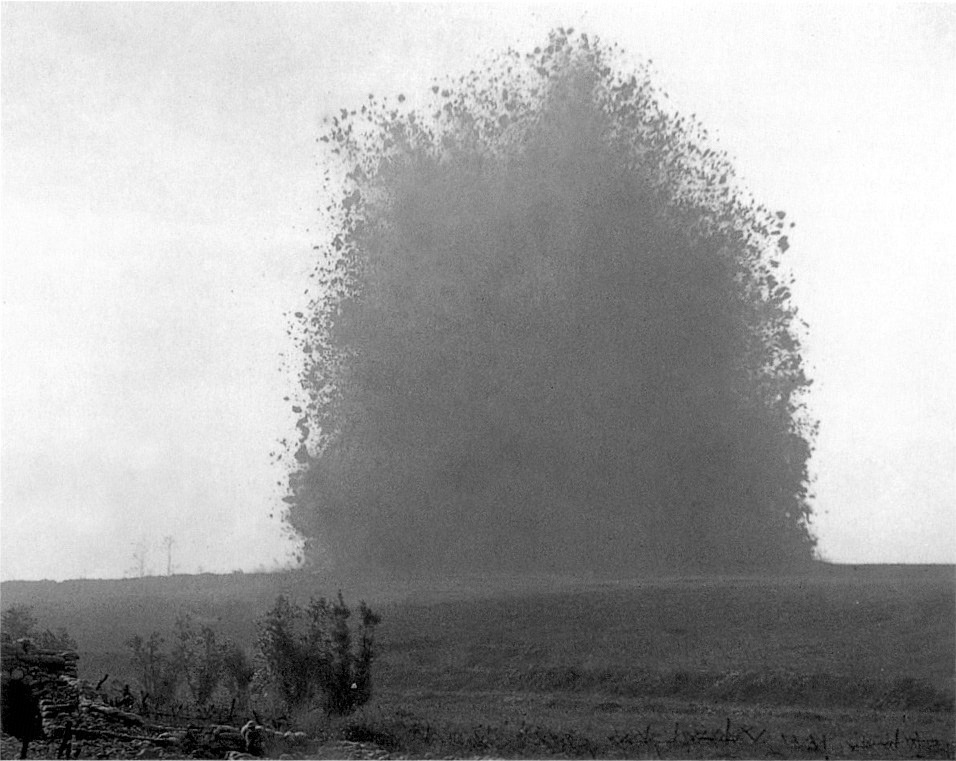
The mine was detonated at 0720 hrs on the morning of 1 July 1916, some eight minutes earlier than the remaining ones along the Somme front, at the same time the Artillery barrage lifted from the German frontlines along the VIII Corps front. The reasons for this continue to be a matter of debate to this day.
What makes this detonation unique is the fact that it was filmed, the only existing recording of the detonation of a mine in active warfare during the War. This was undertaken by Lieutenant Geoffrey Malins, who was attached to 29 Division to record the events of the day. After filming two companies of the Lancashire Fusiliers in the Sunken Lane earlier that morning, he then took up a position next to Jacobs Ladder (today the site of a modern pump station).
Despite early positive results achieved by the leading platoons of 2/Royal Fusiliers in taking the western lip of the crater and its nearby trenches, the German defenders, having had ten minutes warning, had prepared their positions, most particularly machine guns, ready for the main attack and were able to unleash withering fire on the advancing troops. The Redoubt itself had only been lightly held throughout the seven day bombardment and as a result the German casualties from the mine detonation, were relatively few, but casualties none the less. Added to this the German Artillery which had been reasonably quiet to this point, opened a devastating barrage on the British front lines, catching many troops before they had passed through their own wire.
By the end of the morning the attack had failed, with many British casualties, but that was not the end of the story at Hawthorn Ridge.
The Germans then proceeded to reinforce the crater. Working quickly they integrated the Crater into the existing trench network, creating a crude system on the northern and western edges of the crater lip. Meanwhile the Royal Engineers had re-entered the original tunnel of H3 and on encountering the destroyed area of tunnel from the 1 July blow, ran a second tunnel at approx. 45 degrees to the south and laid a second, slightly smaller, charge of 30,000lbs (13,600kg). The plan was for a second attack to capture the Ridge and the village in late October, but due to severe weather conditions this was delayed until 13 November 1916.
The second mine was blown at 0545hrs, causing as much ‘disruption’ as ‘destruction’, but inflicting much damage to the 1 July crater and its occupants. Despite difficult conditions and heavy fighting, which inflicted many casualties, the men of the 51 (Highland) Division, V Corps, captured both the Ridge and the village of Beaumont Hamel.
The fighting after this date, continued but on a much lower scale, the ‘official’ end to the Battle of the Somme coming on the 18 November, but it wasn’t the end of the story. Small scale operations would continue in the area until the German withdrawal in March 1917, whereby the craters became part of the British back areas of the Somme for the remainder of the year and into early 1918.
In late March 1918, however, the War returned to the village and the Ridge, with the German Spring Offensives, beginning on 21 March, arriving in the area a week later. Apart from taking over some of the original British frontline trenches and positions, including the Sunken Lane, the German front used the same trenches as 1916, including the craters of Hawthorn Ridge. They would hold these positions for the next five months, during which time the British, after holding up the German advance, would begin to undertake raids (some on a large scale), to test the defences in preparation for the main offensives of August 1918.
As the ‘100 Days’ offensive pushed forward to the south along the axis of the Amiens-Albert-Bapaume/Peronne roads, it would arrive in the area north of Albert in late August when, once again, the Ridge and its craters were re-taken and the advance to victory pushed forward, leaving them behind again.
The craters had now been occupied and re-occupied on four separate occasions.