An occasional newsletter from the Hawthorn Ridge Crater Association (HRCA)
No. 2 – March 2023
INTRODUCTION

To headline this edition I have a photograph of the Hawthorn Crater taken from the Redan Ridge. It was taken by Terry Berry on a cold but bright late February day while he was on the Somme for a couple of days. While there he was able to show a party from Kingham Hill School, Oxfordshire, led by teacher Gareth Williams, around, as well as a group of guides from Leger Tours who took the opportunity to visit the crater while on a reconnaissance of the battlefields. It’s good to see people out and about on the battlefields so early in the year.
My first edition solicited a response from Andrew Hunt that has enabled me to weave extracts from his book, In the Forefront: Alloa at War 1914-1919 (Reveille Press, 2018, ISBN 978-1-999890-05-6), into a piece about the November 1916 battle. This is very much appreciated and I hope others will follow his lead.
The 7th Argyll and Sutherland Highlanders at Beaumont Hamel
The 7th Argyll and Sutherland Highlanders was a Territorial battalion recruited predominately from Clackmannanshire and Kinross, forming part of the Highland Territorial Division, which was re-named the 51st (Highland) Division when it arrived in France in early May 1915. The 7th Argylls were, however, one of a number of battalions from the Highland Division that were up to strength and deemed efficient enough to cross to France earlier, in their case in mid-December 1914. At the beginning of January 1915 they became part of the 10th Brigade, 4th Division, and were destined to not rejoin their parent division until 1 March 1916, when they were transferred to the 154th Brigade.
The 154th Brigade was in reserve for the attack on Beaumont Hamel on 13 November 1916, but the battalions of the Highland Division were familiar with the area having all been in the front line on a number of occasions since first moving into the area six weeks earlier. The 7th Argyll’s history comments that the division attacked and captured ‘the supposed impregnable fortress of Beaumont Hamel, with its almost ridiculous depth of intricate barbed wire entanglements, its fabulously deep cellars and caves, and its picked garrison of the best of the enemy’s troops’. [1]
The battalion War Diary describes the 7th Argyll’s part in the 13 November battle:
“At 11.15 am A + D Coys under Capts Cunningham and Strang were ordered up to reinforce the 152 Inf. Brigade and took up position in dugouts Q10a. At 6 pm the remainder of the Battn. were ordered up to reinforce 152 Inf. Brigade and took up position in dugouts Q10a. At 8 pm A + D Coys were moved forward into BEAUMONT HAMEL to reinforce the 8th Arg and Suth High-ders in the old German 3rd line which was being consolidated… The village was wholly in our possession and third German line completely taken by 6 pm.” [2]
The War Diary then outlined the continuation of the attack on 14 November:
“At 3.00 am B + C Coys under Captains Mitchell and A L Stewart were ordered forward into advanced line E. of BEAUMONT HAMEL. At 7.30 am B + C Coys advanced to occupy MUNICH TRENCH. They moved up the hill in two waves of sections in file supported on either flank by bombing parties moving up BEAUMONT ALLEY + LEAVE AVENUE. The progress was very slow on account of the state of the ground, but at 8 am MUNICH TRENCH was occupied with slight opposition and some prisoners were sent down. … at 1.30 pm forward Coys reported that they had to vacate MUNICH TRENCH on account of the shelling from our own guns and had withdrawn to the head of LEAVE AVENUE which they had consolidated and had thrown out advanced posts in shell holes. Machine guns were reported active in FRANKFURT TRENCH.” [3]
The regimental history summed up the battle:
“It was literally an uphill fight. To walk over the ground after the battle was to be filled with amazement that men found it possible to get into contact with the enemy at all. Yet…they carried the whole objective strictly according to the timetable…’ and ‘It is worthy of note that on the 15th the 7th Argylls were 400 yards further forward (their flanks completely in the air) than any other troops on that part of the front’.” [4]
The 7th Argyll’s success came at a cost and the Alloa Journal reported on 25 November under the title ‘Local Argylls in Action’. Beginning by referral back their previous moment of glory; ‘… the memorable 25th April 1915 when the Battalion received its disastrous baptism of fire at St Julien and resulted in over 400 casualties’, it went on to comment that since then it ‘has been practically immune from serious loss.’ [5]
The Alloa Journal did, however, recognise that its turn had come in November 1916, and was well aware that ‘gallant work in the recent British advance’ meant that ‘local casualties are somewhat heavy’, commenting ‘Alas! that this brilliant feat of arms should have been accomplished at such cost’. An annotated photograph of the battalion’s officers was also published. [6]
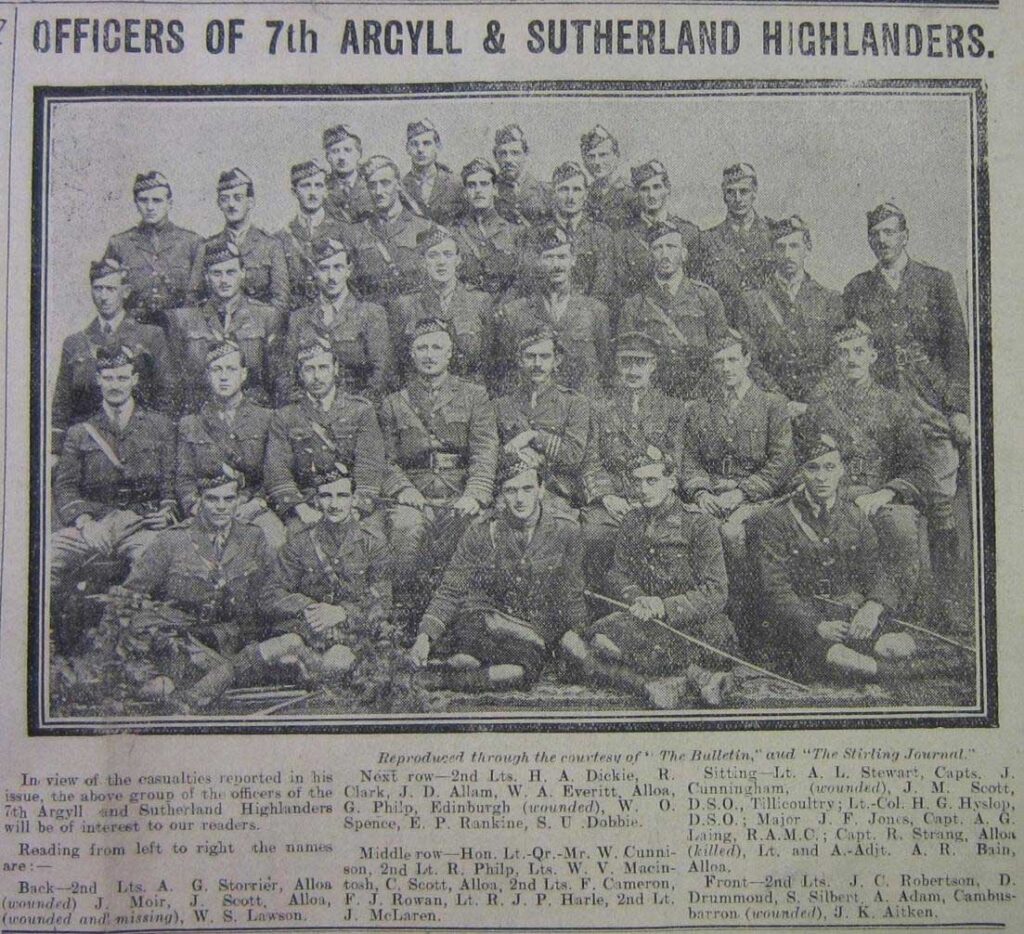
Unfortunately, apart from an account of the death of Captain Robert Strang, (his father was Provost of Alloa in the early years of the war) few other details appeared in the pages of the Alloa Journal. Robert Strang was killed on 14 November and is buried in Mailly Wood Cemetery (Grave I.D.27.), like many of the other Highland Division casualties from November 1916. The after battle report by the 51st Division’s Assistant Director of Medical Services, stated that casualties in the 7th Argylls between 13 – 17 November were 1 officer and 32 men killed; 4 officers and 90 men wounded and 2 officers and 24 men missing.
The 13th November was commemorated by surviving 7th Argylls as ‘Beaumont Hamel Day’ for many years in recognition of their part in the famous victory. Pipe-Major John McLellan (1875-1949) who served in the Highland Division also composed a tune ‘The Taking of Beaumont Hamel’ to commemorate the battle and it can be found if you search on YouTube.
- 7th Battalion Argyll’s Regimental History, p.20.
- War Diary of 7th Argyll and Sutherland Highlanders, 13 Nov 1916.
- War Diary of 7th Argyll and Sutherland Highlanders, 14 Nov 1916.
- 7th Battalion, Argyll’s Regimental History, p.20 & 22.
- Alloa Journal, 25 Nov 1916, p.2.
- Alloa Journal, 25 Nov 1916, p.3.
252nd Tunnelling Company, Royal Engineers
I hope that in future editions I can tell the story of some of those who served with the 252nd Tunnelling Company, and this is the story of what appears to be the company’s first fatality.
Having begun work in the Serre – Beaumont Hamel area at the beginning of November 1915, it was not long before the company began to suffer casualties, however, this one occurred away from the front line. The incident was not mentioned in the War Diary, but it was a tragic culmination to a very short military career.
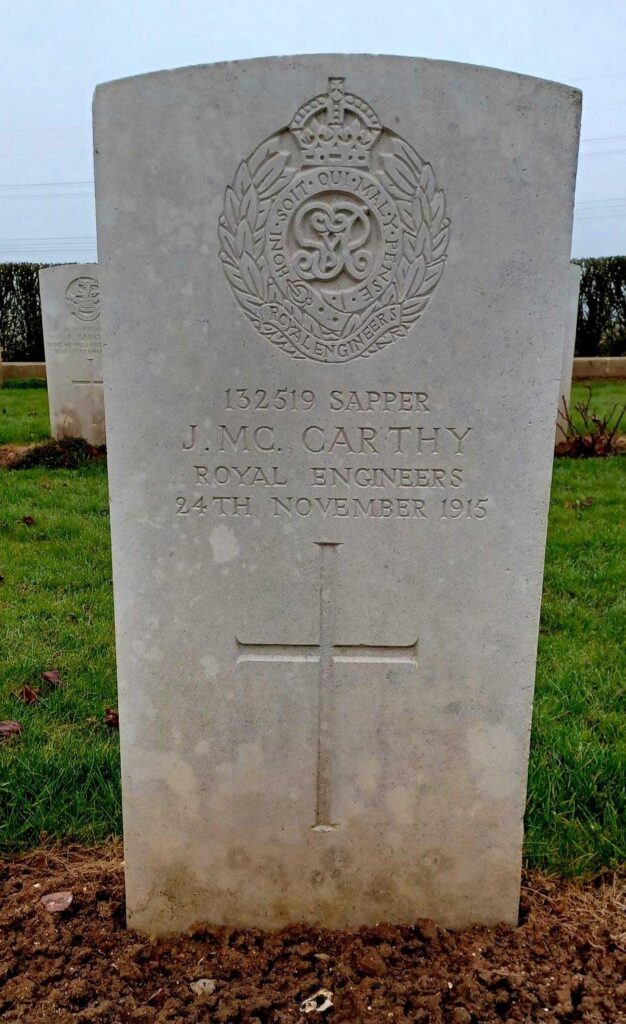
On the evening of 24 November 1915 some men from the company were resting in their billets in Toutencourt where the company HQ was located. Among them was 132519, Sapper, James McCarthy, a 37 year-old unmarried tin miner from Camborne, Cornwall. He had enlisted on 4 October 1915 as a miner’s mate at a rate of two-shillings-and-two-pence a day. A small man at five feet three-and-a-half inches tall with a thirty-four inch chest, he only weighed slightly over nine stones; but that would not be a great disadvantage in the confines of the small mine tunnels he would be expected to work in on the Western Front.
His initial military training, like that of many of the tunnellers, was extremely brief (in some cases it was effectively non-existent!) and he embarked for France on 23 October. Perhaps this lack of indoctrination into the ways of the army and what was expected from him, led to him being charged with drunkenness on 14 November, and being punished by having to serve four days confined to barracks under close arrest.
It is not known when he left the depot, but later reports indicate that he had only arrived at the company shortly before the incident, and he might not have even got as far forward as the company’s mine workings. In his statement for the Court of Inquiry, 121863, Sapper, Patrick Brennan, said that:
“I was laughing and talking in the billet with the men, someone said they had no drill and did not know how to load and unload a rifle, so I offered to show them. I took down a rifle and put in a clip of five, and Goddard… in 252 Coy R.E. who lived in the same billet as me said Paddy I should unload that rifle. I took out the magazine and to make certain pointed the rifle towards the ground and pulled the trigger not knowing that there was a bullet in the breech, it went off and someone said theres been a man shot through the head, after which Sergeant McLeod came in and put me under arrest.”
Other statements broadly corroborated Brennan’s account, with Sapper Goddard stating that:
“At about 8:55 p.m… the accused came in laughing and joking, he went over the partition talking to the other men, when he came back he took down the rifle and took a clip of ammunition from a bandolier in his greatcoat pocket and loaded the rifle, I saw him do it, so I told him to unload it so he took out the magazine and showed it to me and said “will that do for you?” and I said “Yes, thats alright”. And I lay down in bed with my back towards him, and just as I lay down and covered up my shoulders the shot went off…”
Captain Watson, Royal Army Medical Corps, stated that he had been called at about 9:25 p.m. and had attended immediately. He found:
The man lying in his bed undressed he had a large bullet wound on the left side of the head, a large amount of brain material was destroyed and he was obviously dying, he was attended to and sent immediately to 110 Field Ambulance.
Unsurprisingly, when the motor ambulance carrying James McCarthy arrived at the 110th Field Ambulance from Toutencourt at 11 p.m., he was pronounced dead. The Court of Inquiry found James McCarthy’s death to be an accident; although to any of us who have served in the military, or are otherwise familiar with firearms, some basic weapon handling rules were broken in the lead up to the fatal shot being fired. Unfortunately Patrick Brennan’s records do not seem to have survived so I have been unable to find out what happened to him, but it appears that he survived the war.
James McCarthy was initially buried in Varennes Communal Cemetery, but he was moved to nearby Varennes Military Cemetery in 1934, where he still lies today, in Plot 1, Row C, Grave 2. Perhaps when you are next on the Somme you will pay him a visit.
MEMBERSHIP REPORT
Thanks are due to those of you who have paid the membership fee for 2023, and particular thanks must also go to those who have made generous donations as well.
If you have not paid yet it is not too late! Your £10 will help to fund all the work necessary at the crater
over the coming year, plus it will support our website through which we aim to spread word of the crater’s
history and the work of the HRCA to preserve it.
For information on membership, please contact Rick at rick@hawthornridgeca.com
And Finally
There will be a ceremony at the Hawthorn Crater on the morning of 1 July. Everyone should assemble at 7:10 a.m. at the Sunken Lane to get your rum ration and take part in the ceremony that has been organised annually since 2006 by our Vice-President, Andy Robertshaw. Upon the conclusion of Andy’s ceremony we will proceed to the crater where another commemoration will take place. I hope to see you there.
There will no doubt be opportunities for guided tours of the crater on 1 July (or surrounding days) and an email or Twitter message to the addresses given below is the best way to check on availability. As always I am happy to accept articles, photographs or other material for possible inclusion in the newsletter – contact me at my email address below.
Newsletter Editor
derek.bird876@gmail.com
HRCA contact details: –
Website: www.hawthornridgeca.com
Email: enquiries@hawthornridgeca.com
Mobile: 07747 862014
Twitter: @HawthornRidgeCA
Facebook: Hawthorn Ridge Crater Association