An occasional newsletter from the Hawthorn Ridge Crater Association (HRCA)
No. 5 – July 2024
Introduction
I am afraid that I was unable to produce a newsletter in the spring; my feeble excuse being that I was away in the Southern Hemisphere (and then Germany) for more than eight weeks. In this edition I report on the commemorations at Beaumont Hamel on 1 July, and I continue my look at the 252nd Tunnelling Company’s story and examine the first three months of their mining activities.
As always, should you have something of interest relating to the Hawthorn Craters or the surrounding area, let me know and we can add it to the association’s growing archive, and it might also be useful for use in future editions of this newsletter, or on the HRCA website.
1 July 2024
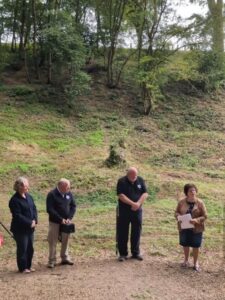
(translator), Derek Bird, Terry Berry
and Madame Lavaquerie
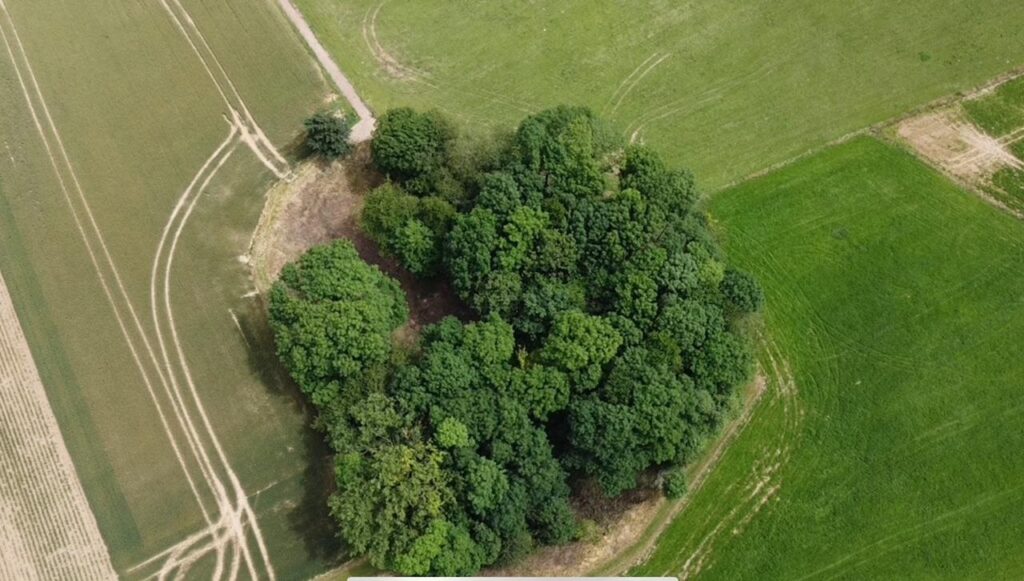
Unlike last year the weather was kind to us on the morning of 1 July, and people started assembling in the Sunken Lane from 7 a.m. onwards. Following the ceremony conducted by Andy Robertshaw at that location everyone moved up to the Hawthorn Crater behind the piper, Sylvain. Terry Berry, HRCA Chairman, and Madame Lavaquerie, Mayor of Beaumont Hamel, welcomed everyone to the craters before the exhortation was given by Rick Smith, the Last Post was played and a silence observed. During the playing of The Flowers of the Forest on the bagpipes, flowers and wreaths were laid. Afterwards many went to the vin d’honneur that was organised by the villagers in Beaumont Hamel. It was pleasing to see such a good attendance, a mix of locals and those from further afield, including our friends from the Brantwood Military Heritage Association in Northern Ireland.

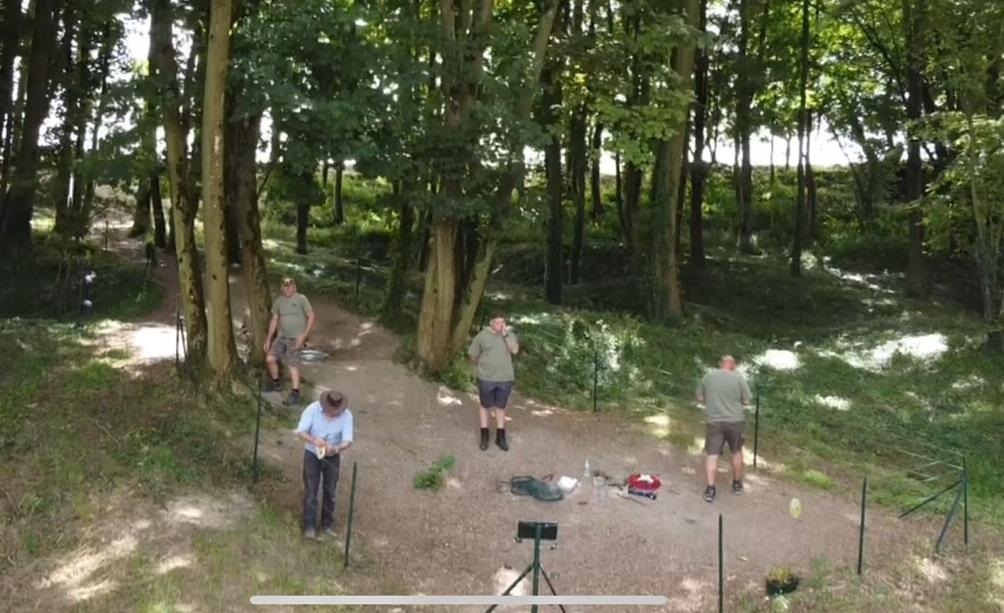
Some of us had travelled over to France a few days earlier prepared to do whatever as necessary to ensure that the site was in good order. Upon arrival, however, it was obvious that Francis from Beaumont Hamel had already done all the hard work with the paths being very tidy and the undergrowth in the crater cut back. Quite how he manages to do so much on his own, especially on the steepest sides of the crater, is a bit of a mystery, but we thank him for his continuing hard work.
The 252nd Tunnelling Company gets into its stride
Following their arrival in France on 21 October 1915, the 252nd Tunnelling Company was quickly moved forward to the area of the Redan Ridge and Beaumont Hamel. On 1 November the unit War Diary records ‘the Redan position was inspected and policy decided on’, and the following day ‘No.3 Section started work driving to meet the enemy mine which was approaching’. Meanwhile Nos. 1 & 2 sections had moved forward to Auchonvillers so as to be close by; they began work on two new tunnel entrances themselves on 2 and 3 November respectively.
The unit’s first offensive action then took place on 5 November when ‘No. 3 Section having driven 35 feet out and down to chalk exploded a mine of 500 lbs [230 kg] of guncotton and destroyed enemy gallery’. There followed a period of rapid progress; Mine R1 had reached 28 feet [8.6m] and R2 some 30 feet [9 m] on 12 November, and 101 feet [31m] and 91 feet [28m] respectively by the 20th. A week later they were at 131 feet and 133 feet [41m] respectively and, while cutting a station at the 65 foot [20m] level in R2, sounds of enemy mining was heard. Captain Trower ordered his men to prepare counter-measures and overnight a short tunnel was dug towards the enemy with a 3 foot x 3 foot [1m] chamber at the end. This was loaded with 980 lbs [445 kg] of guncotton and was tamped and ready by 4 p.m. on the 28th; the shaft was filled with sandbags to within 50 feet [15m] of the surface. The charge was blown at 4:30 p.m. and, with the enemy estimated to be within 30 or 40 feet it, is likely that they suffered a tunnel collapse and loss of life.
December 1915 saw the tunnellers developing an extensive network of galleries (R3 & R4 were started on 10 and 28 December respectively) under the Redan Ridge, largely without the interference of the enemy; although they did explode a charge near R2 on 21 December. This destroyed one of the minor galleries and caused slight damage to the main gallery; the British tunnellers suffered no casualties as they had fortunately been withdrawn 10 minutes before the explosion due to ‘bad air’. On the 27th Captain Logan, a Royal Army Medical Corps ‘gas expert’, visited to take gas samples and; ‘was overcome by CO [carbon monoxide] gas but quickly recovered’. One can only surmise that he was more of an expert after this event than before!
Also that day sounds of enemy digging were detected near R2 and a chamber was prepared 50 feet [15m] along the main gallery. This was charged with one ton of guncotton and Cheddite (a French commercial explosive normally used in quarrying) and fired at 1:45 a.m. on the 31 st. The end of the year saw the company recording that they had made the following progress on shafts, adits (sloping entrance ways) and galleries since starting work on 2 November:-
R1 458 feet [141m]
R2 494 feet [152m]
R3 249 feet [77m]
R4 Started work on adit.
Tit for tat explosions continued into 1916 with one occurring on 8 January: ‘At 3:30 a.m. the enemy exploded a large camouflet [a charge large enough to destroy tunnels but not sufficient to break the surface] to the south east and above the chamber of RIII [the War Diary uses both R3 and RIII in its pages] which was broken in. The south drive was also completely smashed in and two men were cut off and shut in the face of the south drive RIII (I). Rescue work was immediately started, the whole company taking shifts of three to five minutes. A new drive was started from the shaft through unbroken ground and 22 feet [7m] driven through solid chalk to the crushed drive. 48 feet [15m] was then driven through broken ground and the two men taken alive from the end of the tunnel after being entombed for 21 hours.’ The War Diary goes on to record that the company had dug 70 feet [21.5m] in 21 hours, 22 of them through solid chalk. That the two men survived the initial explosion, or did not succumb to a lack of oxygen or gases from the explosion, is miraculous, but thanks to their tunnelling mates they were rescued. Unfortunately, the names of these two fortunate men was not recorded in the War Diary.
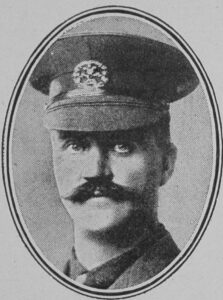
Another explosion was reported the following day, this time causing damage to R2: ‘this is the fifth time that the enemy has blown us and so far we have not lost a man’. Unfortunately the company did suffer a fatality five days later when, at 2 p.m. on the afternoon of the 14th , Lieutenant Frederick Crathorne was killed by a trench mortar shell while leading his men back to work: the War Diary records: ‘such a good officer will be sorely missed’.
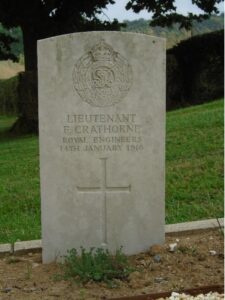
Frederick Crathorne was born in Pietermarizburg, South Africa, on 31 August 1878. He served during the South African War and was awarded the Queen’s Medal with three clasps and the King’s Medal with two clasps. He then travelled to England for a three-year course at the Camborne School of Mines, and after graduating in 1906 returned to Africa and spent the rest of the pre-war years working in a number of African countries. He travelled back to Britain in early 1915 and was initially commissioned into the 11th (Service) Battalion, South Lancashire Regiment, but his valuable mining experience later saw his attachment to the Royal Engineers and subsequent joining of the 252nd Tunnelling Company on 4 November 1915.
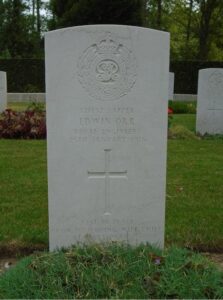
II.A.28.
At 7:20 p.m. on 24 January the Germans blew another camouflet to the south east of RII (I) which caused little damage to the gallery but closed the end, killing one man and injuring another. Unfortunately their names are not recorded but, from the evidence available, I think that 27 year-old Sapper Edwin Orr was most likely the man killed in the tunnel. He was born in Halifax, Yorkshire, and was living with his wife, Emily, at nearby Liversedge at the time of his enlistment. He had arrived in France on 2 October 1915 and appears to have joined the 252nd Tunnelling Company upon its formation later that month. He is buried in Auchonvillers Military Cemetery, Grave II.A.28.
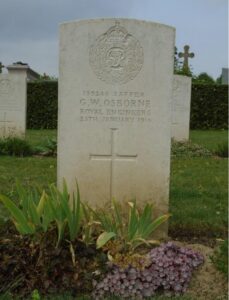
in Mailly-Maillet Communal Cemetery Extension,
Grave C.13.
The following day another man was killed and one wounded when shellfire hit their billet in Auchonvillers. I believe that the man killed was most likely 34 year-old Sapper George Osborne, who was born in Leicester. He was married with two children, a boy born in 1911 and a girl born in 1913, and the family were living in Grimsby. He had originally served with the 1st Battalion, Cameronians (Scottish Rifles), and had arrived in France as early as 1 September 1914, which indicates that he was either a regular soldier or, most likely, a recalled reservist as his battalion had arrived two weeks previously. At some stage he transferred to the Royal Engineers and joined the 252nd Tunnelling Company. He is buried in Mailly-Maillet Communal Cemetery Extension, Grave C.13. It appears that family circumstances were difficult as his widow is noted on pension records as being ‘unworthy’ and her pension withheld, although the child’s element was put in trust and administered by the Soldiers’ and Sailors’ Families Association. It would appear that circumstances did improve and the decision was taken to start paying her pension in early 1917, however, the whole family’s pension income would still be controlled, this time by the National Society for the Prevention of Cruelty to Children. The situation appears to have continued to improve and in early 1918 instructions were given that she could receive the pension direct and this must have been most welcome, however, it was for a reduced amount as a month earlier her son had died, just three days short of his seventh birthday. The Osborne family’s story is a tragic one.
January 1916 was rounded off by the explosion of a 3,000 pound [1,364 kg] charge of guncotton placed in a chamber off gallery RIII (I) (2). Fired at 1:35 a.m. on the 27th it was noted that ‘the enemy were close at the time’ so almost certainly sustained casualties. The tunnellers had achieved much in their first three months digging and had begun to force the German tunnellers back across the Redan Ridge towards their own lines, however, this came at a cost of an officer and two men killed, one of them underground (I wrote about the earlier accidental death of Sapper James McCarthy in The Crater News No.2).
Membership Report
Rick Smith is now looking to gather in membership fees for 2024. These are maintained at just £10 per annum.
For information on membership, please contact Rick at rick@hawthornridgeca.com
And Finally
Ceremonies will be held at Beaumont Hamel on 13 November to mark the capture of the village by the 51st (Highland) Division and the 108th anniversary of the second blow of the Hawthorn Mine that signalled the start of the attack. Firstly, the one I organise on behalf of the Scotland (North) Branch of the Western Front Association will commence at the 51st (Highland) Division flagstaff in the centre of Beaumont Hamel at 10:30 a.m. Thereafter everyone is invited to proceed to the craters for a second ceremony, before returning to the village for refreshments. All are welcome to join us.
Newsletter Editor
derek.bird876@gmail.com
HRCA contact details: –
Website: www.hawthornridgeca.com
Email: enquiries@hawthornridgeca.com
Mobile: 07747 862014
Twitter: @HawthornRidgeCA
Facebook: Hawthorn Ridge Crater Association