The Crater News – Feb ’26

An occasional newsletter from the Hawthorn Ridge Crater Association (HRCA)

Introduction

In this edition I continue the story of 252 Company’s work on the Redan and Hawthorn Ridges. I also have a story about one of the 252 Company tunnellers who was with the unit from March 1916 onwards and survived the war. To finish there is also a rather difficult piece that I have had to write.

252 Tunnelling Company – May 1916

During early May 1916 no less than 11 tunnels were being dug by the company across the Colincamps and Auchonvillers sectors, and on 9 May it was reported that a total of 277 feet (84.5 metres) had been dug within the previous 24 hours.

At 5 p.m. on 10 May the company exploded a 4,000 pound charge (1,814 kg) in RIII A (1) as the enemy had been working past their galley on both sides. Having waited until German working parties were active ‘It is absolutely certain that both enemy galleries were destroyed and that all their working party in each gallery were blown to pieces’.
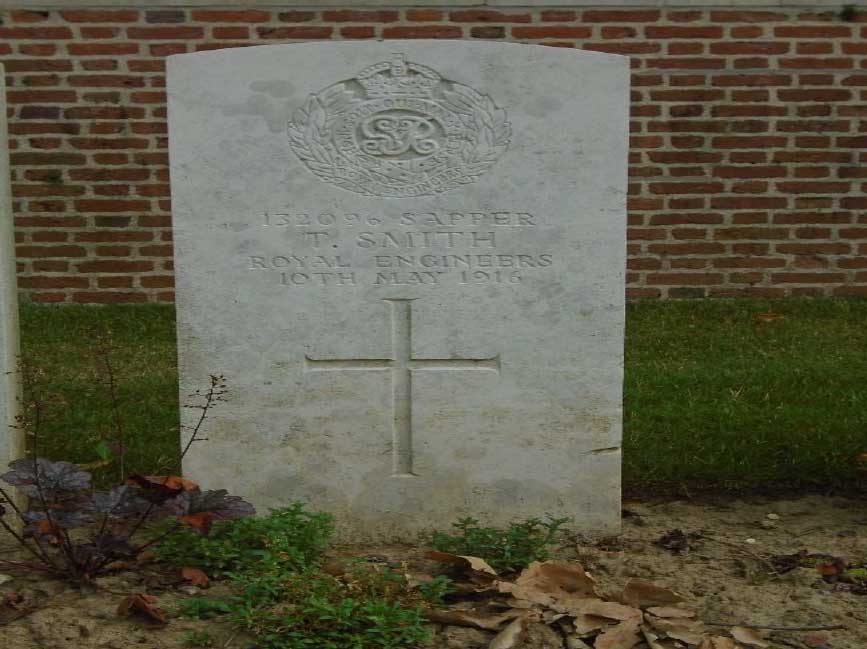
Thomas Smith lies in the Sucrerie Military Cemetery,
Colincamps. Grave 1.AA.21

On the same day 132096, Sapper, Thomas Smith, was reported as being killed by shellfire. He was a 28 year old unmarried man who lived and worked as a coal miner at Stirling, Scotland. He enlisted on 21 September 1915 and was sent to France on 9 October after the briefest of military training, being graded as a Tunneller’s Mate. He returned to the UK for an unspecified reason just a week later, most likely due to illness, and was at the Royal Engineers’ Depot at Chatham, Kent, on 16 – 17 January 1916, when he was found absent from duty for 12 hours and 45 minutes. He was apprehended by the Military Police in the ‘Brook’, presumably a local public house! His punishment was confinement to barracks for five days.

He returned to France on 12 March 1916 and was posted to the 252nd Company to spend two months working on their tunnels and mines before his death. He is buried in the Sucrerie Military Cemetery, Colincamps.

At 12:05 a.m. on the morning of 11 May the enemy blew a large charge on the Redan Ridge, but it did not form a crater and was too far away from British positions to cause any significant damage or casualties, however, the galleries were flooded with gas.

On 13 May Sergeant Coull was struck off strength after being commissioned and was posted to the 178th Tunnelling Company. It appears that he was subsequently killed on 3 July 1917 at the age of 42 and is buried at Fins, south-east of Bapaume.

At 11 a.m. on 13 May, some 59 hours after the previous enemy explosion, Second Lieutenant Stuart, Sergeant Brown and Sapper McLoughlin were passing along the upper level of RIII (4.2) ‘when at the entrance… an explosion of gas occurred. All three were knocked down and severely burnt. This place had all been examined since the enemy blow and no trace of gas discovered’. There are no obvious matches on the CWGC database, so it is possible that all three men survived their injuries.

On 16 May it was reported that 13 tunnels were now being worked on and were each more than 200 feet (61 metres) out from the British lines. At midnight the enemy blew a large camouflet between RI (2) and RI (2.1) ‘shaking the front system badly and causing large falls wherever the galleries were not timbered. There were no casualties from the blow. Ten men who were laid out unconscious by gas at post #3 post were brought out and brought round by 2nd Lt Smillie [252 Company’s medical officer] and the Proto men [specially trained and equipped mine rescuers]. The gas was very bad and the mines continued to be flooded. At 10 a.m. an infantry private and Proto man Gallacher of the company tried to come from #3 post to #1 mine but were killed by gas before they could be rescued’.
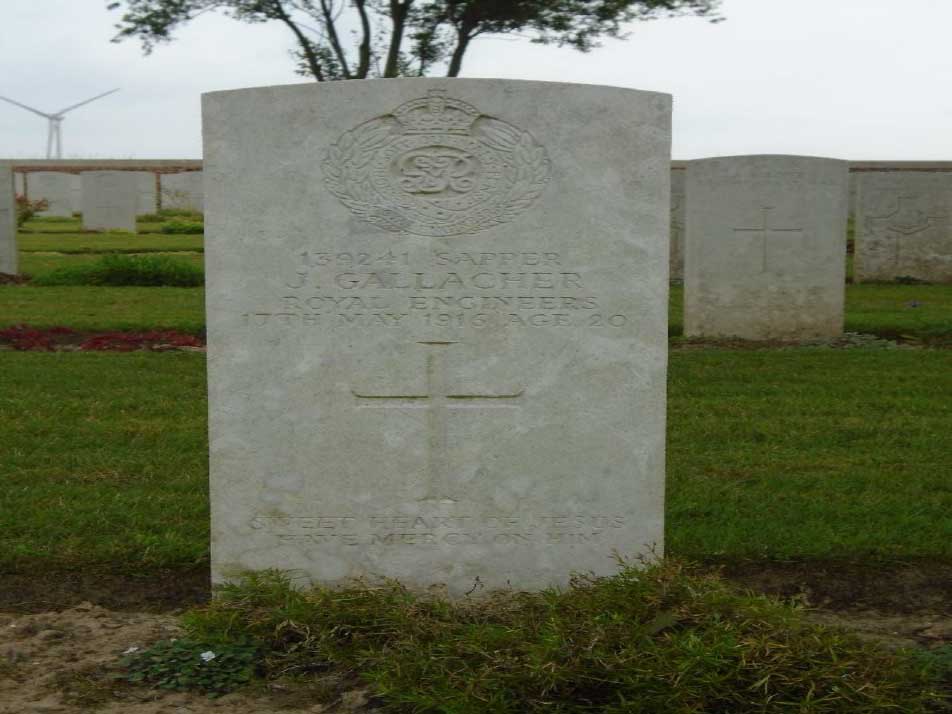
Grave of Sapper John Gallacher – Sucerie Military Cemetery, Collincamps. Grave I.I.112.

Little is known about 139241, Sapper, John Gallacher, but it appears that he initially arrived in France on 25 March 1915 as a private in the Cameronians (Scottish Rifles), before later transferring to the Royal Engineers. He was 20 years old and as a pension card was raised on behalf of a Rose Ann Gallacher at his parents address in Pollockshaws, Glasgow, it likely that he was unmarried and she was his mother.

On 20 May trouble was reported in tunnel H3 (heading towards the Hawthorn Redoubt) and that it was 900 feet (274 metres) long but ‘work is being carried on silently by wetting the face and working the chalk out with bayonets. The face is now almost entirely flint and progress is very slow’.

At 3 a.m. on 26 May ‘the enemy blew a large charge due east of No. 2 mine [on the Redan Ridge] and at some distance away. There were no casualties but the mines were again badly shaken and filled with gas. The enemy are evidently very frightened to come close. They bombarded our No. 2 and No. 3 mine shafts for four hours’.

On the penultimate day of May it was reported that ‘all the tunnels are now out over 400 feet [122 metres] with the exception of Bess and Delaney and silent work has been commenced on most of them. This month the company has driven 5,327 feet [1,624 metres] of underground working’; a remarkable total considering the number of times the Germans managed to interrupt their work.

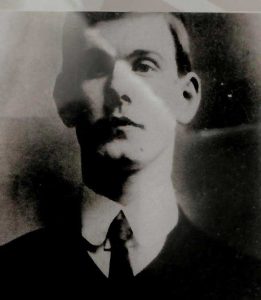
William Fairley

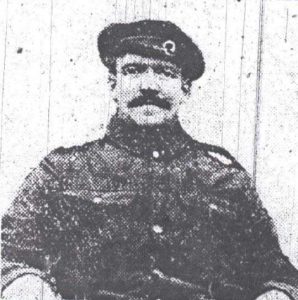
As any of you who have researched men who served in the Great War will know it is often easier to find information on those who died rather than those who survived. Therefore, I am most grateful to Stephen Lacoohee for providing information that enables William Fairley’s story to be told. William Beveridge Fairley was a son of Andrew and Elizabeth Fairley and he was born in Dunbar, Scotland, in 1881. Prior to the war, William was working as a quarry contractor and was qualified in the use of Dynamite and Gelatine at the Humbie Quarry, West Lothian, Scotland. He married Mary Thompson Campbell in December 1905 and lived at Hawthorn Cottage, Ratho, Scotland.
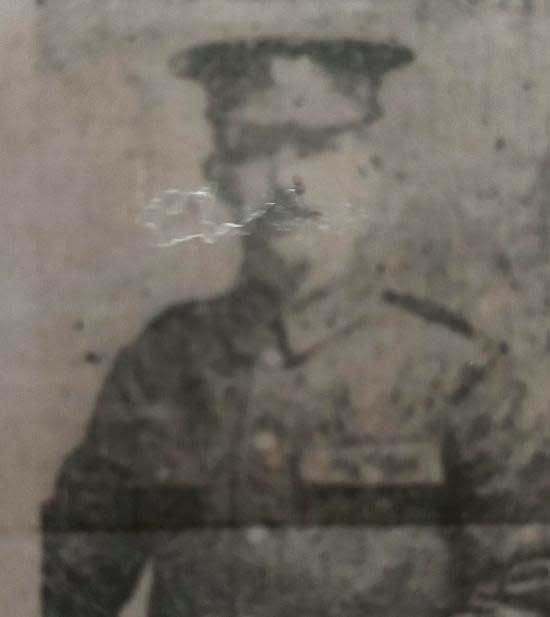
2nd Corporal William Fairley

By mid-1915 the couple had three children, the youngest of which was born on 25 May 1915. William enlisted into the Royal Engineers on 18 November 1915 as a Tunnellers Mate with the pay rate of two shillings and two pence a day. He was allocated service number 144914, and after being equipped and given some very basic military training at Chatham, he was posted to the 179th Tunnelling Company, arriving in France on 6 December. On Christmas Eve 1915 he was admitted to the No. 8 General Hospital suffering from haemorrhoids and was subsequently sent back to Britain for an operation.

Once declared fit again he returned to the Base Depot in France on 12 March 1916 and was posted to the 252nd Tunnelling Company a week later, most likely as a replacement for one of their recent casualties. This was at a time when the company were hard at work on both the Redan and Hawthorn Ridges. He was re-mustered to Tunneller on 31 May 1916, and appointed as Lance Corporal on 28 December 1917, and then 2nd Corporal the following day (2nd Corporal was a rank only used in the Royal Engineers and Army Ordnance Corps until 1920 and was denoted by a single stripe like a Lance Corporal, but unlike the latter which was just an appointment, often unpaid, 2nd Corporal was a full NCO rank). William continued to serve for the rest of the war before being demobilised and transferred to the Reserve in early 1919.

Membership Report

Membership for 2026 is maintained at just £10 per annum (as always you can donate more!) and by setting up a standing order you won’t forget in future.

And Finally

Unfortunately, I have been diagnosed with pancreatic and liver cancer and will probably never be able to return to the battlefields; a great blow after doing so dozens of times over the past 45 years. I have visited almost the whole length of the Western Front from the Belgian coast to the Swiss border, as well as visits to the Italian Front and Gallipoli.

As editor I will, however, indulge in giving myself a short obituary before I resign and “fall off the perch”.

Derek ‘Dickie’ Bird was born in a small village near Brighton, Sussex, in July 1955 and developed an early interest in aviation that led me to join the 225th Apprentice Entry at RAF Halton, Buckinghamshire, in November 1971, aged just 16. Rising through the apprentice ranks I was promoted to Sergeant Craft Apprentice prior to passing out, “not through any merit but to make the parade look pretty with the two flight commanders wearing the same rank”!
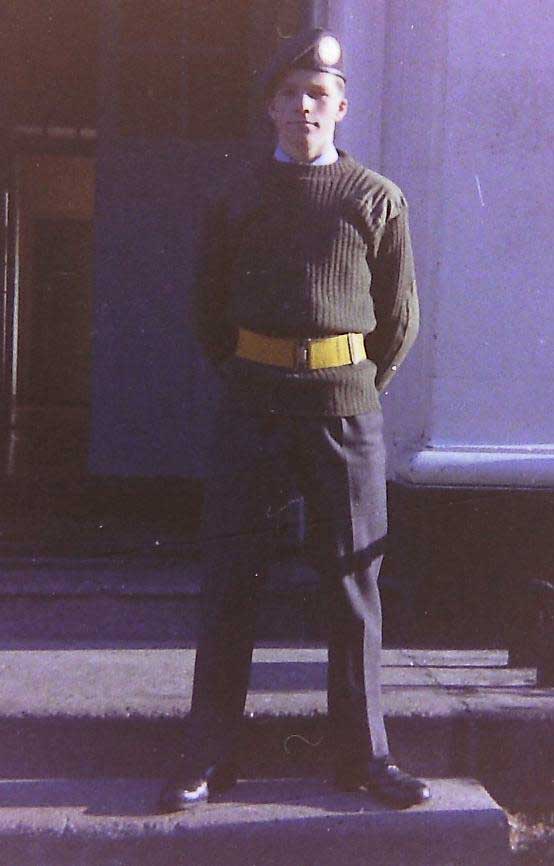
Derek Bird as a 16 year-old apprentice at
RAF Halton, 1971.

Postings followed to Brize Norton, Oxfordshire; Wattisham, Suffolk and Binbrook, Lincolnshire, before a posting to Germany, from where I made my first trip to Ypres to see the battlefields over the 1981 Easter weekend. Returning to the UK after three years meant a posting to Odiham, Hampshire, before a move up to Lossiemouth, Scotland, in 1985. I then stayed at Lossiemouth until retiring in 2015, apart from six months spent in Belize in 1988.

Along the way I worked on a wide variety of aircraft including the Britannia, Lightning, Puma helicopters, Buccaneer, Hunter and Tornado, as well as working in component repair bays, on major structural repairs and as an Aircraft Battle Damage Repair Instructor, before ending up deskbound in Engineering Operations; the last 12 years as a Full Time Reservist. Along the way I was awarded a Commander-in-Chief RAF Germany Commendation and two Air Officer Commanding Group Commendations.

Final retirement came in July 2015 at the age of 60 and, having earned 42 years’ worth of RAF pension, I never worried about seeking further employment! Having developed a such deep interest in the Great War many years before, I continued my research and study of the subject. I had become chairman of the Scotland (North) Branch of the Western Front Association at the end of 1998 and have arranged about 160 public meetings, two branch battlefield tours and commemorative events, at home and abroad, over the following 27 years. In 2006 I was instrumental in the erection of the replacement flagstaff at Beaumont Hamel, after the original erected by the 51st (Highland) Division in 1924 had become semi-derelict, and thereafter organised the annual commemorations on 13 November. In 2008 I completed 10 years of research and self-published The Spirit of the Troops is Excellent, a history of the 6th (Morayshire) Battalion, Seaforth Highlanders, in the Great War. I was a founding member of the Hawthorn Ridge Crater Association, and in 2022 I graduated from the University of Wolverhampton with the MA in Britain and the History of the First Word War. In 2024 I achieved something very special combining my interests in aviation and the Great War when visiting New Zealand and was given the chance to act as the rear gunner in a 1917 Bristol F2B Fighter during an airborne photographic shoot. Previous aviation highlights have included flights in an English Electric Lightning and a Spitfire, and a rather ‘interesting’ flight in a Puma helicopter up a Portuguese forest fire break at below tree-top height!

I have also been helping in the restoration of Avro Lancaster NX611, ‘Just Jane’, at East Kirkby, Lincolnshire, to an airworthy standard but, alas, will now not see her completed or flying. I also did much to reunite members of the 225th Entry and arranged their first reunion in 2011 to mark the 40th anniversary of joining the RAF, and a 50th anniversary of passing out reunion in October 2023. After more than 42 years of marriage I am saddened to soon be leaving a widow and a daughter. It is also very sad to be leaving so many friends around the world, and not get the chance to meet up with fellow enthusiasts on the battlefields again. If by, some unlikely miracle, I fight through this illness, then I’ll be back to the battlefields one day, however, the initial prognosis is far from good, so it is only fair that I resign as at this stage and concentrate on what family life I may have left.
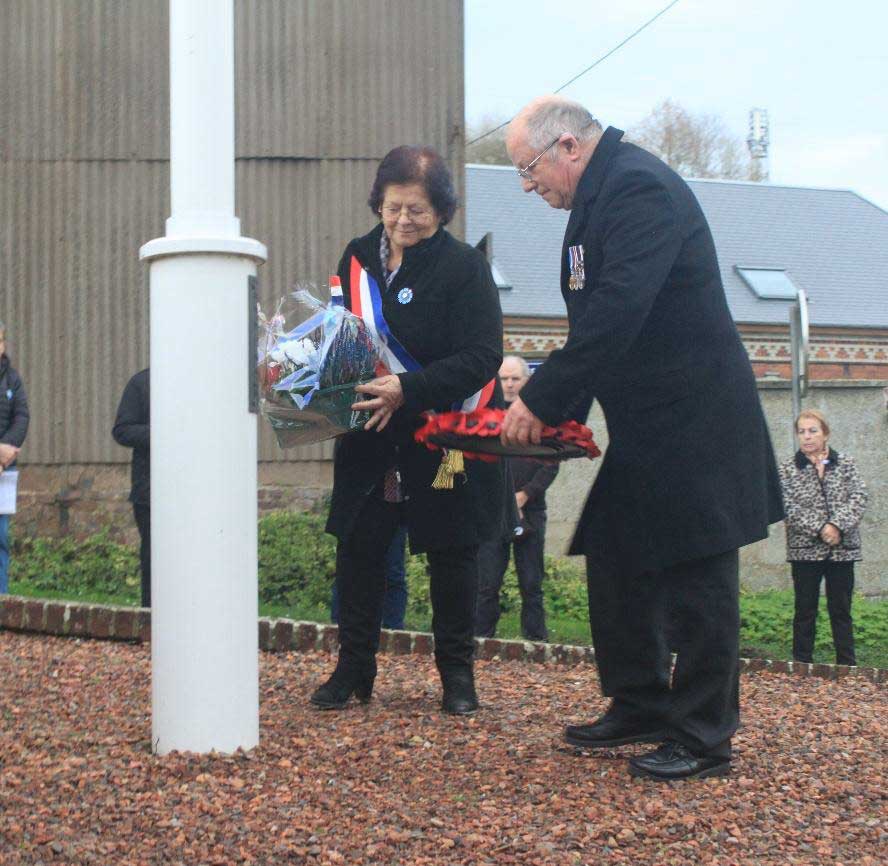
Dickie placing a wreath at the 51st (Highland) Division flagstaff on 13 November 2025, with Madame Agnes Lavaquerie, Mayor of Beaumont Hamel.

I have arranged for the HRCA, in conjunction with the village, to take care of the 51st (Highland) Division flagstaff and to organise the 13 November commemorations from this point onwards… I will be there in spirit.

Là a´ Bhlàir `s Math Na Càirdean
(Friends are good on the day of battle)
We Will Remember Them.
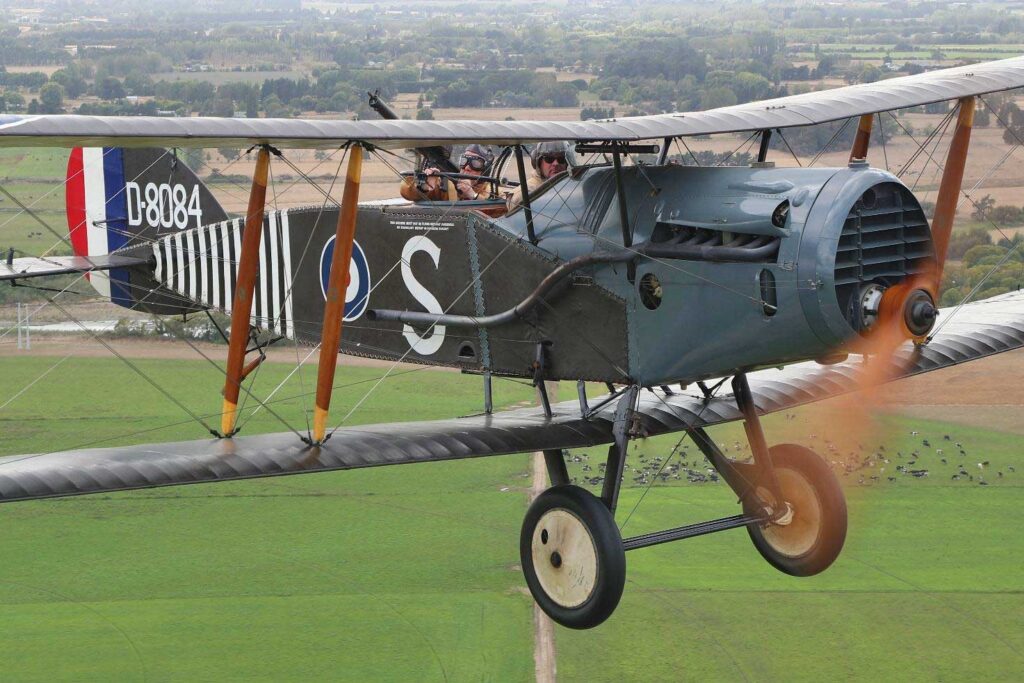
Mixing aviation and the Great War, Masterton, New Zealand, February 2024 – it doesn’t get much better
than this! Photo © Gavin Conroy.


Good bye, and thank you for your support of the HRCA in maintaining this iconic site and commemorating those, of all sides, who fought at Beaumont Hamel; for many it is their final resting place. My thanks also go to the good people of Beaumont Hamel who have, for more than 20 years, supported the efforts of a non French speaking ‘stranger’ who had wild ideas to put up a new flagstaff. Ably guided by the three mayors that I have worked with; the late Monsieur Omiel; Monsieur Magniez and Madame Lavaquerie, many villagers turn out every November, in all weathers, to commemorate the men of the Highland Division – it has been a humbling experience to see them caring about their heritage and history, and also to see them embracing the HRCA since its formation. Others who deserve a special mention are Monsieur Regnard, who interpreted so admirably during the initial negotiations when I was first looking to erect the flagstaff and at many of the subsequent ceremonies, and to Avril Williams at ‘Ocean Villas’ who has supported and helped me in more ways than I could list or ever hope to repay.

If you haven’t previously done so, I would recommend a visit to Beaumont Hamel, particularly to join Andy Robertshaw’s ceremony at the Sunken Lane on 1 July, before processing up to the Hawthorn Crater for a second ceremony; or at the 51st (Highland) Division flagstaff on the morning of 13 November, again followed by a ceremony at the crater. Refreshments in the Village Hall then follow the ceremonies.

If you would like to take over as newsletter editor please contact the HRCA via the enquiries email address to express your interest.

Derek Bird

Newsletter Editor
derek.bird876@gmail.com

HRCA contact details: –
Website: www.hawthornridgeca.com
Email: enquiries@hawthornridgeca.com
Mobile: 07747 862014
Twitter: @HawthornRidgeCA
Facebook: Hawthorn Ridge Crater Association
The Crater News – Jul ’25.

No. 8 – July 2025

An occasional newsletter from the Hawthorn Ridge Crater Association (HRCA)

Introduction

In this edition I report on the 1 July 2025 commemorations at Beaumont Hamel, and I also continue the story of 252 Tunnelling Company by looking at what happened in March 1916.

1 July 2025

This year saw 1 July dawn very bright and warm, indeed later in the day it was a sweltering 34 ̊ C and, in my case, saw a retreat to the shade and a ready supply of cold drinks! From 7 a.m. onwards people started assembling at the Sunken Lane for the ceremony led by Andy Robertshaw where a tot of rum was offered to all. Also, envelopes were handed out for opening at 7:30 a.m., each containing the brief story of one of those who fought at Beaumont Hamel on 1 July 1916 and their fate that day. Once again we were delighted to see
David and Richard Spencer at the ceremony; David’s father, Second Lieutenant George Spencer, 1st Battalion, Lancashire Fusiliers, advanced from the Sunken Lane that day, and I told the story of his incredible service during the war in Newsletter No. 6 .

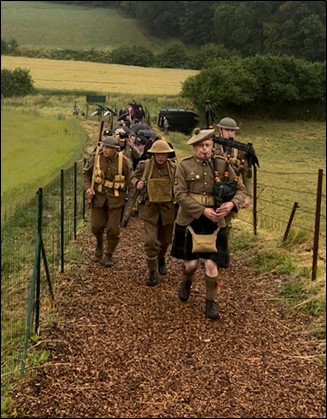
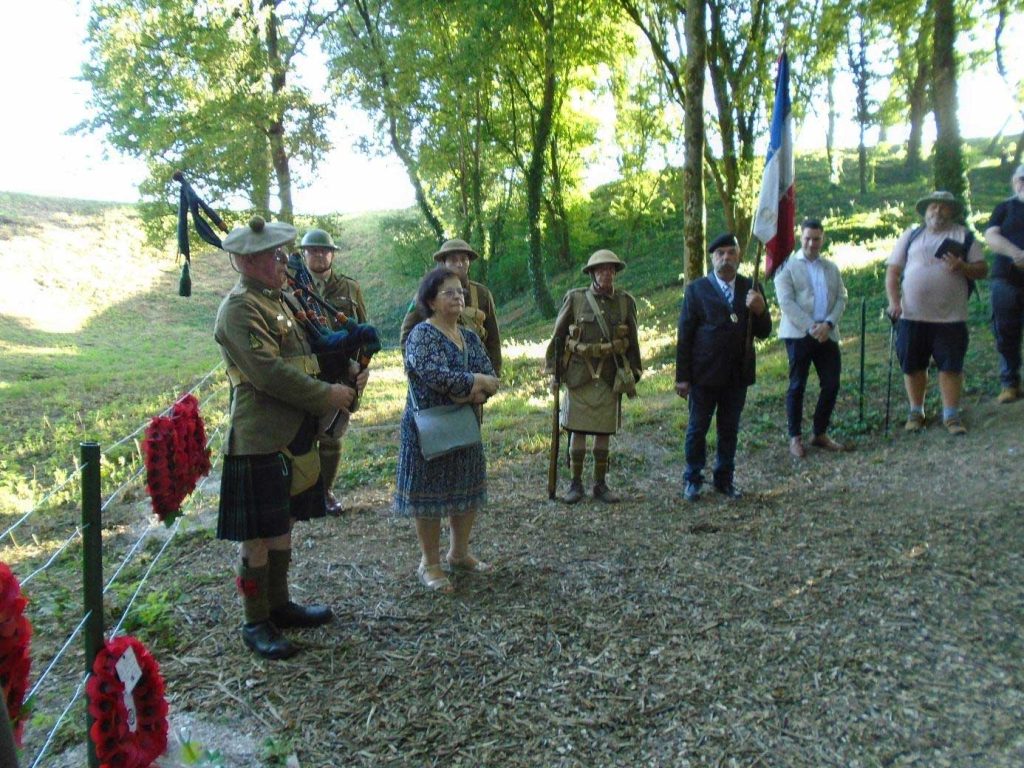
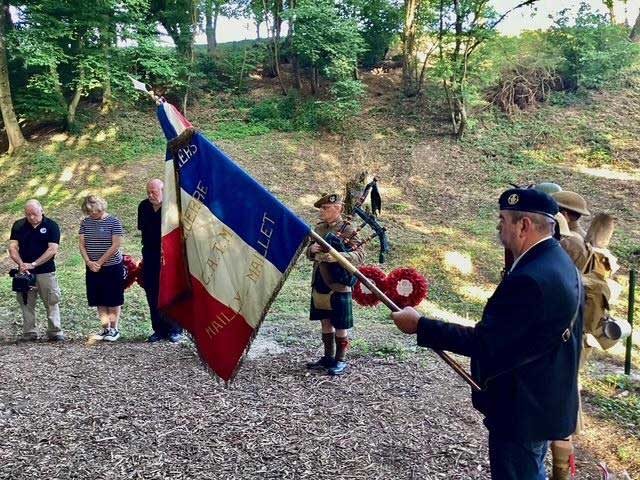
Following the completion of the ceremony at the Sunken Lane the vast majority walked up to the Hawthorn Crater behind the piper, Sylvain, who deserves the highest praise for completing the march up the steep hill in a khaki uniform and ever increasing temperatures. It was good to see the crater in such good order and thanks go to Francis Lavaquerie for strimming it all in the days before the ceremony – another notable feat of endurance in the hot weather!

At the crater Terry Berry, HRCA Chairman, and Madame Lavaquerie, Mayor of Beaumont Hamel, thanked everyone for attending and spoke of the significance of the day. After the exhortation was given by Rick Smith, the Last Post was played before observing a minute’s silence. The silence was broken by Sylvain playing Flowers of the Forest while wreaths, flowers and other tributes were laid. Thereafter everyone was invited to the village hall for refreshments.

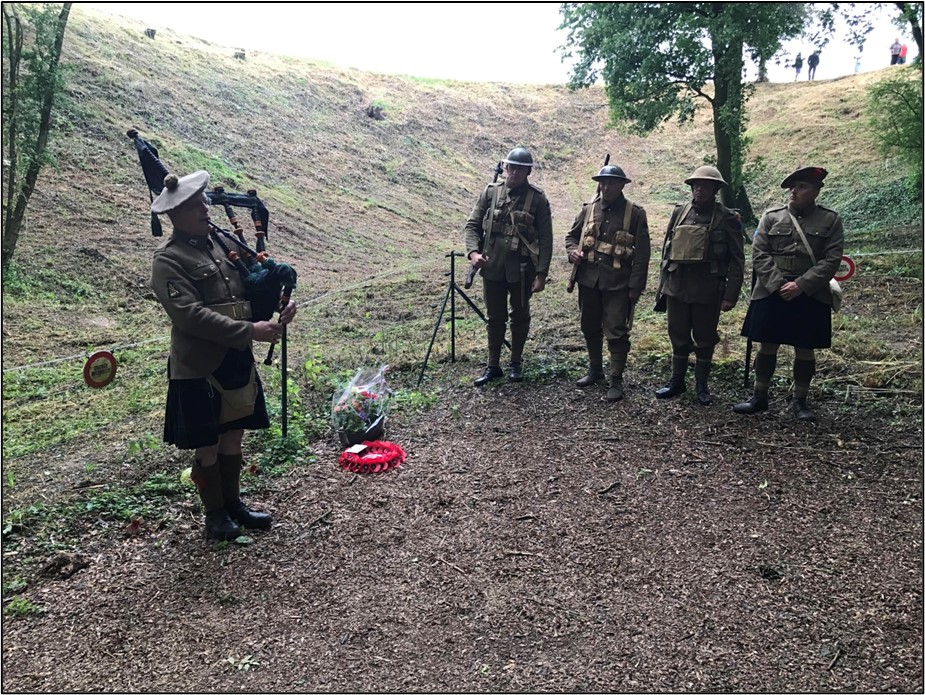
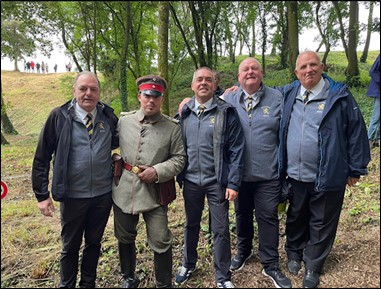
HRCA committee members, the Mayor of Beaumont Hamel, piper, local veterans’ standard bearer, re-enactors and Newfoundland Park representative paying their respects in Hawthorn Ridge Crater, 1 July 2025
Pictures by Derek Bird and Peter Wilkins.

The 252nd Tunnelling Company – March 1916.

March 1916 got off to a very bad start when on the first day of the month ‘the enemy blew a large camouflet at 11:57 a.m. directly east of RIII (2) (3) and by it destroyed 62 feet [19 metres] of our gallery. Sgt Dean and two sappers were working in the face at the time and were killed. It was impossible to get near the bodies. The strength of the German charge was probably about 3,000 lbs H.E.’ [pounds of High Explosive = 1,364 kg]. For the bravery shown during this incident both Sergeant Brown and Sapper Burns were awarded the Distinguished Conduct Medal. The citation for Sergeant Edward Brown stated that his award was: ‘For conspicuous devotion to duty in rescuing men who had been incapacitated after the blowing in of a camouflet. Later he re-entered the mine to rescue incapacitated tunnellers and worked strenuously till exhausted to extricate men who were entombed in a destroyed gallery’. Sapper John Burns’ citation reads: ‘For
conspicuous devotion to duty and disregard for danger. Following the explosion of an enemy mine, he rescued an injured comrade, and later carried out two others. Sapper Burns then returned to aid the rescue work under very dangerous conditions’.

The three dead tunnellers were subsequently buried together in Auchonvillers Military Cemetery. For some reason, despite the date of the incident being clearly recorded in the War Diary as being on 1 March, the three victims are shown on other records as dying on the 2nd, perhaps this was due to their fate not being confirmed until the time when their bodies were found and recovered.

Despite the loses, the tunnellers continued their work, although progress was slowed by No.2 Section, consisting of two officers and 61 other ranks, being detached on 6 March for duty with 174 Tunnelling Company at Bray for a month. Then, the following day, all work had to be stopped when the 107th Infantry Brigade, 36 th (Ulster) Division, who were manning the sector, were unable to supply any men to act as labourers.

Thereafter work soon picked up pace and on 12 March it was recorded that No.4 Section broke a record by driving a gallery 69 feet (21 metres) through chalk in 65 hours. Three days later mention is made of the choosing of the sites and the start of the new workings, HI and HII, on the Hawthorn Ridge. On 17 March they got revenge for the earlier losses when a 3,000 pound (1,364 kg) charge was fired at 6:30 a.m. at the end of RIII (2) (2) as ‘previous to the blow the enemy were heard with naked ear very close and above our gallery
but having past the point of charge and advanced towards our parapet. There is no doubt that the enemy were destroyed and his gallery blown in, a long depression being visible on the surface where his gallery collapsed’. Five days later the Germans retaliated by firing a large mine that cratered the ground just in front of the parapet of the British front line, but luckily no casualties were caused.

On the last day of March 1916 the British tunnellers exploded two more mines, one of 2,000 pounds (907 kg) of Ammonal at RII (1) (3) at 5 p.m. which ‘caught the enemy and destroyed their gallery’, followed 30 minutes later by similar charge at RIII (2) (4) which ‘destroyed the enemy gallery’.

On 7 March, due to German artillery fire, the company’s advanced billets, that had been in the cellars of houses in Auchonvillers, were moved to a tented site on the lawns of the chateaux at Beaussart. Unfortunately, on the 29th, a German aeroplane dropped two bombs on the camp at Beaussart and seriously injured four tunnellers, one of whom was to later die of his injuries – his story will be told in the next edition. A second attack was made the following day, but thankfully the five bombs dropped caused no damage.

Acting Sergeant Alfred Dean

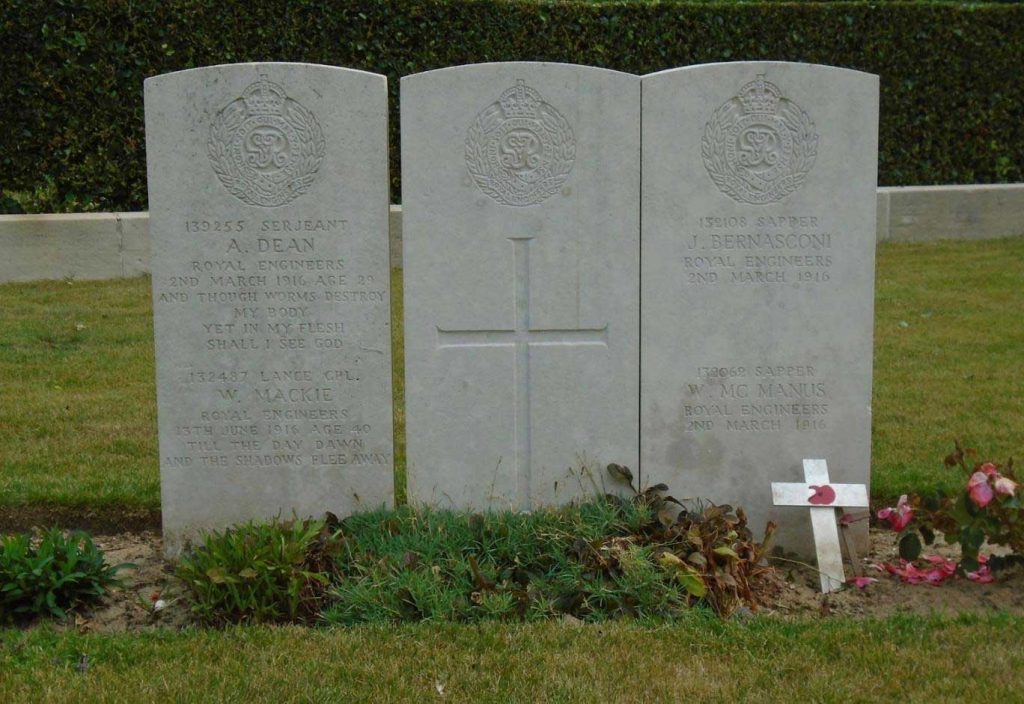
Unfortunately little has been discovered about 139255, Acting Sergeant, Albert Dean, but he appears to have arrived in France on 3 May 1915 as a member of the 4th Royal Fusiliers, and later transferred to the Royal Engineers. He was born at Audley, Staffordshire, to Daniel and Mary Dean in 1890. In 1911 he was living with his parents and three siblings at 220 Congleton Road, Talke, near Stoke-on-Trent, and was working underground as a coal loader. He is buried with the other two men who were killed in the explosion of 1 March 1916, and another who died a few months later, in Auchonvillers Military Cemetery, Grave Ref: II.A.14. His headstone has an unusual epitaph: ‘And though worms destroy my body yet in my flesh I shall see God’. He left his effects to his youngest sister, Annie Burton, who also received his War Gratuity.

Gravestones of 139255, Acting Sergeant, Albert Dean, 132062, Sapper, William McManus, and 132108, Sapper, James Bernasconi who were all killed in the explosion on 1 March 1916. Auchonvillers Military Cemetery, Somme, France.

Sapper William McManus

132062, Sapper, William McManus, was born in Batley, Yorkshire on 18 May 1884, but his mother, Mary Townsend, was unmarried and therefore his birth was recorded as William Townsend. However, Mary married Thomas McManus two years later and William thereafter used the McManus surname.

132062, Sapper, William McManus. Picture of William McManus courtesy of the Batley History Group.

In July 1902 he added two years to his age and enlisted into the King’s Royal Rifle Corps, but only served for 179 days before being given a free discharge. Returning to Batley he resumed mining, and in March 1905 William married Maggie Redgwick, a 21 year-old rag sorter – using his proper surname of Townsend on the marriage certificate. Unfortunately, William appears to have spent a short time in Wakefield Prison as a debtor in 1907, and by the 1911 Census he and Maggie were living, childless, at 38 Peel Street, Batley. In July 1911, however, Maggie reverted to her maiden name and left Britain for the USA to live with her aunt. The failure of the marriage may have been the catalyst for William to move to Darfield, near Barnsley, Yorkshire, where he was employed at the Mitchell Main Colliery for more than two years before enlisting into the Royal Engineers as a tunneller’s mate on 22 September 1915, using the McManus surname.

After being equipped and given a minimum of military training at the Royal Engineer’s Depot at Chatham, Kent, he arrived in France on 9 October and joined the 252 Tunnelling Company on the 21st. On 6 November he was remustered to tunneller. On 2 January 1916 he was admitted to hospital for an unspecified illness, and in mid-February he was found guilty of overstaying leave by 24 hours, for which the company commander, Major Trower, sentenced him to 14 day’s Field Punishment No.2 and fined him one day’s pay. His punishment was only completed the day before his death, thanks to 1916 being leap year.

His father, Thomas McManus, had been in receipt of a separation allowance while William was serving, and he was also awarded a five shillings a week pension payable from 3 October 1916, but unfortunately this was short-lived as Thomas died just 25 days later. Although he is generally commemorated under his assumed surname, McManus, he is named as William Townsend on the memorial at St. Mary of the Angels Catholic Church, Batley.

Thanks go to the ‘Past to Present Genealogy’ website and the Batley History Group for information.

Sapper James Bernasconi

132108, Sapper, James Bernasconi. Thanks go to Bernard Bernasconi for information that has helped to build the story of his grandfather.

The third man to die in the 1 March 1916 explosion was 132108, Sapper, James Bernasconi. James was born to James and Martha Bernasconi in 1884 at Leeds, Yorkshire. He married Ethel Haley in December 1910, and a son, Frederick, was born in January 1912. A second son, James, was born in September 1913, but unfortunately he died in July 1915.

James Bernasconi worked as a coal miner and enlisted at Leeds as a tunnellers mate on 23 September 1915 and, after the briefest training, embarked for France on 9 October to join 252 Tunnelling Company. Following his death in the explosion of 1 March 1916, enquiries were made on behalf of his widow regarding his personal effects namely ‘… a watch which she would like for her little boy if it had been found and his Rosary Beads’, however, it appears that these items were not forthcoming. His widow was subsequently awarded a pension of 15 shillings a week.

13 November 2025 Ceremonies

As usual there will be two ceremonies held at Beaumont Hamel on the morning of 13 November, the anniversary of the second mine explosion at the Hawthorn Redoubt and the subsequent capture of the village by the men of the 51st (Highland) Division. The first ceremony, that I organise on behalf of the Scotland (North) Branch of the Western Front Association, will be held at 10:30 a.m. at the 51st (Highland) Division flagstaff in the centre of the village. At its conclusion everyone is invited to walk up to the Hawthorn Crater for the HRCA ceremony, before returning to the village for refreshments.

Derek Bird

Newsletter Editor
derek.bird876@gmail.com

HRCA contact details: –
Website: www.hawthornridgeca.com
Email: enquiries@hawthornridgeca.com
Mobile: 07747 862014
Twitter: @HawthornRidgeCA
Facebook: Hawthorn Ridge Crater Association
The Crater News – Jul ’24

An occasional newsletter from the Hawthorn Ridge Crater Association (HRCA)
No. 5 – July 2024

Introduction

I am afraid that I was unable to produce a newsletter in the spring; my feeble excuse being that I was away in the Southern Hemisphere (and then Germany) for more than eight weeks. In this edition I report on the commemorations at Beaumont Hamel on 1 July, and I continue my look at the 252nd Tunnelling Company’s story and examine the first three months of their mining activities.

As always, should you have something of interest relating to the Hawthorn Craters or the surrounding area, let me know and we can add it to the association’s growing archive, and it might also be useful for use in future editions of this newsletter, or on the HRCA website.

1 July 2024

In the craters – L to R: Helen Basson
(translator), Derek Bird, Terry Berry
and Madame Lavaquerie
In the craters – L to R: Helen Basson
(translator), Derek Bird, Terry Berry
and Madame Lavaquerie

Unlike last year the weather was kind to us on the morning of 1 July, and people started assembling in the Sunken Lane from 7 a.m. onwards. Following the ceremony conducted by Andy Robertshaw at that location everyone moved up to the Hawthorn Crater behind the piper, Sylvain. Terry Berry, HRCA Chairman, and Madame Lavaquerie, Mayor of Beaumont Hamel, welcomed everyone to the craters before the exhortation was given by Rick Smith, the Last Post was played and a silence observed. During the playing of The Flowers of the Forest on the bagpipes, flowers and wreaths were laid. Afterwards many went to the vin d’honneur that was organised by the villagers in Beaumont Hamel. It was pleasing to see such a good attendance, a mix of locals and those from further afield, including our friends from the Brantwood Military Heritage Association in Northern Ireland.

Rick Smith and Terry Berry line up in front of the Bergwerk with the piper and the
French re-enactors who attended the ceremonies on 1 July.
Rick Smith and Terry Berry line up in front of the Bergwerk with the piper and the French re-enactors who attended the ceremonies on 1 July.

Some of us had travelled over to France a few days earlier prepared to do whatever as necessary to ensure that the site was in good order. Upon arrival, however, it was obvious that Francis from Beaumont Hamel had already done all the hard work with the paths being very tidy and the undergrowth in the crater cut back. Quite how he manages to do so much on his own, especially on the steepest sides of the crater, is a bit of a mystery, but we thank him for his continuing hard work.

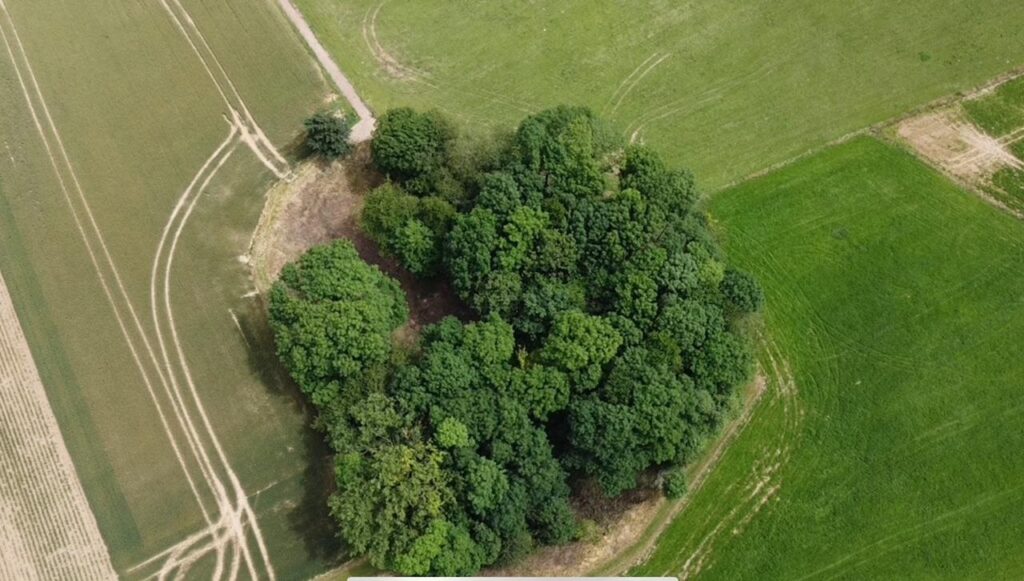
The Hawthorn Craters from above. Photo by Terry Berry
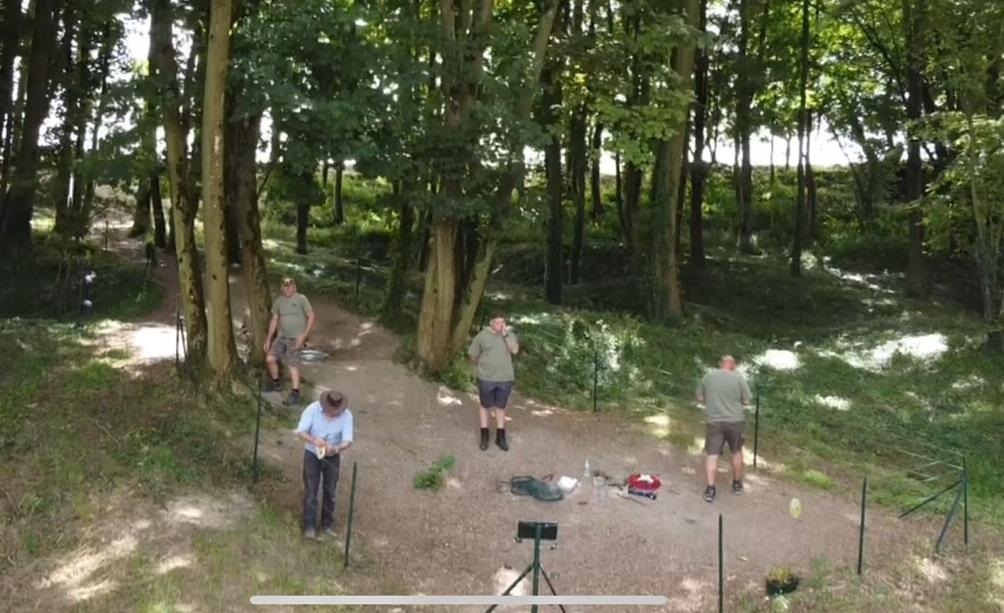
Danger: Men at Work! A wiring party (2024 style) carrying out some fence repairs.

The 252nd Tunnelling Company gets into its stride

Following their arrival in France on 21 October 1915, the 252nd Tunnelling Company was quickly moved forward to the area of the Redan Ridge and Beaumont Hamel. On 1 November the unit War Diary records ‘the Redan position was inspected and policy decided on’, and the following day ‘No.3 Section started work driving to meet the enemy mine which was approaching’. Meanwhile Nos. 1 & 2 sections had moved forward to Auchonvillers so as to be close by; they began work on two new tunnel entrances themselves on 2 and 3 November respectively.

The unit’s first offensive action then took place on 5 November when ‘No. 3 Section having driven 35 feet out and down to chalk exploded a mine of 500 lbs [230 kg] of guncotton and destroyed enemy gallery’. There followed a period of rapid progress; Mine R1 had reached 28 feet [8.6m] and R2 some 30 feet [9 m] on 12 November, and 101 feet [31m] and 91 feet [28m] respectively by the 20th. A week later they were at 131 feet and 133 feet [41m] respectively and, while cutting a station at the 65 foot [20m] level in R2, sounds of enemy mining was heard. Captain Trower ordered his men to prepare counter-measures and overnight a short tunnel was dug towards the enemy with a 3 foot x 3 foot [1m] chamber at the end. This was loaded with 980 lbs [445 kg] of guncotton and was tamped and ready by 4 p.m. on the 28th; the shaft was filled with sandbags to within 50 feet [15m] of the surface. The charge was blown at 4:30 p.m. and, with the enemy estimated to be within 30 or 40 feet it, is likely that they suffered a tunnel collapse and loss of life.

December 1915 saw the tunnellers developing an extensive network of galleries (R3 & R4 were started on 10 and 28 December respectively) under the Redan Ridge, largely without the interference of the enemy; although they did explode a charge near R2 on 21 December. This destroyed one of the minor galleries and caused slight damage to the main gallery; the British tunnellers suffered no casualties as they had fortunately been withdrawn 10 minutes before the explosion due to ‘bad air’. On the 27th Captain Logan, a Royal Army Medical Corps ‘gas expert’, visited to take gas samples and; ‘was overcome by CO [carbon monoxide] gas but quickly recovered’. One can only surmise that he was more of an expert after this event than before!

Also that day sounds of enemy digging were detected near R2 and a chamber was prepared 50 feet [15m] along the main gallery. This was charged with one ton of guncotton and Cheddite (a French commercial explosive normally used in quarrying) and fired at 1:45 a.m. on the 31 st. The end of the year saw the company recording that they had made the following progress on shafts, adits (sloping entrance ways) and galleries since starting work on 2 November:-
R1 458 feet [141m]
R2 494 feet [152m]
R3 249 feet [77m]
R4 Started work on adit.

Tit for tat explosions continued into 1916 with one occurring on 8 January: ‘At 3:30 a.m. the enemy exploded a large camouflet [a charge large enough to destroy tunnels but not sufficient to break the surface] to the south east and above the chamber of RIII [the War Diary uses both R3 and RIII in its pages] which was broken in. The south drive was also completely smashed in and two men were cut off and shut in the face of the south drive RIII (I). Rescue work was immediately started, the whole company taking shifts of three to five minutes. A new drive was started from the shaft through unbroken ground and 22 feet [7m] driven through solid chalk to the crushed drive. 48 feet [15m] was then driven through broken ground and the two men taken alive from the end of the tunnel after being entombed for 21 hours.’ The War Diary goes on to record that the company had dug 70 feet [21.5m] in 21 hours, 22 of them through solid chalk. That the two men survived the initial explosion, or did not succumb to a lack of oxygen or gases from the explosion, is miraculous, but thanks to their tunnelling mates they were rescued. Unfortunately, the names of these two fortunate men was not recorded in the War Diary.

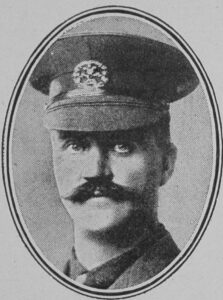
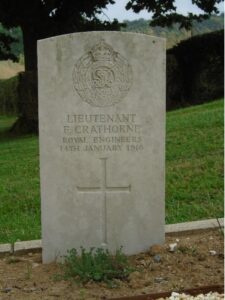
Lieutenant Frederick Crathorne

Another explosion was reported the following day, this time causing damage to R2: ‘this is the fifth time that the enemy has blown us and so far we have not lost a man’. Unfortunately the company did suffer a fatality five days later when, at 2 p.m. on the afternoon of the 14th , Lieutenant Frederick Crathorne was killed by a trench mortar shell while leading his men back to work: the War Diary records: ‘such a good officer will be sorely missed’.

Lieutenant Frederick Crathorne is buried in
Toutencourt Communal Cemetery
Grave I.B.5
Lieutenant Frederick Crathorne is buried in Toutencourt Communal Cemetery Grave I.B.5

Frederick Crathorne was born in Pietermarizburg, South Africa, on 31 August 1878. He served during the South African War and was awarded the Queen’s Medal with three clasps and the King’s Medal with two clasps. He then travelled to England for a three-year course at the Camborne School of Mines, and after graduating in 1906 returned to Africa and spent the rest of the pre-war years working in a number of African countries. He travelled back to Britain in early 1915 and was initially commissioned into the 11th (Service) Battalion, South Lancashire Regiment, but his valuable mining experience later saw his attachment to the Royal Engineers and subsequent joining of the 252nd Tunnelling Company on 4 November 1915.

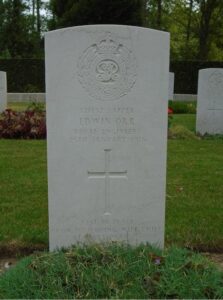
Sapper Edwin Orr is buried in Auchonvillers Military Cemetery, Grave
II.A.28.
Sapper Edwin Orr is buried in Auchonvillers Military Cemetery, Grave
II.A.28.

At 7:20 p.m. on 24 January the Germans blew another camouflet to the south east of RII (I) which caused little damage to the gallery but closed the end, killing one man and injuring another. Unfortunately their names are not recorded but, from the evidence available, I think that 27 year-old Sapper Edwin Orr was most likely the man killed in the tunnel. He was born in Halifax, Yorkshire, and was living with his wife, Emily, at nearby Liversedge at the time of his enlistment. He had arrived in France on 2 October 1915 and appears to have joined the 252nd Tunnelling Company upon its formation later that month. He is buried in Auchonvillers Military Cemetery, Grave II.A.28.

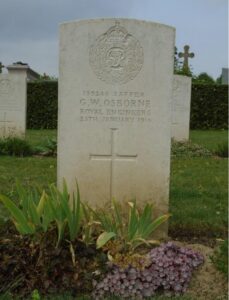
Sapper George Osborne is buried
in Mailly-Maillet Communal Cemetery Extension,
Grave C.13.
Sapper George Osborne is buried
in Mailly-Maillet Communal Cemetery Extension,
Grave C.13.

The following day another man was killed and one wounded when shellfire hit their billet in Auchonvillers. I believe that the man killed was most likely 34 year-old Sapper George Osborne, who was born in Leicester. He was married with two children, a boy born in 1911 and a girl born in 1913, and the family were living in Grimsby. He had originally served with the 1st Battalion, Cameronians (Scottish Rifles), and had arrived in France as early as 1 September 1914, which indicates that he was either a regular soldier or, most likely, a recalled reservist as his battalion had arrived two weeks previously. At some stage he transferred to the Royal Engineers and joined the 252nd Tunnelling Company. He is buried in Mailly-Maillet Communal Cemetery Extension, Grave C.13. It appears that family circumstances were difficult as his widow is noted on pension records as being ‘unworthy’ and her pension withheld, although the child’s element was put in trust and administered by the Soldiers’ and Sailors’ Families Association. It would appear that circumstances did improve and the decision was taken to start paying her pension in early 1917, however, the whole family’s pension income would still be controlled, this time by the National Society for the Prevention of Cruelty to Children. The situation appears to have continued to improve and in early 1918 instructions were given that she could receive the pension direct and this must have been most welcome, however, it was for a reduced amount as a month earlier her son had died, just three days short of his seventh birthday. The Osborne family’s story is a tragic one.

January 1916 was rounded off by the explosion of a 3,000 pound [1,364 kg] charge of guncotton placed in a chamber off gallery RIII (I) (2). Fired at 1:35 a.m. on the 27th it was noted that ‘the enemy were close at the time’ so almost certainly sustained casualties. The tunnellers had achieved much in their first three months digging and had begun to force the German tunnellers back across the Redan Ridge towards their own lines, however, this came at a cost of an officer and two men killed, one of them underground (I wrote about the earlier accidental death of Sapper James McCarthy in The Crater News No.2).

Membership Report

Rick Smith is now looking to gather in membership fees for 2024. These are maintained at just £10 per annum.

For information on membership, please contact Rick at rick@hawthornridgeca.com

And Finally

Ceremonies will be held at Beaumont Hamel on 13 November to mark the capture of the village by the 51st (Highland) Division and the 108th anniversary of the second blow of the Hawthorn Mine that signalled the start of the attack. Firstly, the one I organise on behalf of the Scotland (North) Branch of the Western Front Association will commence at the 51st (Highland) Division flagstaff in the centre of Beaumont Hamel at 10:30 a.m. Thereafter everyone is invited to proceed to the craters for a second ceremony, before returning to the village for refreshments. All are welcome to join us.

Derek Bird

Newsletter Editor
derek.bird876@gmail.com

HRCA contact details: –
Website: www.hawthornridgeca.com
Email: enquiries@hawthornridgeca.com
Mobile: 07747 862014
Twitter: @HawthornRidgeCA
Facebook: Hawthorn Ridge Crater Association
The Crater News – Jul ’23

An occasional newsletter from the Hawthorn Ridge Crater Association (HRCA)
No. 3 – July 2023

Introduction

Photograph courtesy of Terry Berry

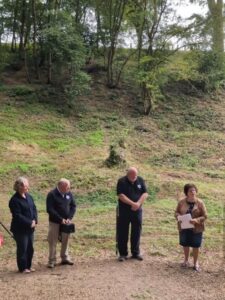
I am pleased to report that despite an overcast and damp start to the day there was a good turnout for the ceremonies at Beaumont Hamel on 1 July.  The morning started at the Sunken Lane with the issue of the rum ration at the ceremony organised by Andy Robertshaw.  Then, in the minutes before 7:30 a.m., he gave a brief overview of events on the morning of 1 July 1916, such as the appearance of cinematographer Geoffrey Malins in the Sunken Lane, to the blowing of the Hawthorn Mine at 7:20 a.m.  At 7:30 a.m. he blew his whistle and, after a few moments for reflection, he blew it for a second time and asked everyone to open the envelope they had been given to see the fate of one of those present on 1 July 1916.

Then everyone followed the piper to the Hawthorn Craters where a short ceremony was held and wreaths were laid on behalf of the HRCA and the Brantwood Military Heritage Association, Belfast.  Flowers were laid by Madame Lavaquerie, Mayor of Beaumont Hamel, on behalf of the village.  Following this the participants were invited to the village hall in Beaumont Hamel for refreshments, which were most welcome as we had all had an early start and many had not yet had any breakfast.

Local piper, Sylvain, plays the Flowers of the Forest in the crater as French re-enactors look on.
Photograph courtesy of Peter Wilkins

Two of the re-enactors at the rim of the Hawthorn Craters, with the spire of Beaumont Hamel Church in the background.

Photograph courtesy of Peter Wilkins

Neil Black (centre) and fellow Brantwood Military Heritage Association (BMHA) members from Northern Ireland take a prisoner!

Special thanks must go to the BMHA for making a generous donation to the HRCA on the day.

Photograph courtesy of Terry Berry

Tunnelling Operations

For this edition I thought that a brief overview of the background to the tunnelling operations would be useful as some of you may not be familiar with this aspect of the story.  Therefore our tunnelling ‘guru’ Colin Lukas-Winn has provided me with an article giving a history of military mining: –

Military mining has been around for centuries when it was first used for undermining walls of fortifications where the wooden props the miners inserted were set fire to and the walls would collapse.  The invention of explosives greatly increased the damage the miners could do, and as more powerful explosives were developed they became capable of ‘lifting’ large quantities of earth from much greater depths.  This increase in mining depths also helped to avoid detection and made mining a much feared and almost invisible weapon.  During the Great War the Germans began using mine to great effect in early 1915 and caused much shock amongst their enemies.  This led to the rapid establishment of the Tunnelling Companies (TC) within the Royal Engineers (RE), under the direction of John Norton Griffiths.

Norton Griffiths, known as ‘Empire Jack’ because of his fierce patriotism, was a wealthy contractor who specialised in digging sewers in places like Manchester, Liverpool and London, with his ‘Clay Kickers’ using a unique method to remove the clay under city streets.  A man would lie against an angled board and use both legs to push a special spade into the clay and remove a large ‘spit’ of material, the angled board allowed the kicker to use both legs and thereby his strongest muscles in tandem.  The spit would be removed by another man and passed back to clear the spoil away, an extremely effective way of digging rapidly.  Norton Griffiths realised the technique would be ideal in the clay found in Flanders, so he wrote to the War Office outlining his ideas and techniques.  He received no reply; his letter was simply filed away under ‘M’ for moles.  Once the Germans fired their first mines, consternation ran through the British command, with someone finally telling Kitchener about the letter that had been filed away.  Immediately Norton Griffiths was summoned to see Kitchener, where he gave a graphic demonstration of clay kicking on the office carpet and explained the rate of progress he thought would be easily attainable under the battlefields.  The effect was astonishing and Kitchener appointed Norton Griffiths to head up the formation of specialist Tunnelling Companies within the RE and demanded 10,000 men immediately.  Kitchener was told this was impossible but he still sent Griffiths away to recruit every man he could with underground experience.  Griffiths sought out those in the Army in the UK who had worked underground in any capacity, then travelled to France and Flanders visiting every battalion in and out of the line where he pulled men away, much to the chagrin of local commanders who would be losing valuable men.  Griffiths placated these commanders with bottle of whisky or brandy from a stock he carried in the boot of his Rolls Royce motor car!  Within days men began to arrive at the RE barracks in Chatham for induction; it was realised that civilian recruits would not need full military training as they would simply be digging and would never be serving in the conventional way in the trenches.  Therefore their training was only a week or so long, with a rudimentary medical check before they were shipped over to France.  RE commanders were horrified by this state of affairs, expressing strong views on the ‘ragtag ragamuffins’ now wearing the proud colours of their corps, these objections were quickly and firmly put down by the High Command citing the vital nature of the tunnellers’ work.

A great number of the men recruited would never have got into the regular Army as they tended to be older and not always in the best of health, but their knowledge of tunnelling techniques overrode every objection against their employment.  An interesting point raised by Griffiths was the subject of pay, a British private received a basic shilling a day whereas the tunnellers were given a pay rate to match what they had been earning in the civilian mines, six shillings a day.  This naturally caused some bad feelings amongst the troops when it became common knowledge, the result being that the rate was adjusted with only specialist men being given the six-shilling rate with ‘tunnellers mates’ being paid two-shillings-and-two-pence a day.  The question that arises then is why would a man getting six shillings a day in a civilian mine that was relatively safe (notwithstanding tunnel collapses and gas) volunteer to go into a front line situation for the same pay?  Simply it came down to security; in civilian life the mines were privately owned until 1947 and if a man was killed underground his family received little or no compensation, but in the Army if the worst happened his family would receive a military pension.  This was a big enticement in the severe financial situation prevalent during those times, and so hundreds of men from all corners of the country answered the call and gave sterling service, but sadly many paid the ultimate price for their endeavours.  One of the most interesting aspects of the tunnelling work was the marked difference in techniques employed in Flanders as opposed to the Somme, for instance.  In Flanders the ground was a layer of dark red clay based topsoil some 2 to 12 feet thick, below this was a layer of ‘schwimmersand’ which could be 20 feet or so thick and was a glutinous, wet, sandy loam which flowed like water and would fill up any hole within minutes.  Below this was the infamous Blue Clay, which was disliked immensely by the British and, although dark red in colour underground, when brought to the surface and exposed to oxygen it turned a bright blue colour.  This made it difficult to conceal spoil brought up from below and also gave a clear indication to German observers of the depths the British tunnellers were working at.  Early attempts to camouflage the spoil involved throwing rapid-growing mustard seeds over the clay at night, this would result in a green covering by morning, although as time went on and the entire battle areas turned into a brown slush even the green stood out.  Attempts at concealment ceased when it was realised that both sides knew their opponents were tunnelling and concealment was not only pointless but a waste of men’s time and effort.

The actual galleries and tunnels had to be fully shored and supported by iron and oak planking with constant pumping to remove the all pervading water which seeped constantly into the workings.  A fascinating insight into the ingenuity of the tunnellers comes from the method of driving a shaft down through the ‘schwimmersand’.  They used screw jacks to force iron hoops down, putting one hoop on top of another to create a vertical tube and then removing the material from inside the tube until the required depth had been reached and a gallery could be driven horizontally towards the lines.

Completely different techniques were used in chalk based areas such as the Somme, where there was little or no need for shoring as the galleries were self-supporting if dug in the correct arched shape, some tunnellers even found ‘slabbing’ where there was a natural horizontal fissure in the chalk and this could be used as the gallery roof.  Similarly shafts could simply be dug without hoops or shoring, these were generally 4 feet square and up to 100 feet deep, the only notable downside to digging chalk was that, much the same as blue clay, the spoil was instantly recognisable as a vivid white scar on the landscape although very quickly all attempts at concealment were given up for the same reasons as in Flanders.  Another point which became obvious to the tunnellers was the fact that as they dug deeper, the chalk became darker in colour and much harder, making progress painfully slow in some areas.  The War Diary for 179 TC at La Boisselle reveals a rate of advance of only 18 inches per day, and some of the galleries there are 600 yards long at depths of 80 and 100 feet, a phenomenal effort by the wiry, tough miners.

These men had to contend with not only all the normal dangers of working underground, but also the added threat of retaliation by the enemy in the form of counter charges known as ‘camoflets’.  These small charges were laid close to enemy workings and blown to collapse the gallery and entomb the men working therein, a brutal, vicious form of no holds barred warfare.  To this end, both sides employed listening officers and silent working techniques to help negate the threat of entombment.  Men worked without boots or metal items on their clothing, they rarely spoke and then only in whispers, and they prised chunks of fractured chalk out as opposed to digging with picks and chisels.  The listeners employed several methods to detect enemy activity.  To begin with a simple tin of water which would show ripples from the vibration of digging was used, then listening sticks placed between the ear and the ground to pick up noises, and finally the Geophone came into use.  This device was like a doctor’s stethoscope with two mica discs encased in small round cases which could be placed at different positions on the ground whilst the operator listened through the earpieces.  A skilled Geophone operator could detect workings up to 250 feet away and could even vector onto the sounds to give a heading, then retaliatory work could begin to deal with the enemy.  There are recorded cases of deliberate enticement underground by the use of dummy picks, these simple devices were placed in a disused gallery or listening post and would mimic the noise of digging.  The enemy would dig towards the dummy workings, where a charge had been placed in readiness.  When the listening officers deemed the enemy were close by the charge was blown.  Then the officer would wait until he could detect a rescue party digging towards the entombed men, and order a second charge be laid and blown.  No quarter was given or expected underground.

Instances were recorded in both France and Flanders of tunnellers breaking through into an enemy gallery where in the inky blackness fierce hand-to-hand fighting took place.  One technique employed by the British was to feel the shoulder of a man nearby, if he wore epaulettes he was German as such adornments were strictly forbidden in British and French workings, then a swift stab into the neck from the highly effective tunnellers knife would deal with the enemy.  One or two cases of fire-fights with pistols and rifles are recorded, indeed examples of shortened Lee Enfield rifles have been found that would enable their use in the narrow confines of the galleries, but these events do not appear to have been commonplace.

It can be seen that the tunnellers world was one fraught with danger from many causes underground such as the threat of collapse, gas from old explosions (a threat even today in chalk as the substrate holds gas for years), the enemy breaking into the tunnels or firing a ‘camoflet’.  They were of course not safe above ground as they had to pass through the trenches to get to and from their billets, which could be several miles away, many miners were killed by a random long-distance shell.  And yet, throughout the mining campaign, there are no recorded instances of mining being delayed due to a shortage of manpower.  The only part of the manpower which intensely disliked the mining activities were the infantry attached as working parties to remove the spoil.  The tunnellers’ skills were considered too valuable to waste time on spoil removal so ‘resting’ troops would be drafted in to carry out the task, a universally hated detail, but a very necessary one.

Some further reading ideas: –

Tunnel-master and Arsonist of the Great War: The Norton-Griffiths Story by Tony Bridgland and Anne Morgan. Leo Cooper, 2003.  ISBN 0-85052-995-6

War Underground: The Tunnellers of The Great War by Alexander Barrie.  Tom Donovan Publishing, 1961.  ISBN 1-871085-00-4

The Underground War: Vimy Ridge to Arras by Phillip Robinson and Nigel Cave.  Pen & Sword, 2011.  ISBN9718-1-84415-976-5

Short Film

Steve Benson has kindly produced a short film (less than 9 minutes running time) showing the Hawthorn Crater and its immediate surrounds.  The clever thing is that he has managed to combine modern images from a drone, Google Earth etc. with film, photographs and trench maps from 1916 to help explain the battlefield.  It can be viewed on the HRCA Facebook page.

Site Leaflets

Some of you will be aware that work has been underway for some time to produce leaflets explaining the Hawthorn Crater site.  The English and French versions are now on the HRCA website and can be downloaded and copies have also been placed in a number of strategic locations in the Beaumont Hamel area.  The German version is well advanced and should be available via the website in the not too distant future.

13 November 2023 Commemorations

There will be two ceremonies at Beaumont Hamel on the morning of 13 November, the 107th anniversary of the blowing of the second mine at the Hawthorn Redoubt and the subsequent capture of the village by the men of the 51st (Highland) Division.  The first will take place at 10:30 a.m. at the Highland Division flagstaff in the centre of the village.  Thereafter we will proceed to the Hawthorn Craters for another ceremony – all are welcome to attend and anyone can lay wreaths, flowers or other tributes if they wish to.  Following the ceremonies we will return to the village for a vin d’honneur in the village hall.

It is also anticipated that tours of the craters will be available on 13 November, and possibly on the days either side – use the contact details below to see what can be arranged.

Membership Report

A reminder that membership is currently maintained at just £10 per annum (you are of course welcome to give more), and by setting up a standing order you won’t forget in future.

Your £10 will help to fund all the work necessary at the crater over the coming year, plus it will support our website through which we aim to spread word of the crater’s history and the work of the HRCA to preserve it.

For information on membership, please contact Rick at rick@hawthornridgeca.com

And Finally

I am pleased that during my July visit to the Somme I was able to visit the graves of all the 252 Tunnelling Company men who died in 1915 and 1916, including those who died of wounds in Base Hospitals as far away as Rouen.  Now, armed with photographs of their graves, some further research will hopefully allow me to tell their stories in future newsletters.  If anyone has any information on these men (or indeed any other aspect of the 252 TC’s activities) I would be delighted to hear from you.

Derek Bird

Newsletter Editor
derek.bird876@gmail.com

HRCA contact details: –
Website: www.hawthornridgeca.com
Email: enquiries@hawthornridgeca.com
Mobile: 07747 862014
Twitter: @HawthornRidgeCA
Facebook: Hawthorn Ridge Crater Association