An occasional newsletter from the Hawthorn Ridge Crater Association (HRCA)
No. 3 – July 2023
Introduction
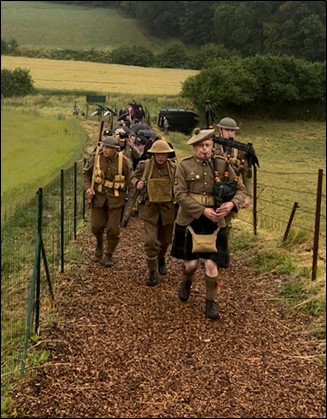
I am pleased to report that despite an overcast and damp start to the day there was a good turnout for the ceremonies at Beaumont Hamel on 1 July. The morning started at the Sunken Lane with the issue of the rum ration at the ceremony organised by Andy Robertshaw. Then, in the minutes before 7:30 a.m., he gave a brief overview of events on the morning of 1 July 1916, such as the appearance of cinematographer Geoffrey Malins in the Sunken Lane, to the blowing of the Hawthorn Mine at 7:20 a.m. At 7:30 a.m. he blew his whistle and, after a few moments for reflection, he blew it for a second time and asked everyone to open the envelope they had been given to see the fate of one of those present on 1 July 1916.
Then everyone followed the piper to the Hawthorn Craters where a short ceremony was held and wreaths were laid on behalf of the HRCA and the Brantwood Military Heritage Association, Belfast. Flowers were laid by Madame Lavaquerie, Mayor of Beaumont Hamel, on behalf of the village. Following this the participants were invited to the village hall in Beaumont Hamel for refreshments, which were most welcome as we had all had an early start and many had not yet had any breakfast.
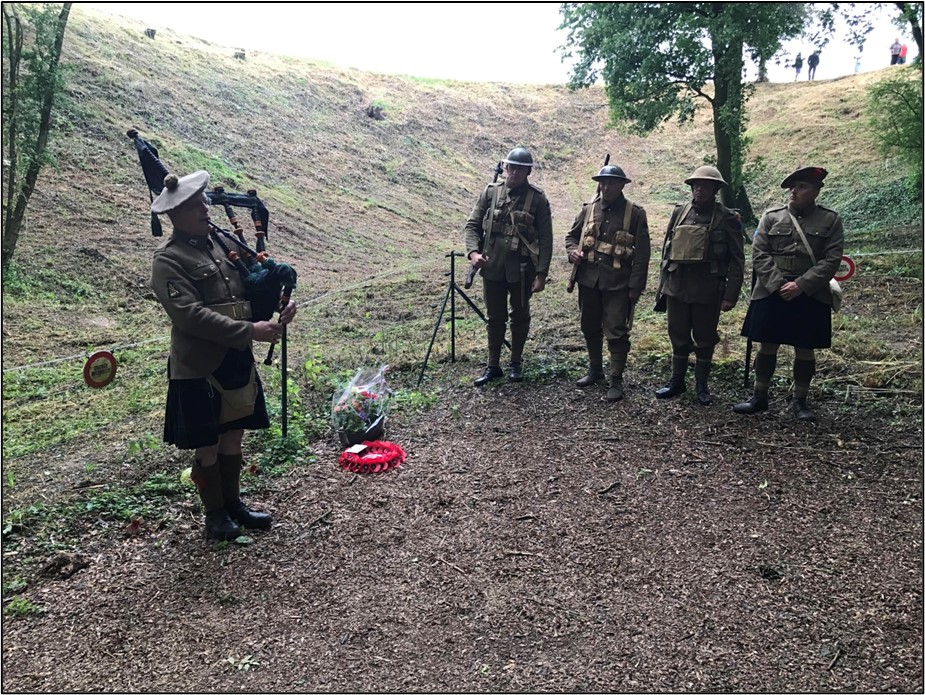
Photograph courtesy of Peter Wilkins
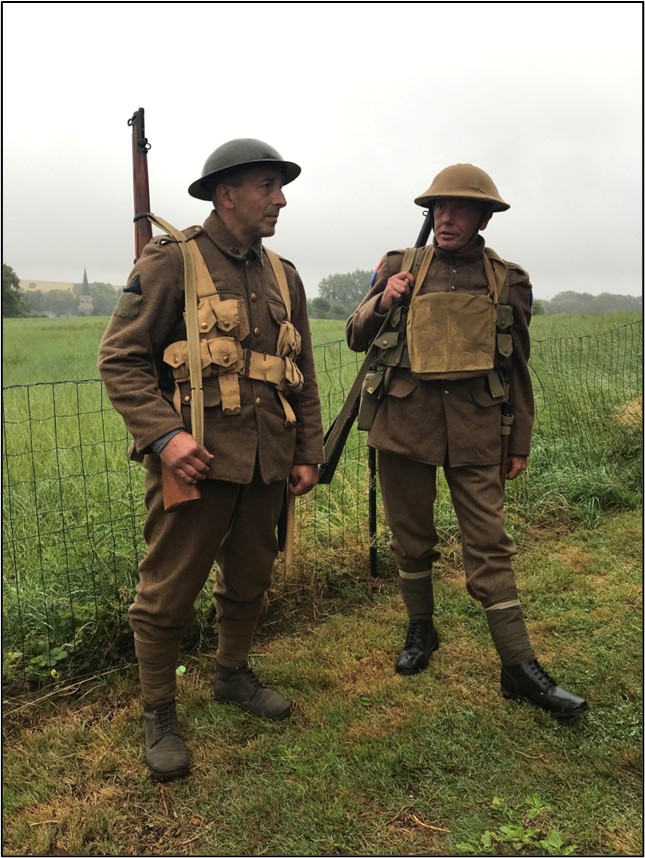
Two of the re-enactors at the rim of the Hawthorn Craters, with the spire of Beaumont Hamel Church in the background.
Photograph courtesy of Peter Wilkins
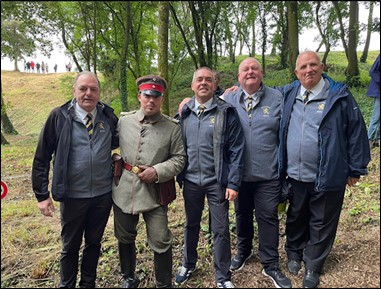
Neil Black (centre) and fellow Brantwood Military Heritage Association (BMHA) members from Northern Ireland take a prisoner!
Special thanks must go to the BMHA for making a generous donation to the HRCA on the day.
Photograph courtesy of Terry Berry
Tunnelling Operations
For this edition I thought that a brief overview of the background to the tunnelling operations would be useful as some of you may not be familiar with this aspect of the story. Therefore our tunnelling ‘guru’ Colin Lukas-Winn has provided me with an article giving a history of military mining: –
Military mining has been around for centuries when it was first used for undermining walls of fortifications where the wooden props the miners inserted were set fire to and the walls would collapse. The invention of explosives greatly increased the damage the miners could do, and as more powerful explosives were developed they became capable of ‘lifting’ large quantities of earth from much greater depths. This increase in mining depths also helped to avoid detection and made mining a much feared and almost invisible weapon. During the Great War the Germans began using mine to great effect in early 1915 and caused much shock amongst their enemies. This led to the rapid establishment of the Tunnelling Companies (TC) within the Royal Engineers (RE), under the direction of John Norton Griffiths.
Norton Griffiths, known as ‘Empire Jack’ because of his fierce patriotism, was a wealthy contractor who specialised in digging sewers in places like Manchester, Liverpool and London, with his ‘Clay Kickers’ using a unique method to remove the clay under city streets. A man would lie against an angled board and use both legs to push a special spade into the clay and remove a large ‘spit’ of material, the angled board allowed the kicker to use both legs and thereby his strongest muscles in tandem. The spit would be removed by another man and passed back to clear the spoil away, an extremely effective way of digging rapidly. Norton Griffiths realised the technique would be ideal in the clay found in Flanders, so he wrote to the War Office outlining his ideas and techniques. He received no reply; his letter was simply filed away under ‘M’ for moles. Once the Germans fired their first mines, consternation ran through the British command, with someone finally telling Kitchener about the letter that had been filed away. Immediately Norton Griffiths was summoned to see Kitchener, where he gave a graphic demonstration of clay kicking on the office carpet and explained the rate of progress he thought would be easily attainable under the battlefields. The effect was astonishing and Kitchener appointed Norton Griffiths to head up the formation of specialist Tunnelling Companies within the RE and demanded 10,000 men immediately. Kitchener was told this was impossible but he still sent Griffiths away to recruit every man he could with underground experience. Griffiths sought out those in the Army in the UK who had worked underground in any capacity, then travelled to France and Flanders visiting every battalion in and out of the line where he pulled men away, much to the chagrin of local commanders who would be losing valuable men. Griffiths placated these commanders with bottle of whisky or brandy from a stock he carried in the boot of his Rolls Royce motor car! Within days men began to arrive at the RE barracks in Chatham for induction; it was realised that civilian recruits would not need full military training as they would simply be digging and would never be serving in the conventional way in the trenches. Therefore their training was only a week or so long, with a rudimentary medical check before they were shipped over to France. RE commanders were horrified by this state of affairs, expressing strong views on the ‘ragtag ragamuffins’ now wearing the proud colours of their corps, these objections were quickly and firmly put down by the High Command citing the vital nature of the tunnellers’ work.
A great number of the men recruited would never have got into the regular Army as they tended to be older and not always in the best of health, but their knowledge of tunnelling techniques overrode every objection against their employment. An interesting point raised by Griffiths was the subject of pay, a British private received a basic shilling a day whereas the tunnellers were given a pay rate to match what they had been earning in the civilian mines, six shillings a day. This naturally caused some bad feelings amongst the troops when it became common knowledge, the result being that the rate was adjusted with only specialist men being given the six-shilling rate with ‘tunnellers mates’ being paid two-shillings-and-two-pence a day. The question that arises then is why would a man getting six shillings a day in a civilian mine that was relatively safe (notwithstanding tunnel collapses and gas) volunteer to go into a front line situation for the same pay? Simply it came down to security; in civilian life the mines were privately owned until 1947 and if a man was killed underground his family received little or no compensation, but in the Army if the worst happened his family would receive a military pension. This was a big enticement in the severe financial situation prevalent during those times, and so hundreds of men from all corners of the country answered the call and gave sterling service, but sadly many paid the ultimate price for their endeavours. One of the most interesting aspects of the tunnelling work was the marked difference in techniques employed in Flanders as opposed to the Somme, for instance. In Flanders the ground was a layer of dark red clay based topsoil some 2 to 12 feet thick, below this was a layer of ‘schwimmersand’ which could be 20 feet or so thick and was a glutinous, wet, sandy loam which flowed like water and would fill up any hole within minutes. Below this was the infamous Blue Clay, which was disliked immensely by the British and, although dark red in colour underground, when brought to the surface and exposed to oxygen it turned a bright blue colour. This made it difficult to conceal spoil brought up from below and also gave a clear indication to German observers of the depths the British tunnellers were working at. Early attempts to camouflage the spoil involved throwing rapid-growing mustard seeds over the clay at night, this would result in a green covering by morning, although as time went on and the entire battle areas turned into a brown slush even the green stood out. Attempts at concealment ceased when it was realised that both sides knew their opponents were tunnelling and concealment was not only pointless but a waste of men’s time and effort.
The actual galleries and tunnels had to be fully shored and supported by iron and oak planking with constant pumping to remove the all pervading water which seeped constantly into the workings. A fascinating insight into the ingenuity of the tunnellers comes from the method of driving a shaft down through the ‘schwimmersand’. They used screw jacks to force iron hoops down, putting one hoop on top of another to create a vertical tube and then removing the material from inside the tube until the required depth had been reached and a gallery could be driven horizontally towards the lines.
Completely different techniques were used in chalk based areas such as the Somme, where there was little or no need for shoring as the galleries were self-supporting if dug in the correct arched shape, some tunnellers even found ‘slabbing’ where there was a natural horizontal fissure in the chalk and this could be used as the gallery roof. Similarly shafts could simply be dug without hoops or shoring, these were generally 4 feet square and up to 100 feet deep, the only notable downside to digging chalk was that, much the same as blue clay, the spoil was instantly recognisable as a vivid white scar on the landscape although very quickly all attempts at concealment were given up for the same reasons as in Flanders. Another point which became obvious to the tunnellers was the fact that as they dug deeper, the chalk became darker in colour and much harder, making progress painfully slow in some areas. The War Diary for 179 TC at La Boisselle reveals a rate of advance of only 18 inches per day, and some of the galleries there are 600 yards long at depths of 80 and 100 feet, a phenomenal effort by the wiry, tough miners.
These men had to contend with not only all the normal dangers of working underground, but also the added threat of retaliation by the enemy in the form of counter charges known as ‘camoflets’. These small charges were laid close to enemy workings and blown to collapse the gallery and entomb the men working therein, a brutal, vicious form of no holds barred warfare. To this end, both sides employed listening officers and silent working techniques to help negate the threat of entombment. Men worked without boots or metal items on their clothing, they rarely spoke and then only in whispers, and they prised chunks of fractured chalk out as opposed to digging with picks and chisels. The listeners employed several methods to detect enemy activity. To begin with a simple tin of water which would show ripples from the vibration of digging was used, then listening sticks placed between the ear and the ground to pick up noises, and finally the Geophone came into use. This device was like a doctor’s stethoscope with two mica discs encased in small round cases which could be placed at different positions on the ground whilst the operator listened through the earpieces. A skilled Geophone operator could detect workings up to 250 feet away and could even vector onto the sounds to give a heading, then retaliatory work could begin to deal with the enemy. There are recorded cases of deliberate enticement underground by the use of dummy picks, these simple devices were placed in a disused gallery or listening post and would mimic the noise of digging. The enemy would dig towards the dummy workings, where a charge had been placed in readiness. When the listening officers deemed the enemy were close by the charge was blown. Then the officer would wait until he could detect a rescue party digging towards the entombed men, and order a second charge be laid and blown. No quarter was given or expected underground.
Instances were recorded in both France and Flanders of tunnellers breaking through into an enemy gallery where in the inky blackness fierce hand-to-hand fighting took place. One technique employed by the British was to feel the shoulder of a man nearby, if he wore epaulettes he was German as such adornments were strictly forbidden in British and French workings, then a swift stab into the neck from the highly effective tunnellers knife would deal with the enemy. One or two cases of fire-fights with pistols and rifles are recorded, indeed examples of shortened Lee Enfield rifles have been found that would enable their use in the narrow confines of the galleries, but these events do not appear to have been commonplace.
It can be seen that the tunnellers world was one fraught with danger from many causes underground such as the threat of collapse, gas from old explosions (a threat even today in chalk as the substrate holds gas for years), the enemy breaking into the tunnels or firing a ‘camoflet’. They were of course not safe above ground as they had to pass through the trenches to get to and from their billets, which could be several miles away, many miners were killed by a random long-distance shell. And yet, throughout the mining campaign, there are no recorded instances of mining being delayed due to a shortage of manpower. The only part of the manpower which intensely disliked the mining activities were the infantry attached as working parties to remove the spoil. The tunnellers’ skills were considered too valuable to waste time on spoil removal so ‘resting’ troops would be drafted in to carry out the task, a universally hated detail, but a very necessary one.
Some further reading ideas: –
Tunnel-master and Arsonist of the Great War: The Norton-Griffiths Story by Tony Bridgland and Anne Morgan. Leo Cooper, 2003. ISBN 0-85052-995-6
War Underground: The Tunnellers of The Great War by Alexander Barrie. Tom Donovan Publishing, 1961. ISBN 1-871085-00-4
The Underground War: Vimy Ridge to Arras by Phillip Robinson and Nigel Cave. Pen & Sword, 2011. ISBN9718-1-84415-976-5
Short Film
Steve Benson has kindly produced a short film (less than 9 minutes running time) showing the Hawthorn Crater and its immediate surrounds. The clever thing is that he has managed to combine modern images from a drone, Google Earth etc. with film, photographs and trench maps from 1916 to help explain the battlefield. It can be viewed on the HRCA Facebook page.
Site Leaflets
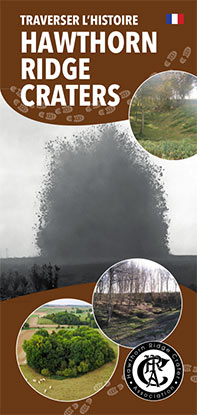
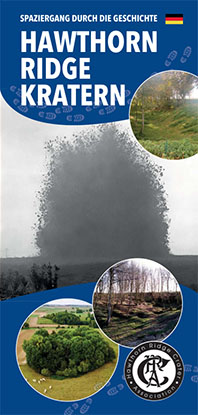
Some of you will be aware that work has been underway for some time to produce leaflets explaining the Hawthorn Crater site. The English and French versions are now on the HRCA website and can be downloaded and copies have also been placed in a number of strategic locations in the Beaumont Hamel area. The German version is well advanced and should be available via the website in the not too distant future.

13 November 2023 Commemorations
There will be two ceremonies at Beaumont Hamel on the morning of 13 November, the 107th anniversary of the blowing of the second mine at the Hawthorn Redoubt and the subsequent capture of the village by the men of the 51st (Highland) Division. The first will take place at 10:30 a.m. at the Highland Division flagstaff in the centre of the village. Thereafter we will proceed to the Hawthorn Craters for another ceremony – all are welcome to attend and anyone can lay wreaths, flowers or other tributes if they wish to. Following the ceremonies we will return to the village for a vin d’honneur in the village hall.
It is also anticipated that tours of the craters will be available on 13 November, and possibly on the days either side – use the contact details below to see what can be arranged.
Membership Report
A reminder that membership is currently maintained at just £10 per annum (you are of course welcome to give more), and by setting up a standing order you won’t forget in future.
Your £10 will help to fund all the work necessary at the crater over the coming year, plus it will support our website through which we aim to spread word of the crater’s history and the work of the HRCA to preserve it.
For information on membership, please contact Rick at rick@hawthornridgeca.com
And Finally
I am pleased that during my July visit to the Somme I was able to visit the graves of all the 252 Tunnelling Company men who died in 1915 and 1916, including those who died of wounds in Base Hospitals as far away as Rouen. Now, armed with photographs of their graves, some further research will hopefully allow me to tell their stories in future newsletters. If anyone has any information on these men (or indeed any other aspect of the 252 TC’s activities) I would be delighted to hear from you.
Newsletter Editor
derek.bird876@gmail.com
HRCA contact details: –
Website: www.hawthornridgeca.com
Email: enquiries@hawthornridgeca.com
Mobile: 07747 862014
Twitter: @HawthornRidgeCA
Facebook: Hawthorn Ridge Crater Association