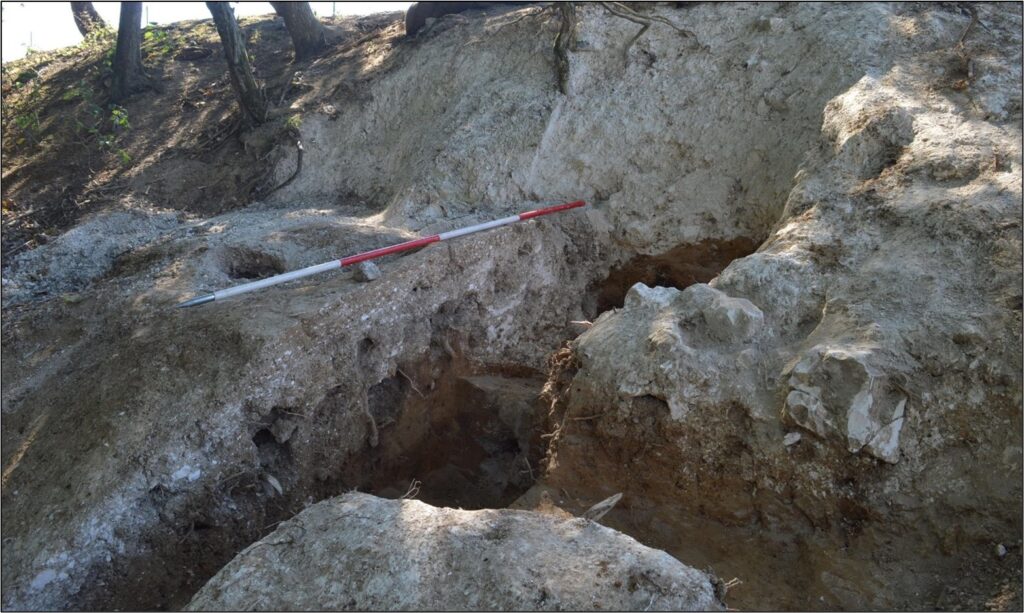
An occasional newsletter from the Hawthorn Ridge Crater Association (HRCA)
No. 3 – December 2023
Introduction
Welcome to the latest edition of ‘The Crater News’ in which I have once again mixed historical information with reports on recent events. As always, should you have something of interest relating to the Hawthorn Crater or the surrounding area let me know and I might be able to use it in future editions.
13 November 2023
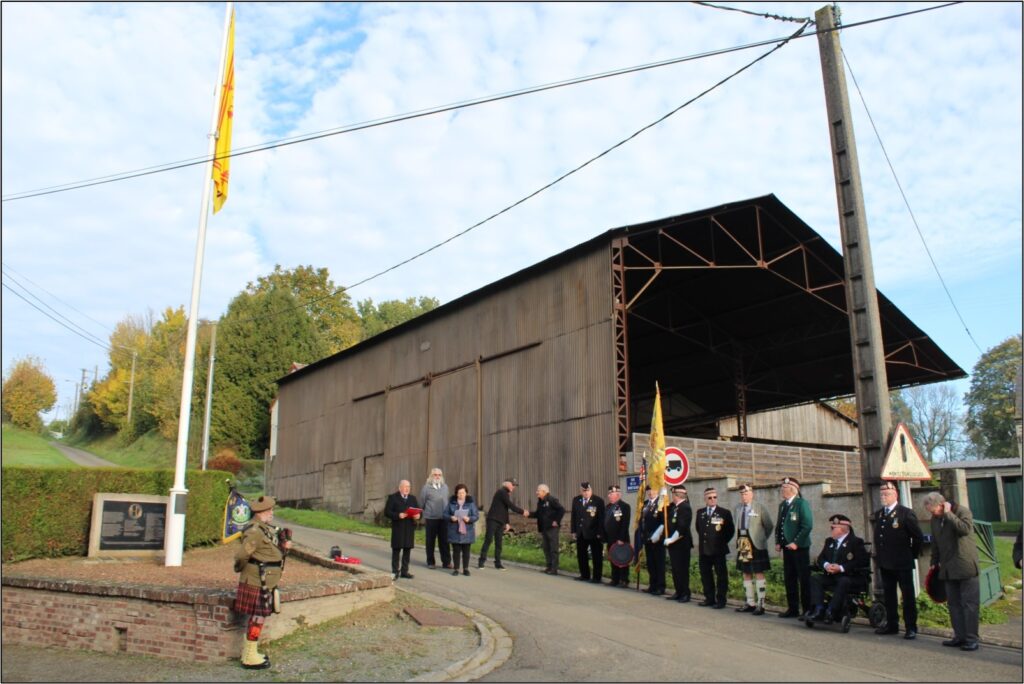
On the 107th anniversary of the firing of the second mine under the Hawthorn Redoubt, two commemorations were held. The first at the 51st (Highland) Division flagstaff in the centre of Beaumont Hamel commemorates the Highlanders who went forward at 5:45 a.m. and succeeded in capturing the village after a very hard day’s fighting. This is an event that I have organised on behalf of the Scotland (North) Branch of The Western Front Association since 2006 when we unveiled the new flagstaff and memorial stone. I am pleased that a good number of villagers and visitors from many countries, including the UK, Canada and the Netherlands, attended this year’s ceremony.
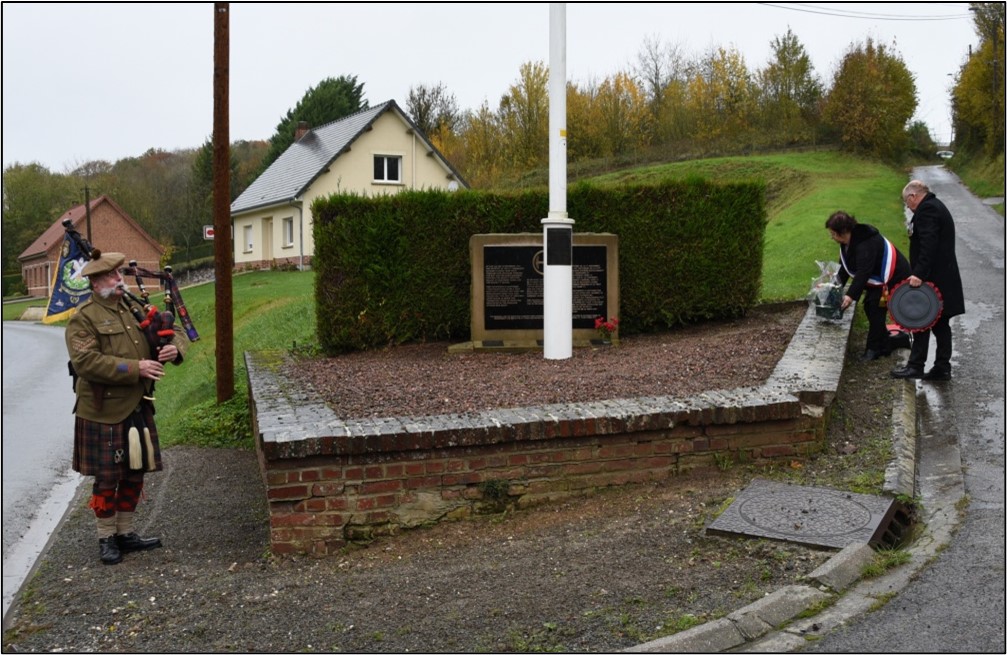
Photo courtesy of Arno Roorda
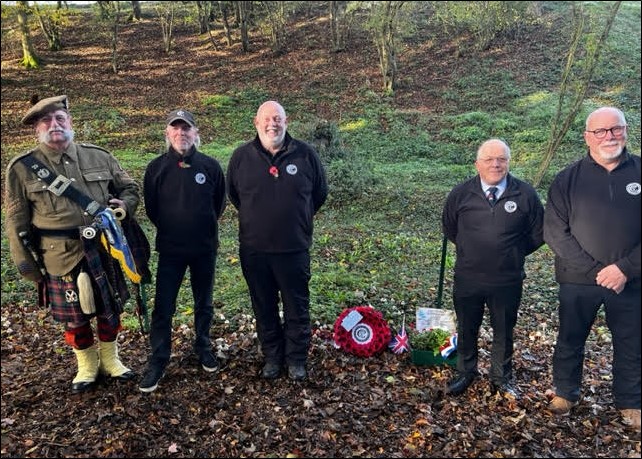
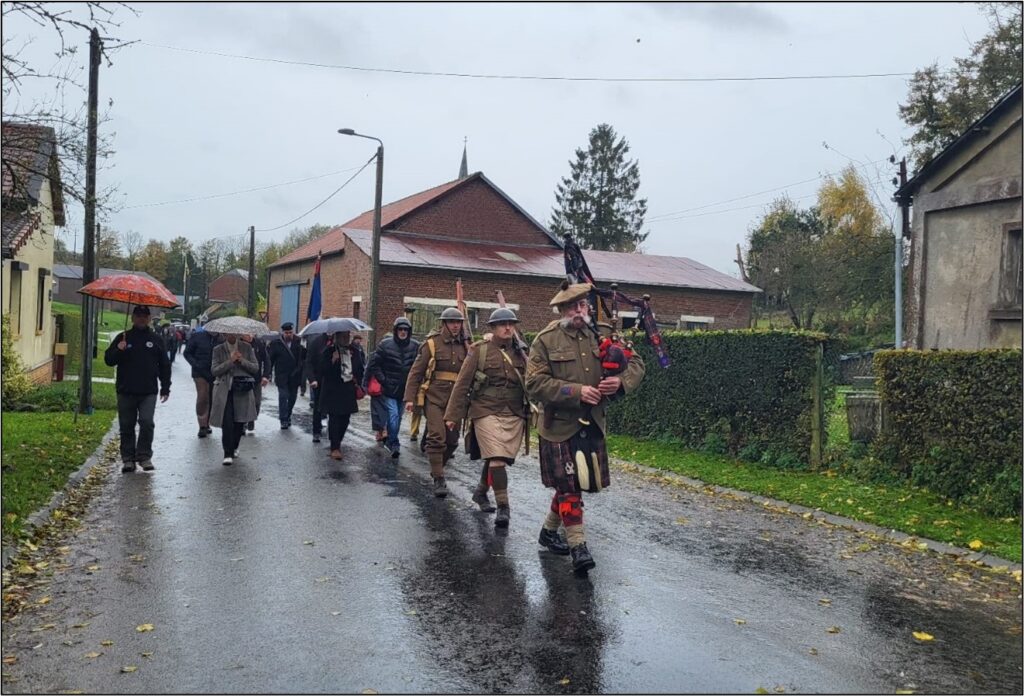
Once the ceremony at the flagstaff was completed I changed roles and joined everyone behind the piper going up to the Hawthorn Crater, where the HRCA’s ceremony took place. The weather was at least reasonably kind, even if only compared to the torrential rain in the previous and following days!
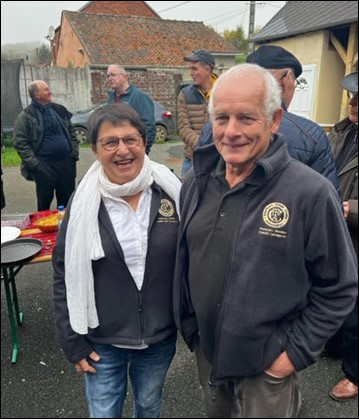
After introductions and words of welcome from HRCA Chairman, Terry Berry, and the Mayor of Beaumont Hamel, Agnes Lavaquerie, the Exhortation was read, the Last Post was played and a minute’s silence was observed. The silence was broken by Yves Holbecq playing a new tune he has specially composed for the occasion, ‘Remembrance at the Hawthorn Crater’, and we thank Yves for this kind gesture.
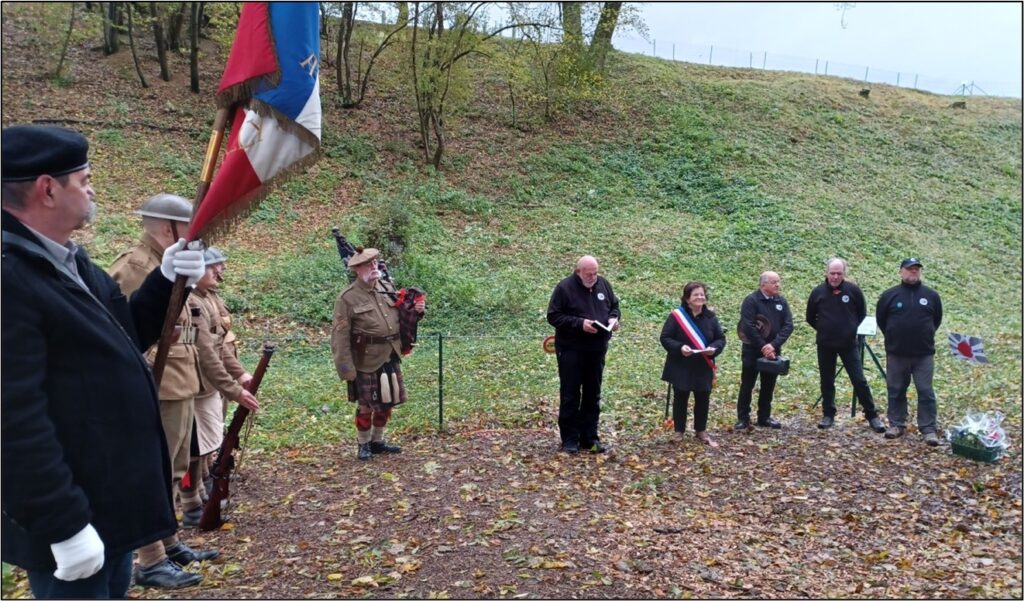
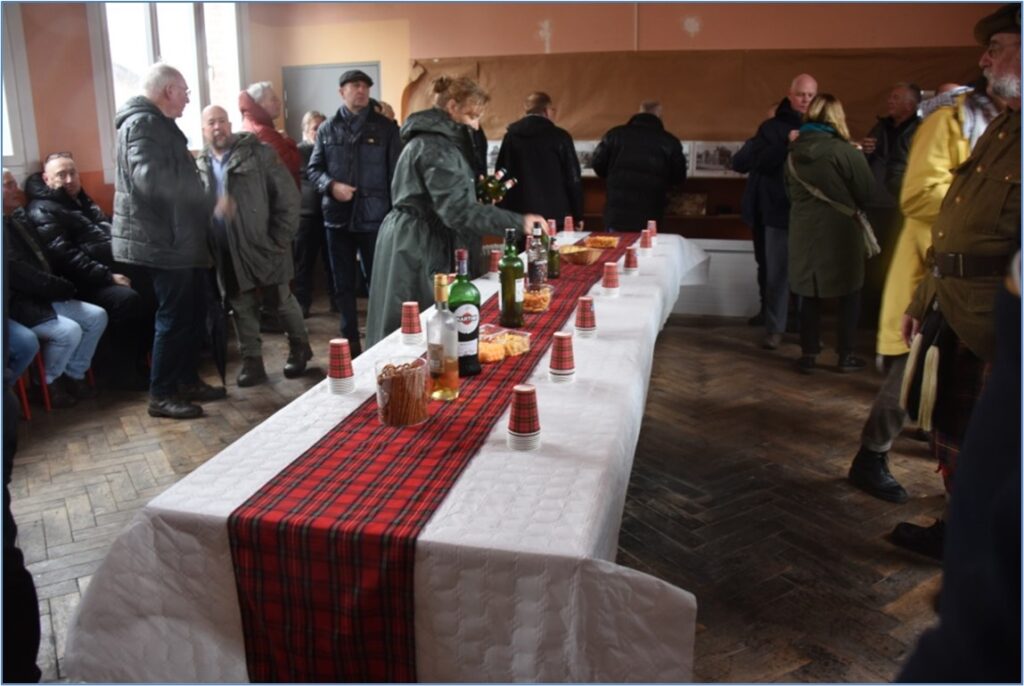
Photo courtesy of Arno Roorda
Tunnelling at Beaumont Hamel – Overview
In this edition I am continuing Colin Lukas-Winn’s overview of tunnelling operations; this time he focuses more on the work carried out in the Beaumont Hamel area:
The first question most people ask when they hear the term ‘underground war’ is why? There are in fact several reasons for the decision to go underground, but the primary one was to break any stalemate on the surface. Trench warfare can very easily degenerate into a dull, tedious and predictable pattern of minor actions, trench raids and sniping. This state of affairs was usually broken by the artillery, long and short range guns making life very arduous in the trenches, and it was for this type of reason that the Germans first brought miners and tunnellers to the conflict in November 1914. Their remit was not offensive but defensive, they constructed vast subterranean shelters linked by galleries and even, as was the case later on at Beaumont Hamel, extended the medieval sous-terrains dug by the villagers as protection against the feared Spanish troops during the 17th Century Franco-Spanish War. These shelters, to a certain extent, negated all but the heaviest calibres of artillery.
The next thing to take into account is the topography of the area. In the case of Hawthorn Ridge being situated in a gentle valley, leading up to the flatter land towards Serre on one flank and Newfoundland Park on the other. It can be seen that any activity on anywhere but these flatter areas would be very quickly and easily seen and dealt with. A case in point was the large scale attack the French mounted on 19 November 1914. This attack was very robustly repulsed with the French taking heavy casualties along the whole Hamel to La Signy Farm front. As a result the commanders ordered miners of the 6th Engineer Regiment into the area around Cote 143, which we now know as the Redan Ridge, to drive saps and galleries forward towards the German lines. One gallery had a charge placed at its end to destroy a listening post, in which it was entirely successful but unfortunately it also caused an unknown German charge to detonate resulting in heavy damage to the French front line and some casualties. Both sides then settled down to a systematic pattern of mining, countermining and listening. No large (over 2,500 kilos) charges were used during this period and indeed the artillery began to take charge of the field once more. The most obvious effect of the underground work was the almost lunar, cratered ground around Cote 143, which made any further surface attacks at best difficult and more likely impossible. Underground works also took place around ‘Raven en Y’ (Y Ravine), the deep, steep features of which made it eminently suitable for huge dugouts, store rooms, aid posts and anything else that could be protected by moving it below ground.
The sector became a ‘quiet area’ but mining continued right through until July 1915 when the British 4th and 48th Divisions arrived to take over the northern sector of the Somme area. Also, in common with other areas taken over, it was decided the mining activities would continue but in a more focussed and deliberate way. The French works tended to be too shallow and often poorly constructed, whereas the Royal Engineers had, even at this early stage of mining activity, a much better understanding of geology, strata and the performance of explosives under differing conditions. Around Beaumont Hamel the responsibility for mining was handed to 252 Tunnelling Company, under the command of Captain Reginald (universally known as Rex) Trower. He was a real character not averse to propping himself against a trench wall with a rifle and taking pot shots at low flying German aircraft. In peacetime he was the Paris Representative of the Ingersoll Rand Company and as such was able to acquire powerful compressors to power either drills or forcing jacks to speed up tunnelling operations. An entry in the 252 Company’s War Diary attests to its achievements: ‘This Company has every record for the Army beaten by the driving in the Hawthorne [sic] Mine. In this we made 35 feet [11 metres] in 24 hours; 200 feet [61 metres] in one week of seven days; 322 feet [98 metres] in fourteen days and 565 feet [172 metres] in 26 days. This is one tunnel with one face only and the length to destroy the enemy will be 1055 feet [320 metres]’. However it was not always plain sailing, as explained: ‘Extraordinary difficulty is being encountered with mine H3. The length is now 900ft [274 metres] and work is being carried on silently by wetting the face and working the chalk out with bayonets. This face is now entirely flint and progress is very slow’. So slow in fact that the decision was taken to divert the tunnel left until the flint was passed, before resuming towards the original target point. The unfortunate outcome of this was that the tunnel failed to reach its intended target point in the time available and the charge room was positioned 100 feet [30 metres] short. This resulted in only 20% of the Hawthorn Redoubt being destroyed by the mine, although most of the enemy’s nearby trenches were filled by falling debris.
252 Company had begun work by digging saps and short tunnels for Stokes Mortar positions. Thirteen would eventually be completed, along a tunnel for access to the Sunken Lane, before they turned their attention to H3, a tunnel running north of Mary Sap, towards the Hawthorn Redoubt some 1050 feet [320 metres] distant. The tunnel was entered via a standard 4 foot [1.2 metres] square shaft dug from the junction of Pilk Street and Cripps Cut trenches to a depth of 56 feet [17 metres] below the surface. The tunnel itself was the standard RE size of 4 foot 6 inches [1.37 metres] high by 2 foot 6 inches [0.76 metres] wide, was lit by candles and dug in the normal silent manner for fear of German listening posts detecting the noise of working. There is, however, no real evidence of counter mining in this area except for a German diary entry stating that listeners were searching for British miners at work; notwithstanding this all the usual protocols still had to be followed to protect the important tunnel.
H3 was one of 19 mines, eight large and eleven smaller charges, planned to be blown on 1 July along the Somme front, mostly placed under redoubts or other strategically important positions and designed to negate these positions from having any influence over the planned advance by British troops. This particular mine consisted of 40,600 pounds [18.4 tonnes] of Ammonal high explosive (a mix of ammonium nitrate, aluminium powder and charcoal), with a guncotton core and electrically fired detonators.
H3 was timed to be blown at 7:20 a.m. on 1 July, a time chosen by Hunter-Weston (Commander III Corps) despite many protestations and discussions about the choice. It was even suggested by Brigadier Harvey that Trower had some say in the decision. Harvey told Edmonds, the official historian, ‘My own impression of Trower is that he probably had something to do with the mine being fired early, and that when the result was a fearful massacre of our own troops, he denied all responsibility for it’. Trower vehemently denied the accusations, pointing out ‘I remember distinctly VIII Corps HQ wishing to fire the mine the night before and you stopping that. I also remember the keen disappointment amongst the company when we understood that the mine was not to be the signal for going over. The VIII Corps were of the opinion that the falling debris would kill a great many of our own men, and not having fired a mine as big, I was not willing to swear that some of our men might not be hit by falling stuff. That is, I think, the point that made VIII Corps insist on the Zero minus 10 as the hour’. To this day it is difficult to say with certainty who made the fateful decision, or their reasoning.
The other 18 mines were to be blown at 7:28 a.m. with the attack by the infantry timed for 7:30 a.m., the delay to allow the debris to fall to earth before the advancing troops arrived on the spot. The Hawthorn Ridge blow was filmed by Geoffrey Malins, the official cinematographer of the British Army and remains the only large scale mine to ever be recorded live on film.
The attack failed due to various factors, but as soon as 4 July plans were being made to repeat the exercise within a few months. To this end the miners removed the tamping from H3 and dug south east to create a new charge room some 140 feet [43 metres] to the south of the original one. This time 30,000lb [13.6 tonnes] of Ammonal was used, a smaller amount as the volume of ground to be ‘lifted’ was less due to the existing crater from the previous blow and the lack of resistance within. Lessons had been learned from July, and this time the mine was blown in near darkness at 5:45 a.m. on 13 November, with the attacking troops advancing at the same moment – it was now known that the debris would fall to ground in seconds not minutes. Another benefit was that the blast wave washed across and through the first crater, which the Germans had fortified since the July explosion, probably killing instantly most of those manning the posts around the crater lip.
Changes to the Committee
At the AGM held in the Mairie at Beaumont Hamel on 11 November, a change in the composition of the HRCA committee was confirmed. Rick Smith is moving to a new post covering research and website development, which is a fairly self-explanatory role. He will therefore now be the first port of call should anyone have any information to pass on regarding the crater, the fighting that took place in vicinity of Beaumont Hamel, or the men who served there.
The post of secretary has been taken on by Tanya Ferguson. Tanya has been a supporter of the HRCA since its earliest days and is keen to contribute to the cause of caring for the Hawthorn Crater and remembering those who fought and died there. Her contact details for general matters regarding the HRCA are: –
Email: tanyamf@hotmail.com
Phone: 0044 (0)7757 124325
Membership Report
Rick Smith is now looking to gather in membership fees for 2024. These are maintained at just £10 per annum.
For information on membership, please contact Rick at rick@hawthornridgeca.com
And Finally
The programme of maintenance at the Hawthorn Crater was completed this year, despite the weather being bad at times. While working parties from the UK have done their bit, we are indebted to Francis Lavaquerie for his ongoing commitment to look after the site and keep it in good order. It is a great comfort to the committee to know that we have such a dedicated man on the spot.
There has not been much in the way of repairs needed over the past year, but updated signs at the entrance (in three languages) have now been installed. There is some damage to the perimeter fence which will be addresses in 2024, and also installation of the new QR code posts will be completed. When fully established the QR codes will then enable anyone to scan them with their phone and be shown detailed information on the crater as they move around the site.
Rick Smith has also recently overseen the production of the German version of the information leaflet and this is now available at tourist sites on the Somme. Should you wish to view it (or the English and French versions) they can be seen, downloaded and printed off at the HRCA website at www.hawthornridgeca.com
Newsletter Editor
derek.bird876@gmail.com
HRCA contact details: –
Website: www.hawthornridgeca.com
Email: enquiries@hawthornridgeca.com
Mobile: 07747 862014
Twitter: @HawthornRidgeCA
Facebook: Hawthorn Ridge Crater Association