An occasional newsletter from the Hawthorn Ridge Crater Association (HRCA)
No. 6 – January 2025
Introduction
In this edition I report on the commemorations at Beaumont Hamel on 13 November 2024, and I look at the story of a very young subaltern who was amongst those attacking from the Sunken Lane on 1 July 1916. There is also some very good news regarding donations from Anglia Tours.
13 November
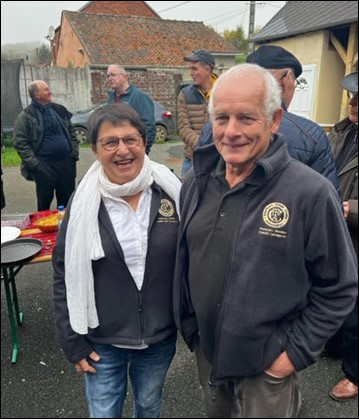
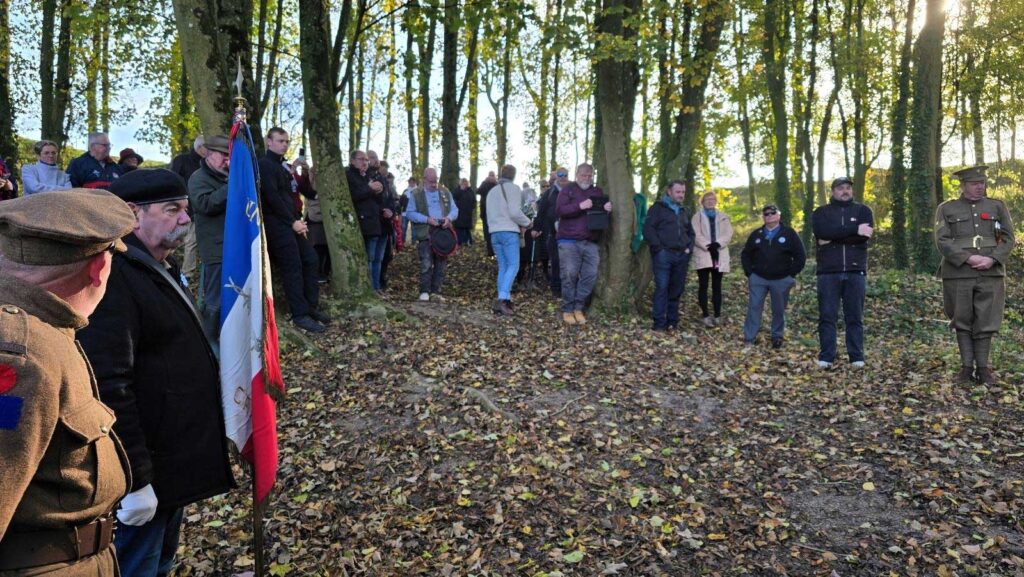
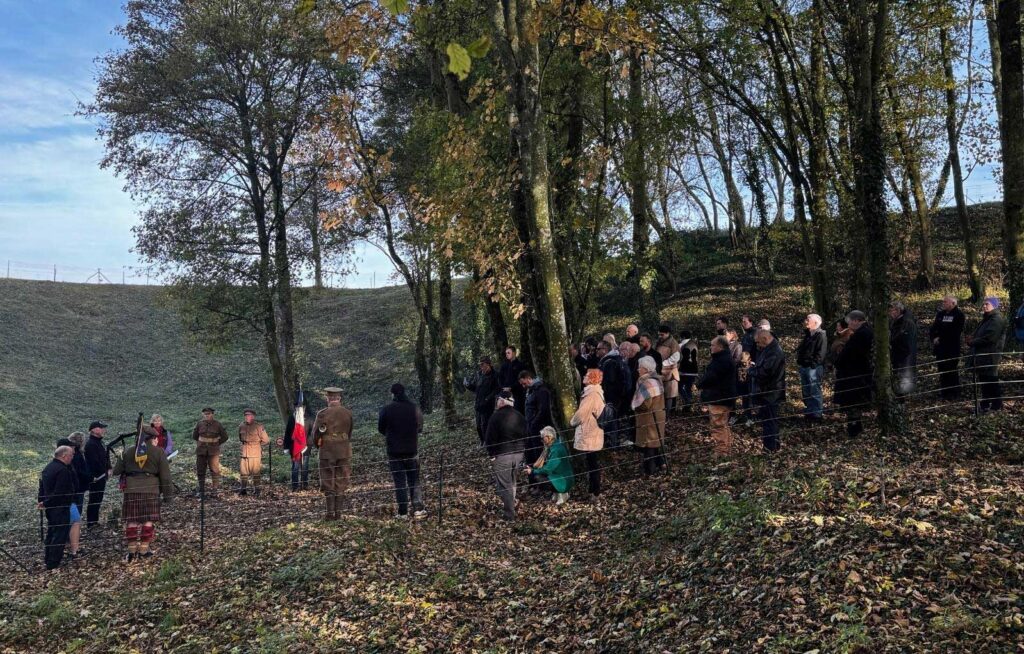
We were greeted with a fine morning for the ceremonies in Beaumont Hamel and at the Hawthorn Crater on 13 November, with a good number of villagers and visitors in attendance. This year we were pleased that Kelvyn Jenkins was able to play the bugle for us at both locations, and Yves played the bagpipes, as has now become customary.
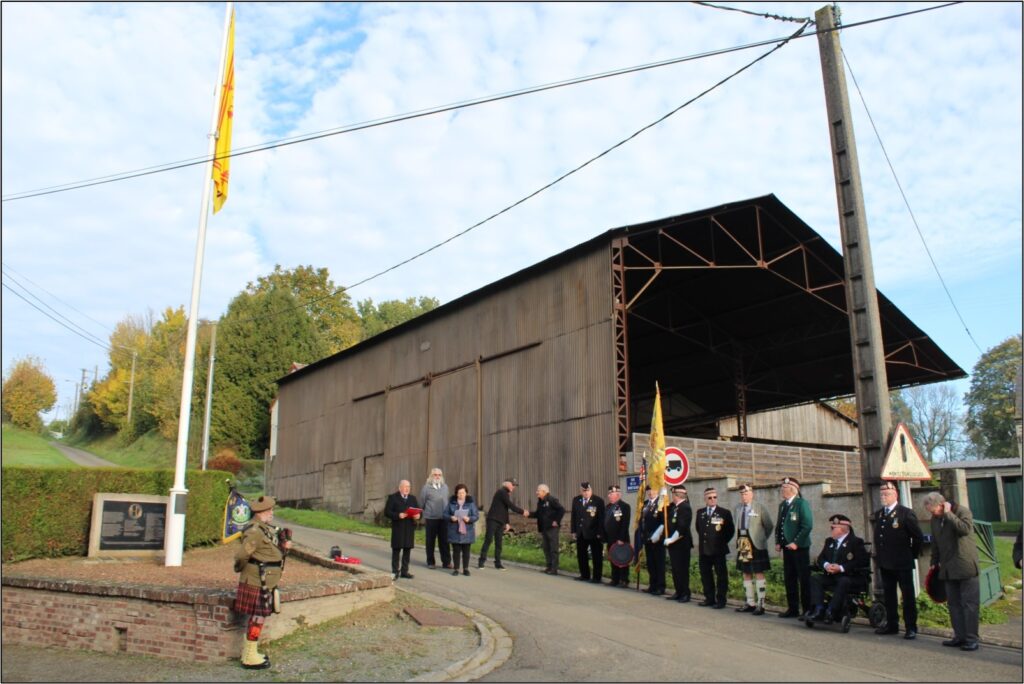
At the ceremony I organise on behalf of the Scotland (North) Branch of The Western Front Association at the 51st (Highland) Division flagstaff, Liz Middleton told the story of her uncle Louis who fought at Beaumont Hamel on 13 November 1916. Unfortunately, the effects of what he saw and suffered that day led to his evacuation from the battlefield with severe shell shock and his subsequent incarceration in a mental institution, where he lived until his death in 1972. A tragic story.
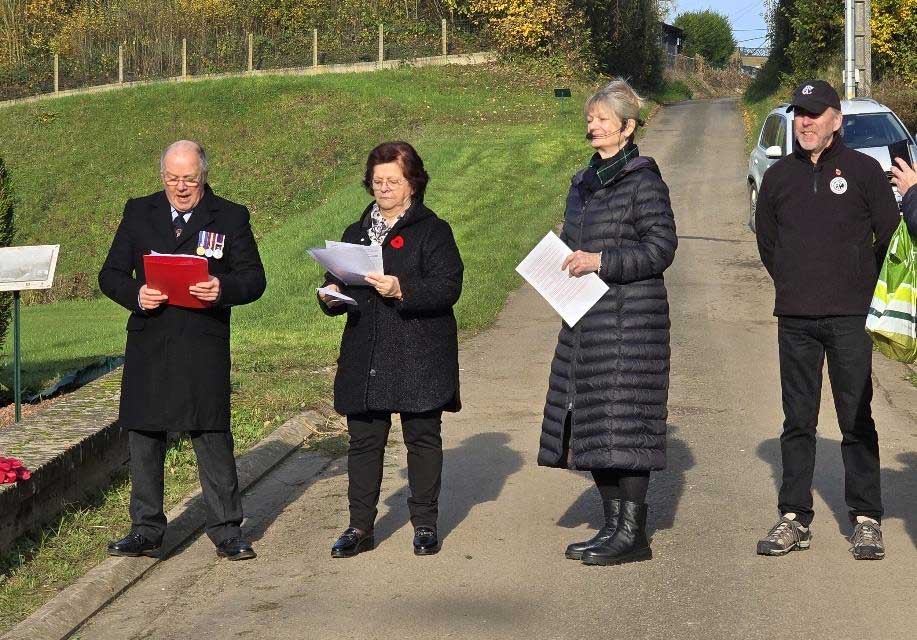
At the 51st (Highland) Division flagstaff ceremony L to R:
Myself; Mayor of Beaumont Hamel; guest speaker Liz Middleton and Rick Smith who gave the Exhortation.
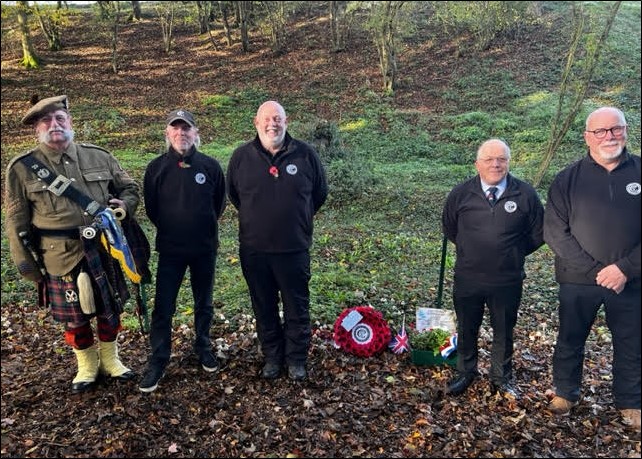
After the flagstaff ceremony the majority of attendees walked up to the crater for the HRCA ceremony. Here Rick Smith and the Mayor of Beaumont Hamel, Agnes Lavaquerie, spoke, before Tanya Ferguson gave the Exhortation. Then Kelvyn played the Last Post and Reville either side of a minute’s silence, and Yves played his lament ‘Remembrance at Hawthorn Crater’. Thereafter everyone returned to the village for refreshments.
Later a presentation was given by Dane Wright, HRCA Lead Archaeologist, on the findings from a recent non-invasive archaeological investigation of the field immediately to the east of the crater. The survey revealed much of interest for future investigation, and a short report is included later in this newsletter.
George Riley Spencer – Lancashire Fusiliers & Royal Flying Corps / Royal Air Force
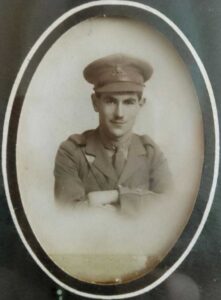
At the ceremonies on 1 July 2024 we were joined by Richard Spencer and his father David. They had come to see where George Riley Spencer, David’s father, had fought on the opening day of the Battle of the Somme. Although this one day of action is a focus of our attention, the wider story of George Spencer is far too interesting to ignore – I hope you agree.
George Spencer was born in Southport, Lancashire, in October 1897. He enlisted into the Lancashire Fusiliers in November 1914, a month after his 17th birthday and underwent initial officer training at the St Albans Officer Training Centre, before being commissioned on 10 March 1915. He then joined the 3rd (Reserve) Battalion, Lancashire Fusiliers, forming part of the Humber defences at Hull.
In the August he was posted to the 1st Battalion, Lancashire Fusiliers (1/LF), who had been fighting in Gallipoli since the initial landings on 25 April. He was one of a reinforcement draft of 112 officers and men. I have not been able to ascertain exactly when George Spencer arrived, but for the first half of the month the 1/LF were alternating periods in the line near Krithia with rest periods at Gully Beach. On the 19th, however, they boarded the SS Clacton and were transferred north to Suvla Bay, where they went into action at Hill 112 on the 21st. Thereafter they had periods in the line, in reserve at the Salt Lake, or at rest on the nearby island of Imbros. They were in the trenches at Suvla when a deadly blizzard and flood hit on 26 November.
On 14 December they boarded the SS Barry for a short rest at Mudros, before being shipped back to the Cape Helles beachhead two days later. The end of December saw them at the rest area on ‘X’ Beach, before being transferred to ‘V’ Beach on 2 January 1916, from where they were evacuated to Egypt on the SS Caledonia.
The 1/LF remained in Egypt until 12 March when they sailed for France on the SS Miltiades; arriving at Marseilles on the 20th. A long train journey saw them arriving at Candas on the Somme on the last day of March, and on 13 April they began their first period of trench duties on the Western Front at the White City, Beaumont Hamel. Over the following weeks they rotated with the other battalions of the 86th Brigade, before moving up to the front on 29 June, in preparation for the forthcoming battle.
The plan of attack included the 1/LF moving two companies, bombing parties and Stokes Mortar teams forward from the White City into the Sunken Lane in the early hours of 1 July. This was achieved partly through a tunnel from Sap 7 excavated by 252 Tunnelling Company in the period 1 to 20 June, and then via a new trench from the end of the tunnel to the Sunken Lane. The latter was dug by the 1/2nd Monmouthshire Battalion, the divisional pioneer battalion, the night before the attack. Famously the official war photographer, Geoffrey Malins, went forward via this route about an hour before the attack and spent some time filming the men waiting in the Sunken Lane. Once finished, he returned to the White City and took up position ready to film the blowing of the Hawthorn Mine.
At about 7 a.m. 1/LF Battalion HQ moved forward and the Germans began shelling the Sunken Lane, quite possibly after spotting the new communication trench and movement in it. About 20 casualties were caused by the time that the Hawthorn Mine was fired at 7:20 a.m. At that moment the Stokes Mortars opened rapid fire, however, a flaw in the overall artillery plan saw the artillery lift off of the German front line, enabling the enemy to mount their machine guns and await the attack. The 1/LF would pay a heavy price for this oversight, as would the 2nd Royal Fusiliers advancing on their right flank towards the newly blown crater.
At 7:30 a.m. the leading platoons of B and D Companies, along with bombing parties advanced. On the right B Company’s platoons under the command of Second Lieutenants Prescott, Edwards and Kershaw emerged from the deepest part of the Sunken Lane and began to advance across No Man’s Land towards the German strong point known as the Bergwerk. On the left the D Company’s platoons emerged from the shallower part of the Sunken Lane, commanded by Second Lieutenants Craig, Gorfunkle and George Spencer, and headed towards the northern part of Beaumont Hamel. Remarkably, George Spencer was by this stage of the war already a seasoned platoon commander with almost a year’s active service, despite only being 18½ years old.
There were a few moments grace before the German machine guns opened fire and men began to fall. The third and fourth waves were virtually wiped out within a few yards of leaving the cover of the Sunken Lane. George Spencer was amongst those who manged to get forward, but he was wounded in both knees and he took shelter, with others, in a small hollow near the German wire.
The 1/LF tried to get more men forward as the morning progressed but nothing was achieved beyond increasing the casualty list. One group of about 75 men led by Second Lieutenant Caseby advanced at 8:15 a.m., but only about 10 got close to the German wire, where they also took shelter.
Parties of 1/LF advancing from the original British front line to the Sunken Lane, or on the south side of the Beaumont Road, suffered similarly. Despite this Brigadier-General Williams ordered a further attack at 12:30 p.m. 1/LF’s commanding officer, Lieutenant-Colonel Magniac, replied:
I have now in Sunken Road 75 men and 1 officer.
In my other trenches about 50 men.
I have tried two advances covered by Stokes and Lewis Guns, both have failed. We are mown down by M.G. fire and only get a few yards beyond the Sunken Road.
If you wish I will of course attack. 50 men from my front line trenches and 75 from the Sunken Road.
I consider it is bound to fail. Machine Guns are behind debris in village and rake the front.
Brigadier-General Williams, once appraised of the parlous state of the 1/LF, cancelled the attack and instead gave instructions to reorganise the available men and put the Sunken Lane into a state of defence. By 6 p.m. the Sunken Lane was garrisoned for the night by just one officer and 25 men. After dark stretcher bearers recovered many of the casualties, and others who had been sheltering in No Man’s Land crawled in. At midnight 2/Lieutenants Craig, Caseby, Gorfunkle and George Spencer, along with 20 men returned from the
positions they had occupied close to the German wire. They had been too weak in number to continue the attack in the morning, but had kept up a useful flanking fire towards the Hawthorn Redoubt during the day.
Casualties for the 1/LF on 1 July were 7 officers killed and 14 wounded, along with 156 men killed, 298 wounded and 11 missing. George Spencer was evacuated from the battlefield to a hospital on the coast at Etretat, about 30 kilometres north of Le Havre. On 4 July he sailed from Le Havre on the hospital ship Panama, arriving at Southampton the following day. He was then transported to the 2nd Western General Hospital, Manchester, where his injuries were assessed as likely to make him unfit for ‘general service’ for
two months.
It is unclear as to whether he returned to France in an infantry role, however, he was attending a Lewis Gun course at Cleethorpes in the October, so probably did not. He did though volunteer for the Royal Flying Corps (RFC) and was transferred early in 1917. After attending the Aerial Gunnery School at Hythe he was posted to 48 Squadron as an observer in the Bristol F2a Fighter on 13 April. The Bristol was a new machine and its introduction into service was disastrous. The first operational patrol of six aircraft, led by Captain Leefe-Robinson VC, on 5 April, encountered Manfred von Richthofen’s Jasta 11, leading to four of the Bristols being shot down, including Leefe-Robinson’s aircraft; he spent the rest of the war as a prisoner.
This was the shattered squadron that George Spencer joined a week later, just as the RFC was fighting for its survival in what became known as ‘Bloody April’. Over the next few months revised tactics, and an improved aircraft, the F2b, saw the Bristol become the best British two-seat fighter of the war and George Spencer was engaged in a number of combats. On 21 July four Bristols were attacked by a dozen German Albatros aircraft and Captain Brian Baker and George Spencer were one of three crews who shared in an Albatros being driven down ‘out of control’ [see footnote]. The following morning 48 Squadron sent out aircraft to try and intercept German bombers returning from a daylight raid on Harwich and, when five Gothas were spotted, Captain Baker dived from 16,000 feet down to 3,000 feet to shoot one down into the sea off Ostend; this victory being shared with another 48 Squadron crew. On 24 July Baker engaged two enemy two-seaters, but George Spencer was slightly wounded by anti-aircraft fire as they pursued them across the front lines, however, he remained at duty. Three days later the Baker / Spencer combination shared the destruction of another Albatros with the pilot of a Sopwith Camel.
This appears to be George Spencer’s last victory as he was posted to Home Establishment on 10 August for employment as a gunnery instructor at the Observers School at Perivale, Middlesex. Four months later he was on the move again, this time to Salonika and 17 Squadron who flew a mixture of aircraft types, both two-seaters and single-seaters. Then, on 1 November 1918 he was posted to the
Base Depot at Aboukir, Egypt, and a week later to the No.3 School of Aeronautics. At the end of December he was posted to the Armament School for a short period before transfer to the Cadet Wing ‘for dispersal’; finally being ‘transferred to the unemployed list’ on 1 June 1919. He had served in multiple theatres of operations; had seen action as a platoon commander in Gallipoli and on the first day of the Somme; he was credited with a part in shooting down four enemy aircraft while an observer with the RFC; he was also wounded on two occasions. George Spencer’s remarkable 4½ year’s war service that encompassed two of the most dangerous roles, junior infantry officer and RFC aircrew, had come to an end, and he was still only 21 years old!
After the war George Spencer was involved in the brush industry and became managing director of Jepson, Spencer Co. Ltd. of Shudehill, Manchester. During WW2 he enlisted as a special constable, and during a German air raid on Manchester his premises were destroyed. In 1947 he moved to Pinner, Middlesex, and was a director of Messrs. Hamilton and Co. brush makers of Harrow, London. Unfortunately he died in hospital on 2 May 1952 at the age of 54. A newspaper report stated that he ‘was on a Tube train on his way to a London theatre when he collapsed’. An untimely end for an extremely brave man who survived enemy shot, shell and bombs in two world wars.
[Footnote] Brian Edmund Baker was credited with 12 victories during WW1, was promoted to major commanding 141 Squadron on Home Defence duties at Biggin Hill in 1918. He continued to serve in the RAF, eventually retiring as Air Marshal Sir Brian Baker, KBE, CB, DSO, MC, AFC. He died in October 1979.
Archaeology Report
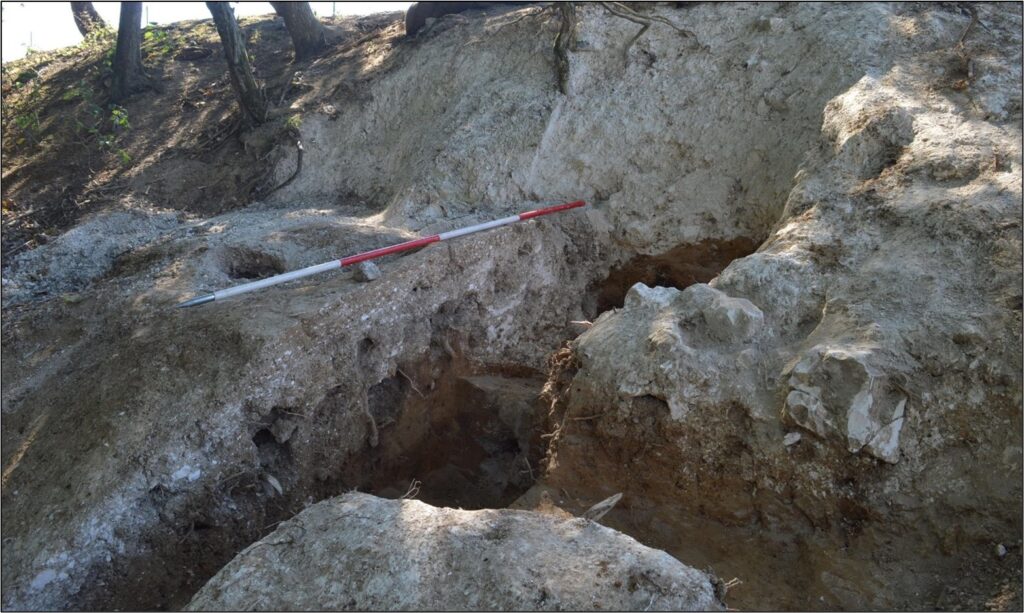
Our lead archaeologist, Dane Wright, has kindly given me an update on recent activities near the crater and, once the results have been fully interpreted, I hope that further information and some images will be available for the newsletter:
It has been a while since there has been an archaeological update. With the craters now accessible and an established footpath in place which is continuously maintained, work slowly turns towards the events that took place there and their physical remains. Previously we undertook both non-invasive and some very limited and targeted excavation. The non-invasive work created a baseline understanding of the condition and preservation of the craters, but also highlighted areas under threat. Burrowing animals, roots and poor weather, all contribute to the decay of the site. While this takes time to have an impact, we have seen some areas more affected than others, which is why some limited excavation had taken place. As has been mentioned previously, the excavation revealed that the positions established by the German Army post 1 July 1916 had also been reoccupied after the German Spring offensive of March 1918.
Recently we had the opportunity to carry out a day’s geophysical survey, using a Magnetometer to survey a small area to the immediate east of the craters and footpath. This was carried out by Kevin Cornwell, Helen Basson and myself. The Magnetometer measures the magnetic susceptibility of the soil which has its own magnetic property; if it is affected by heat, dug out or moved, the readings differ from their immediate surroundings, these changes are picked up during the survey. However, as the name suggests, this type of survey is susceptible to metal which can interfere with the readings and cause it to resemble an analogue TV without any signal! This survey was taken as an experiment, other areas such as those around the Glory Hole at La Boisselle produced positive results, however, they needed a very keen eye to pick out individual features. The results at Beaumont Hamel, which resemble an x-ray image, have, however, surpassed all expectations. Hawthorn Redoubt’s complex trench system is clearly visible, more surprising is that there are some hints at an earlier trench system being present. The earlier trench is visible in pre 1 July 1916 aerial photographs. Finally, a possible rudimentary trench system established across the upcast material of the first mine blow has also been noted.
The latest results have shed some fascinating light on the preservation of the redoubt, and the robust nature of the results would suggest that the trench system is still largely intact and substantial. This is positive news, the results helping contribute towards the association’s archaeological and historical research aims. We would like to understand how the craters were integrated in to this established defensive position and how the later more rudimentary trench system was constructed. Do the construction methods and layout comply well with those suggested in German field fortification manuals, or have they differed due to the nature of the ground and the severity of the blast?
The HRCA will continue to carry out non-invasive archaeological surveys to further map the extent of surviving below surface archaeological features. The aim is to produce a detailed archive of trench maps, aerial photographs and geophysical surveys, compare them and identify activity which contribute to our understanding of the use of this location and the actions which took place throughout the Great War.
Anglia Tours
In the early days of the HRCA Alain Chissel agreed to donate a Euro for every visitor his company, Anglia Tours, brought to the crater. A first payment was made but the Covid pandemic and its impact upon tours etc., saw them cease. We are, however, pleased that with the help of Alain, the new owners of Anglia Tours, the Next Generation Travel Group, have agreed to honour his original commitment and in the year to August 2024 have donated almost £2,800 to the HRCA. This is a most welcome boost to our funds that will go towards website development, onsite maintenance and repairs, and possible future archaeological activities.
Membership Report
With the good news about income from Anglia Tours, membership for 2025 can be maintained at just £10 per annum (you are of course welcome to donate more!)
For information on membership, please contact Rick at rick@hawthornridgeca.com
And Finally
The programme of maintenance at the Hawthorn Crater was completed this year, along with a few fence repairs. While working parties from the UK have done their bit, Francis Lavaquerie has continued to look after the site on a day-to-day basis and keeps it in very good order and we thank him for his continued dedication and hard work.
Newsletter Editor
derek.bird876@gmail.com
HRCA contact details: –
Website: www.hawthornridgeca.com
Email: enquiries@hawthornridgeca.com
Mobile: 07747 862014
Twitter: @HawthornRidgeCA
Facebook: Hawthorn Ridge Crater Association