The Crater News – Feb ’26

An occasional newsletter from the Hawthorn Ridge Crater Association (HRCA)

Introduction

In this edition I continue the story of 252 Company’s work on the Redan and Hawthorn Ridges. I also have a story about one of the 252 Company tunnellers who was with the unit from March 1916 onwards and survived the war. To finish there is also a rather difficult piece that I have had to write.

252 Tunnelling Company – May 1916

During early May 1916 no less than 11 tunnels were being dug by the company across the Colincamps and Auchonvillers sectors, and on 9 May it was reported that a total of 277 feet (84.5 metres) had been dug within the previous 24 hours.

At 5 p.m. on 10 May the company exploded a 4,000 pound charge (1,814 kg) in RIII A (1) as the enemy had been working past their galley on both sides. Having waited until German working parties were active ‘It is absolutely certain that both enemy galleries were destroyed and that all their working party in each gallery were blown to pieces’.
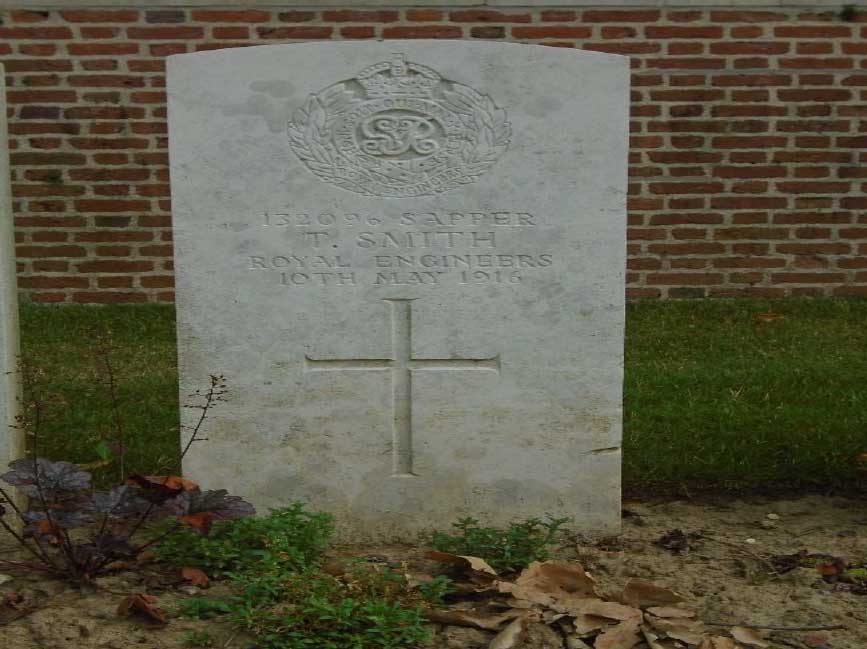
Thomas Smith lies in the Sucrerie Military Cemetery,
Colincamps. Grave 1.AA.21

On the same day 132096, Sapper, Thomas Smith, was reported as being killed by shellfire. He was a 28 year old unmarried man who lived and worked as a coal miner at Stirling, Scotland. He enlisted on 21 September 1915 and was sent to France on 9 October after the briefest of military training, being graded as a Tunneller’s Mate. He returned to the UK for an unspecified reason just a week later, most likely due to illness, and was at the Royal Engineers’ Depot at Chatham, Kent, on 16 – 17 January 1916, when he was found absent from duty for 12 hours and 45 minutes. He was apprehended by the Military Police in the ‘Brook’, presumably a local public house! His punishment was confinement to barracks for five days.

He returned to France on 12 March 1916 and was posted to the 252nd Company to spend two months working on their tunnels and mines before his death. He is buried in the Sucrerie Military Cemetery, Colincamps.

At 12:05 a.m. on the morning of 11 May the enemy blew a large charge on the Redan Ridge, but it did not form a crater and was too far away from British positions to cause any significant damage or casualties, however, the galleries were flooded with gas.

On 13 May Sergeant Coull was struck off strength after being commissioned and was posted to the 178th Tunnelling Company. It appears that he was subsequently killed on 3 July 1917 at the age of 42 and is buried at Fins, south-east of Bapaume.

At 11 a.m. on 13 May, some 59 hours after the previous enemy explosion, Second Lieutenant Stuart, Sergeant Brown and Sapper McLoughlin were passing along the upper level of RIII (4.2) ‘when at the entrance… an explosion of gas occurred. All three were knocked down and severely burnt. This place had all been examined since the enemy blow and no trace of gas discovered’. There are no obvious matches on the CWGC database, so it is possible that all three men survived their injuries.

On 16 May it was reported that 13 tunnels were now being worked on and were each more than 200 feet (61 metres) out from the British lines. At midnight the enemy blew a large camouflet between RI (2) and RI (2.1) ‘shaking the front system badly and causing large falls wherever the galleries were not timbered. There were no casualties from the blow. Ten men who were laid out unconscious by gas at post #3 post were brought out and brought round by 2nd Lt Smillie [252 Company’s medical officer] and the Proto men [specially trained and equipped mine rescuers]. The gas was very bad and the mines continued to be flooded. At 10 a.m. an infantry private and Proto man Gallacher of the company tried to come from #3 post to #1 mine but were killed by gas before they could be rescued’.
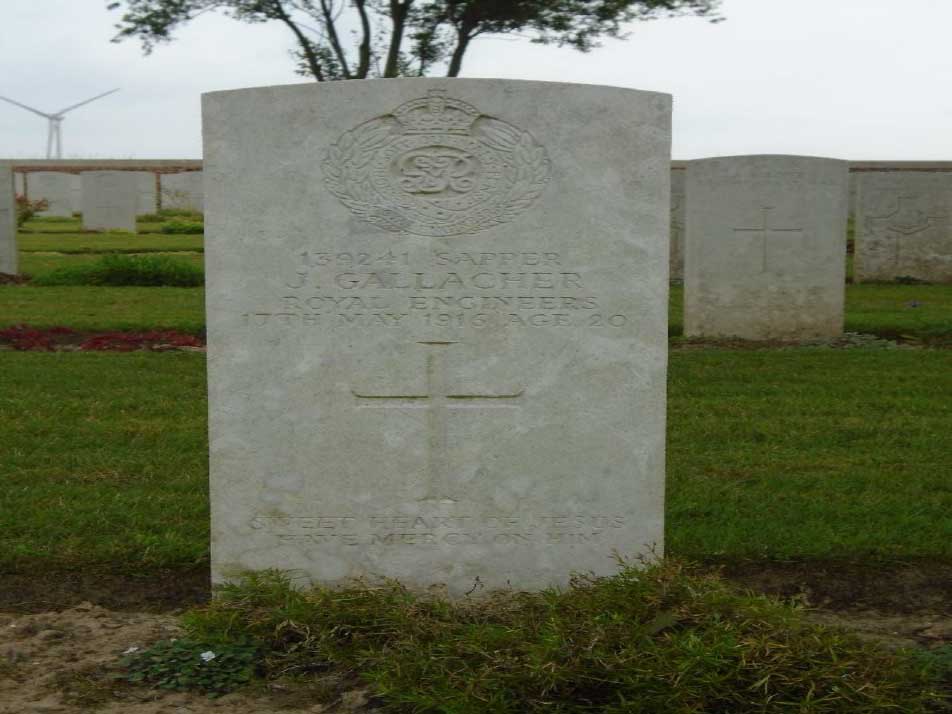
Grave of Sapper John Gallacher – Sucerie Military Cemetery, Collincamps. Grave I.I.112.

Little is known about 139241, Sapper, John Gallacher, but it appears that he initially arrived in France on 25 March 1915 as a private in the Cameronians (Scottish Rifles), before later transferring to the Royal Engineers. He was 20 years old and as a pension card was raised on behalf of a Rose Ann Gallacher at his parents address in Pollockshaws, Glasgow, it likely that he was unmarried and she was his mother.

On 20 May trouble was reported in tunnel H3 (heading towards the Hawthorn Redoubt) and that it was 900 feet (274 metres) long but ‘work is being carried on silently by wetting the face and working the chalk out with bayonets. The face is now almost entirely flint and progress is very slow’.

At 3 a.m. on 26 May ‘the enemy blew a large charge due east of No. 2 mine [on the Redan Ridge] and at some distance away. There were no casualties but the mines were again badly shaken and filled with gas. The enemy are evidently very frightened to come close. They bombarded our No. 2 and No. 3 mine shafts for four hours’.

On the penultimate day of May it was reported that ‘all the tunnels are now out over 400 feet [122 metres] with the exception of Bess and Delaney and silent work has been commenced on most of them. This month the company has driven 5,327 feet [1,624 metres] of underground working’; a remarkable total considering the number of times the Germans managed to interrupt their work.

William Fairley

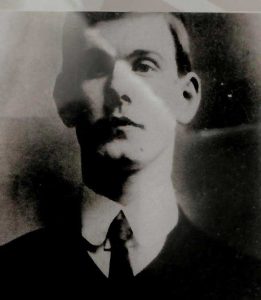
As any of you who have researched men who served in the Great War will know it is often easier to find information on those who died rather than those who survived. Therefore, I am most grateful to Stephen Lacoohee for providing information that enables William Fairley’s story to be told. William Beveridge Fairley was a son of Andrew and Elizabeth Fairley and he was born in Dunbar, Scotland, in 1881. Prior to the war, William was working as a quarry contractor and was qualified in the use of Dynamite and Gelatine at the Humbie Quarry, West Lothian, Scotland. He married Mary Thompson Campbell in December 1905 and lived at Hawthorn Cottage, Ratho, Scotland.
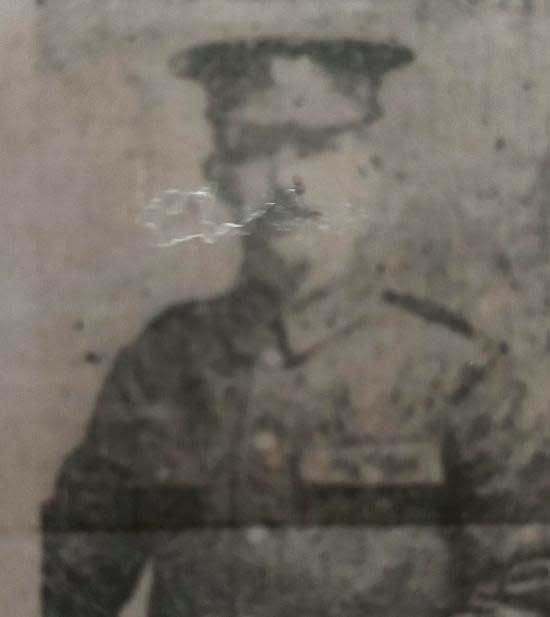
2nd Corporal William Fairley

By mid-1915 the couple had three children, the youngest of which was born on 25 May 1915. William enlisted into the Royal Engineers on 18 November 1915 as a Tunnellers Mate with the pay rate of two shillings and two pence a day. He was allocated service number 144914, and after being equipped and given some very basic military training at Chatham, he was posted to the 179th Tunnelling Company, arriving in France on 6 December. On Christmas Eve 1915 he was admitted to the No. 8 General Hospital suffering from haemorrhoids and was subsequently sent back to Britain for an operation.

Once declared fit again he returned to the Base Depot in France on 12 March 1916 and was posted to the 252nd Tunnelling Company a week later, most likely as a replacement for one of their recent casualties. This was at a time when the company were hard at work on both the Redan and Hawthorn Ridges. He was re-mustered to Tunneller on 31 May 1916, and appointed as Lance Corporal on 28 December 1917, and then 2nd Corporal the following day (2nd Corporal was a rank only used in the Royal Engineers and Army Ordnance Corps until 1920 and was denoted by a single stripe like a Lance Corporal, but unlike the latter which was just an appointment, often unpaid, 2nd Corporal was a full NCO rank). William continued to serve for the rest of the war before being demobilised and transferred to the Reserve in early 1919.

Membership Report

Membership for 2026 is maintained at just £10 per annum (as always you can donate more!) and by setting up a standing order you won’t forget in future.

And Finally

Unfortunately, I have been diagnosed with pancreatic and liver cancer and will probably never be able to return to the battlefields; a great blow after doing so dozens of times over the past 45 years. I have visited almost the whole length of the Western Front from the Belgian coast to the Swiss border, as well as visits to the Italian Front and Gallipoli.

As editor I will, however, indulge in giving myself a short obituary before I resign and “fall off the perch”.

Derek ‘Dickie’ Bird was born in a small village near Brighton, Sussex, in July 1955 and developed an early interest in aviation that led me to join the 225th Apprentice Entry at RAF Halton, Buckinghamshire, in November 1971, aged just 16. Rising through the apprentice ranks I was promoted to Sergeant Craft Apprentice prior to passing out, “not through any merit but to make the parade look pretty with the two flight commanders wearing the same rank”!
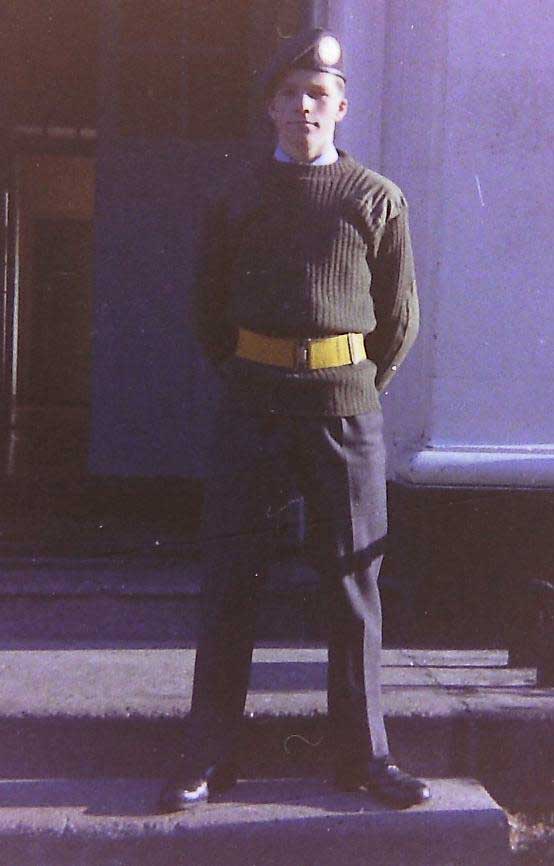
Derek Bird as a 16 year-old apprentice at
RAF Halton, 1971.

Postings followed to Brize Norton, Oxfordshire; Wattisham, Suffolk and Binbrook, Lincolnshire, before a posting to Germany, from where I made my first trip to Ypres to see the battlefields over the 1981 Easter weekend. Returning to the UK after three years meant a posting to Odiham, Hampshire, before a move up to Lossiemouth, Scotland, in 1985. I then stayed at Lossiemouth until retiring in 2015, apart from six months spent in Belize in 1988.

Along the way I worked on a wide variety of aircraft including the Britannia, Lightning, Puma helicopters, Buccaneer, Hunter and Tornado, as well as working in component repair bays, on major structural repairs and as an Aircraft Battle Damage Repair Instructor, before ending up deskbound in Engineering Operations; the last 12 years as a Full Time Reservist. Along the way I was awarded a Commander-in-Chief RAF Germany Commendation and two Air Officer Commanding Group Commendations.

Final retirement came in July 2015 at the age of 60 and, having earned 42 years’ worth of RAF pension, I never worried about seeking further employment! Having developed a such deep interest in the Great War many years before, I continued my research and study of the subject. I had become chairman of the Scotland (North) Branch of the Western Front Association at the end of 1998 and have arranged about 160 public meetings, two branch battlefield tours and commemorative events, at home and abroad, over the following 27 years. In 2006 I was instrumental in the erection of the replacement flagstaff at Beaumont Hamel, after the original erected by the 51st (Highland) Division in 1924 had become semi-derelict, and thereafter organised the annual commemorations on 13 November. In 2008 I completed 10 years of research and self-published The Spirit of the Troops is Excellent, a history of the 6th (Morayshire) Battalion, Seaforth Highlanders, in the Great War. I was a founding member of the Hawthorn Ridge Crater Association, and in 2022 I graduated from the University of Wolverhampton with the MA in Britain and the History of the First Word War. In 2024 I achieved something very special combining my interests in aviation and the Great War when visiting New Zealand and was given the chance to act as the rear gunner in a 1917 Bristol F2B Fighter during an airborne photographic shoot. Previous aviation highlights have included flights in an English Electric Lightning and a Spitfire, and a rather ‘interesting’ flight in a Puma helicopter up a Portuguese forest fire break at below tree-top height!

I have also been helping in the restoration of Avro Lancaster NX611, ‘Just Jane’, at East Kirkby, Lincolnshire, to an airworthy standard but, alas, will now not see her completed or flying. I also did much to reunite members of the 225th Entry and arranged their first reunion in 2011 to mark the 40th anniversary of joining the RAF, and a 50th anniversary of passing out reunion in October 2023. After more than 42 years of marriage I am saddened to soon be leaving a widow and a daughter. It is also very sad to be leaving so many friends around the world, and not get the chance to meet up with fellow enthusiasts on the battlefields again. If by, some unlikely miracle, I fight through this illness, then I’ll be back to the battlefields one day, however, the initial prognosis is far from good, so it is only fair that I resign as at this stage and concentrate on what family life I may have left.
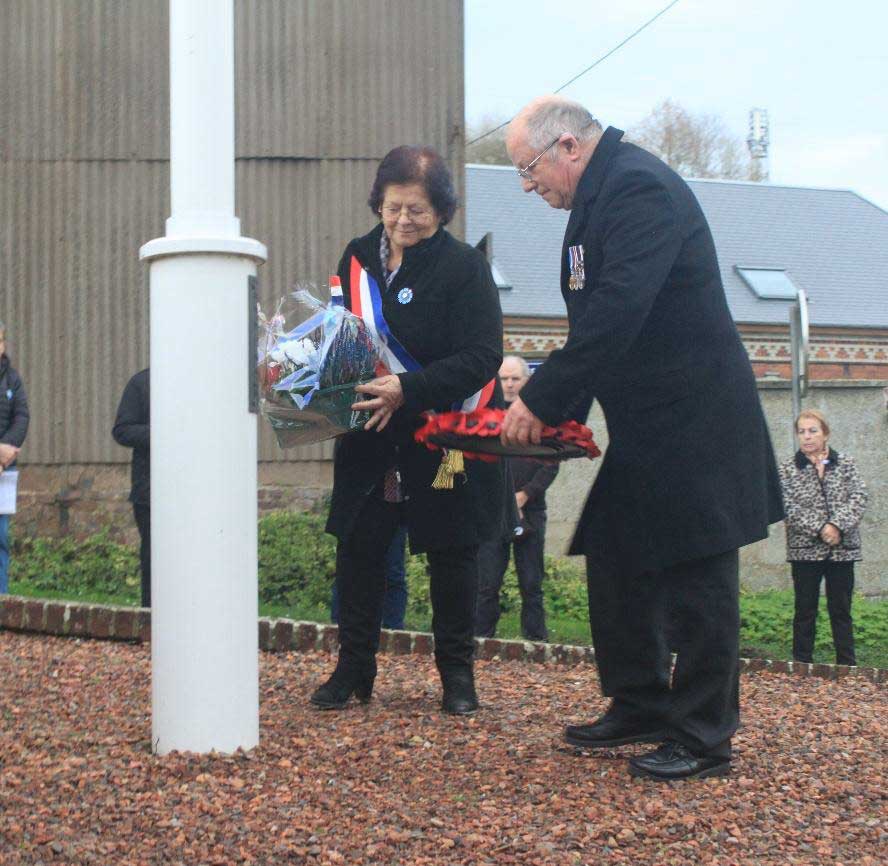
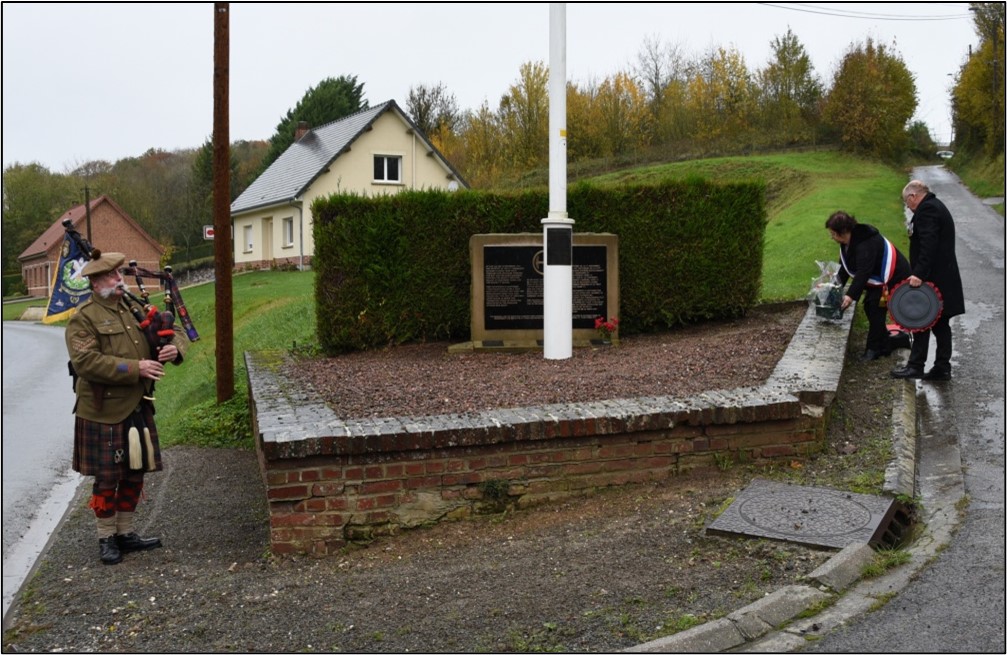
Dickie placing a wreath at the 51st (Highland) Division flagstaff on 13 November 2025, with Madame Agnes Lavaquerie, Mayor of Beaumont Hamel.

I have arranged for the HRCA, in conjunction with the village, to take care of the 51st (Highland) Division flagstaff and to organise the 13 November commemorations from this point onwards… I will be there in spirit.

Là a´ Bhlàir `s Math Na Càirdean
(Friends are good on the day of battle)
We Will Remember Them.
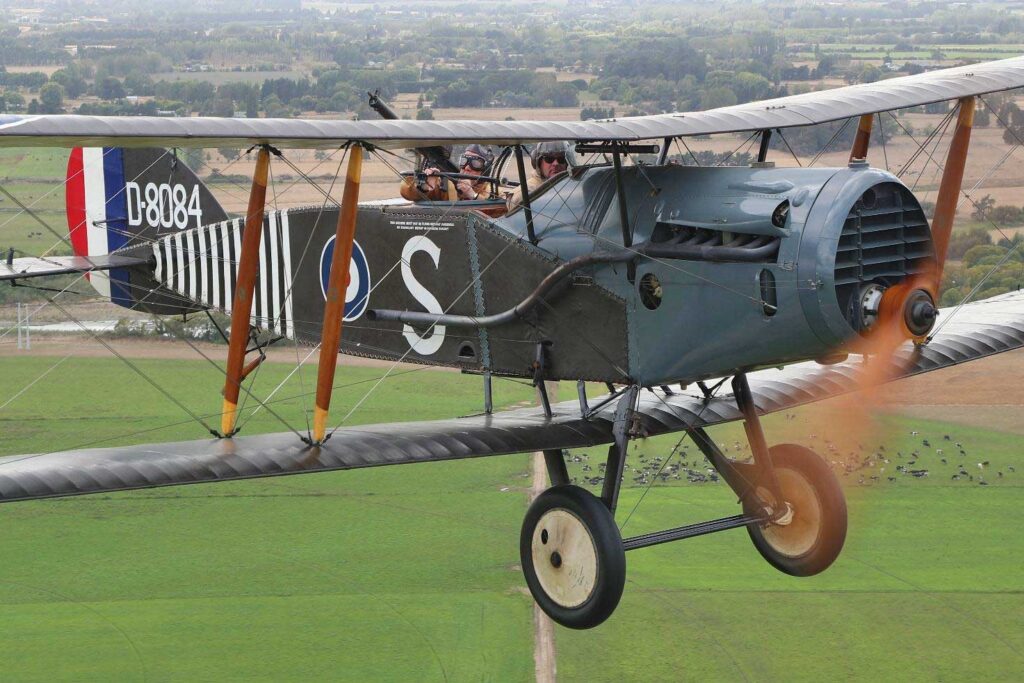
Mixing aviation and the Great War, Masterton, New Zealand, February 2024 – it doesn’t get much better
than this! Photo © Gavin Conroy.


Good bye, and thank you for your support of the HRCA in maintaining this iconic site and commemorating those, of all sides, who fought at Beaumont Hamel; for many it is their final resting place. My thanks also go to the good people of Beaumont Hamel who have, for more than 20 years, supported the efforts of a non French speaking ‘stranger’ who had wild ideas to put up a new flagstaff. Ably guided by the three mayors that I have worked with; the late Monsieur Omiel; Monsieur Magniez and Madame Lavaquerie, many villagers turn out every November, in all weathers, to commemorate the men of the Highland Division – it has been a humbling experience to see them caring about their heritage and history, and also to see them embracing the HRCA since its formation. Others who deserve a special mention are Monsieur Regnard, who interpreted so admirably during the initial negotiations when I was first looking to erect the flagstaff and at many of the subsequent ceremonies, and to Avril Williams at ‘Ocean Villas’ who has supported and helped me in more ways than I could list or ever hope to repay.

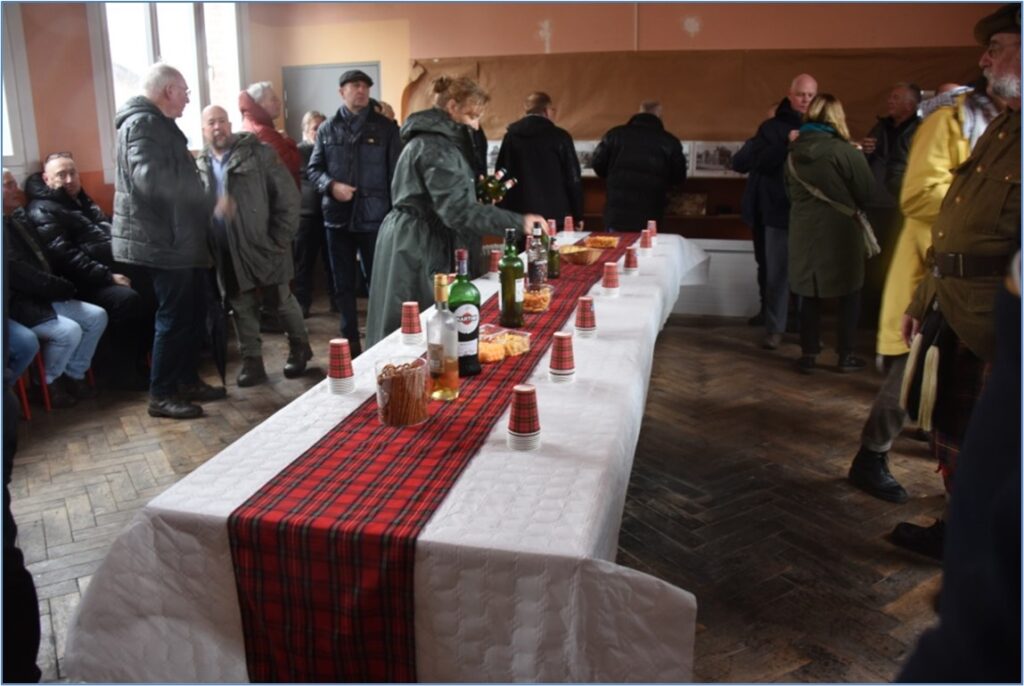
If you haven’t previously done so, I would recommend a visit to Beaumont Hamel, particularly to join Andy Robertshaw’s ceremony at the Sunken Lane on 1 July, before processing up to the Hawthorn Crater for a second ceremony; or at the 51st (Highland) Division flagstaff on the morning of 13 November, again followed by a ceremony at the crater. Refreshments in the Village Hall then follow the ceremonies.

If you would like to take over as newsletter editor please contact the HRCA via the enquiries email address to express your interest.

Derek Bird

Newsletter Editor
derek.bird876@gmail.com

HRCA contact details: –
Website: www.hawthornridgeca.com
Email: enquiries@hawthornridgeca.com
Mobile: 07747 862014
Twitter: @HawthornRidgeCA
Facebook: Hawthorn Ridge Crater Association
The Crater News – Jul ’25.

No. 8 – July 2025

An occasional newsletter from the Hawthorn Ridge Crater Association (HRCA)

Introduction

In this edition I report on the 1 July 2025 commemorations at Beaumont Hamel, and I also continue the story of 252 Tunnelling Company by looking at what happened in March 1916.

1 July 2025

This year saw 1 July dawn very bright and warm, indeed later in the day it was a sweltering 34 ̊ C and, in my case, saw a retreat to the shade and a ready supply of cold drinks! From 7 a.m. onwards people started assembling at the Sunken Lane for the ceremony led by Andy Robertshaw where a tot of rum was offered to all. Also, envelopes were handed out for opening at 7:30 a.m., each containing the brief story of one of those who fought at Beaumont Hamel on 1 July 1916 and their fate that day. Once again we were delighted to see
David and Richard Spencer at the ceremony; David’s father, Second Lieutenant George Spencer, 1st Battalion, Lancashire Fusiliers, advanced from the Sunken Lane that day, and I told the story of his incredible service during the war in Newsletter No. 6 .

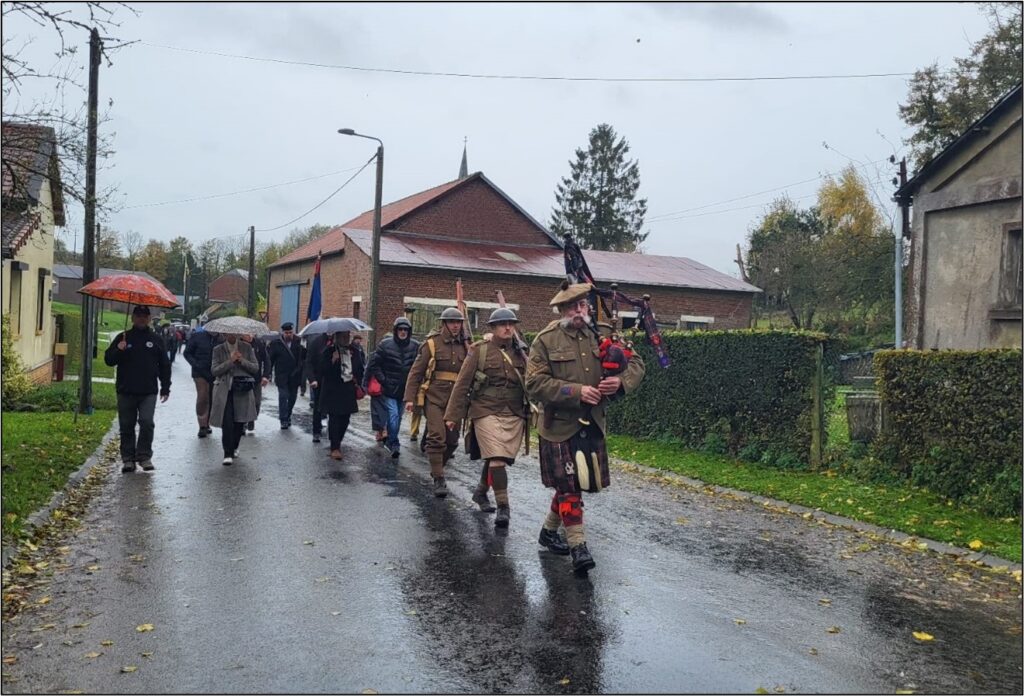
Following the completion of the ceremony at the Sunken Lane the vast majority walked up to the Hawthorn Crater behind the piper, Sylvain, who deserves the highest praise for completing the march up the steep hill in a khaki uniform and ever increasing temperatures. It was good to see the crater in such good order and thanks go to Francis Lavaquerie for strimming it all in the days before the ceremony – another notable feat of endurance in the hot weather!

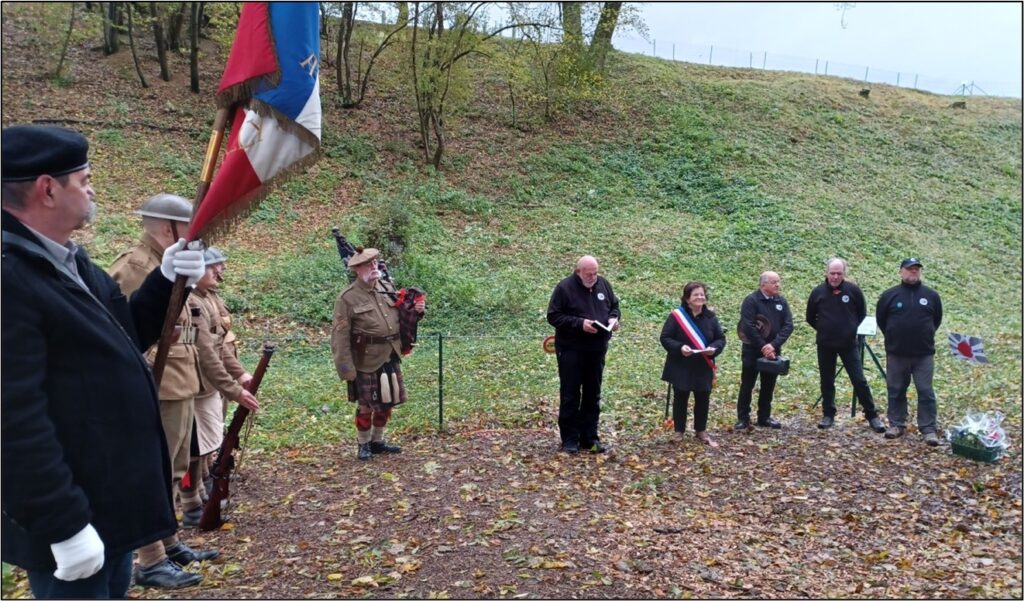
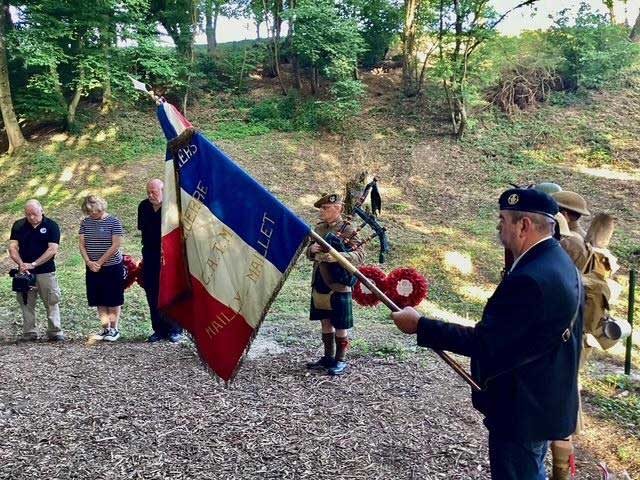
At the crater Terry Berry, HRCA Chairman, and Madame Lavaquerie, Mayor of Beaumont Hamel, thanked everyone for attending and spoke of the significance of the day. After the exhortation was given by Rick Smith, the Last Post was played before observing a minute’s silence. The silence was broken by Sylvain playing Flowers of the Forest while wreaths, flowers and other tributes were laid. Thereafter everyone was invited to the village hall for refreshments.

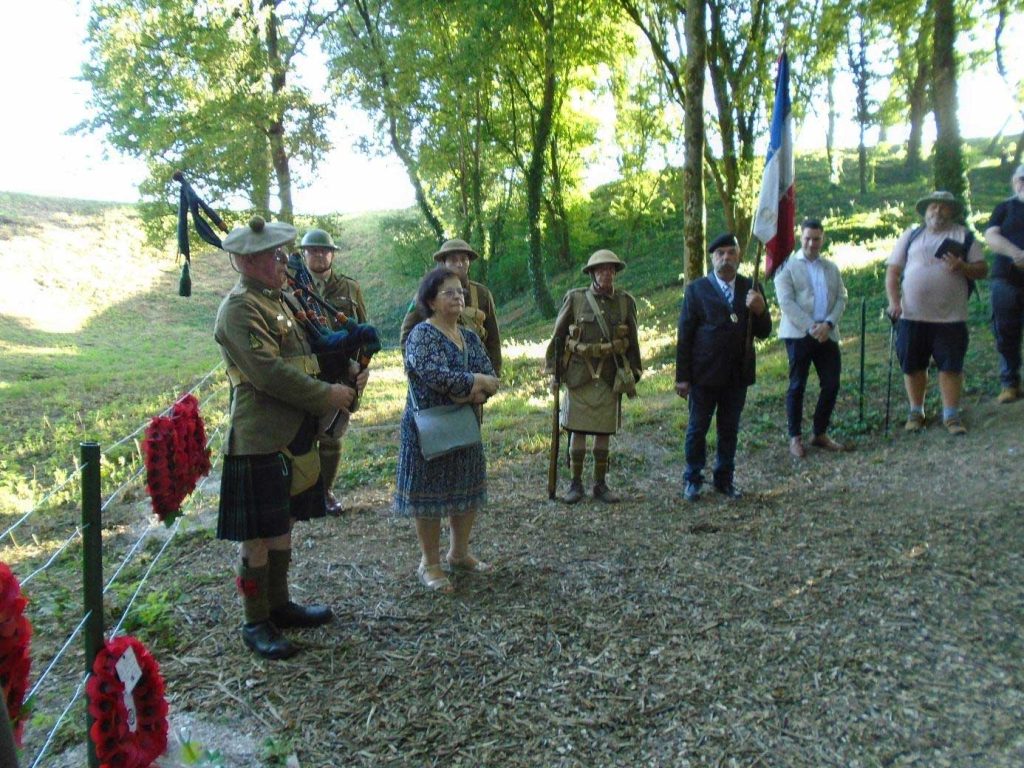
HRCA committee members, the Mayor of Beaumont Hamel, piper, local veterans’ standard bearer, re-enactors and Newfoundland Park representative paying their respects in Hawthorn Ridge Crater, 1 July 2025
Pictures by Derek Bird and Peter Wilkins.

The 252nd Tunnelling Company – March 1916.

March 1916 got off to a very bad start when on the first day of the month ‘the enemy blew a large camouflet at 11:57 a.m. directly east of RIII (2) (3) and by it destroyed 62 feet [19 metres] of our gallery. Sgt Dean and two sappers were working in the face at the time and were killed. It was impossible to get near the bodies. The strength of the German charge was probably about 3,000 lbs H.E.’ [pounds of High Explosive = 1,364 kg]. For the bravery shown during this incident both Sergeant Brown and Sapper Burns were awarded the Distinguished Conduct Medal. The citation for Sergeant Edward Brown stated that his award was: ‘For conspicuous devotion to duty in rescuing men who had been incapacitated after the blowing in of a camouflet. Later he re-entered the mine to rescue incapacitated tunnellers and worked strenuously till exhausted to extricate men who were entombed in a destroyed gallery’. Sapper John Burns’ citation reads: ‘For
conspicuous devotion to duty and disregard for danger. Following the explosion of an enemy mine, he rescued an injured comrade, and later carried out two others. Sapper Burns then returned to aid the rescue work under very dangerous conditions’.

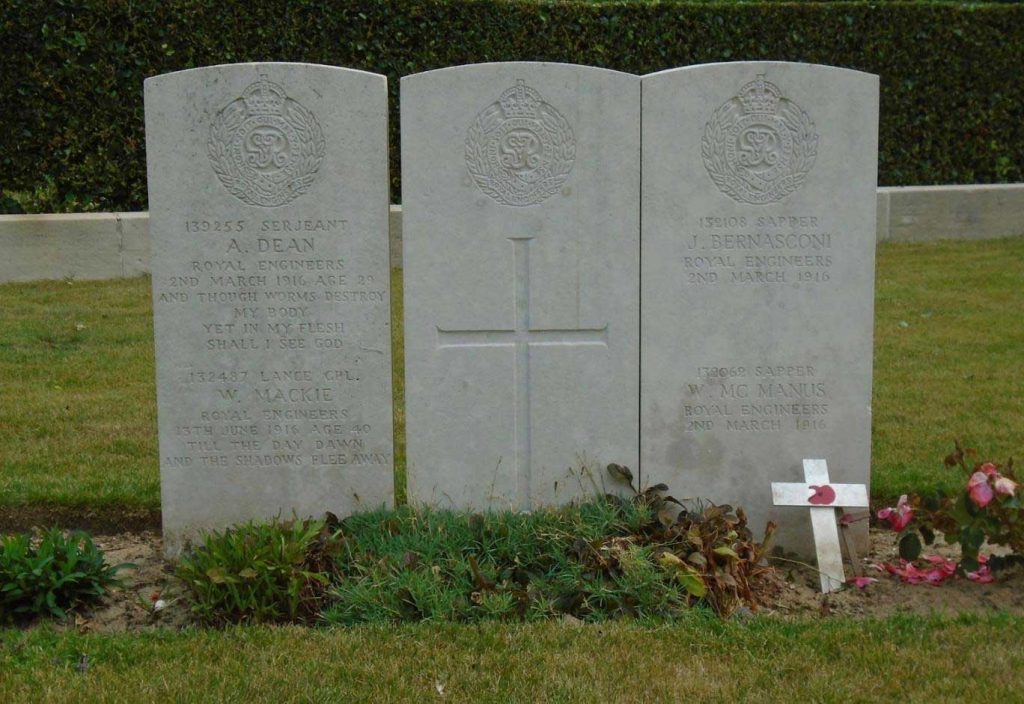
The three dead tunnellers were subsequently buried together in Auchonvillers Military Cemetery. For some reason, despite the date of the incident being clearly recorded in the War Diary as being on 1 March, the three victims are shown on other records as dying on the 2nd, perhaps this was due to their fate not being confirmed until the time when their bodies were found and recovered.

Despite the loses, the tunnellers continued their work, although progress was slowed by No.2 Section, consisting of two officers and 61 other ranks, being detached on 6 March for duty with 174 Tunnelling Company at Bray for a month. Then, the following day, all work had to be stopped when the 107th Infantry Brigade, 36 th (Ulster) Division, who were manning the sector, were unable to supply any men to act as labourers.

Thereafter work soon picked up pace and on 12 March it was recorded that No.4 Section broke a record by driving a gallery 69 feet (21 metres) through chalk in 65 hours. Three days later mention is made of the choosing of the sites and the start of the new workings, HI and HII, on the Hawthorn Ridge. On 17 March they got revenge for the earlier losses when a 3,000 pound (1,364 kg) charge was fired at 6:30 a.m. at the end of RIII (2) (2) as ‘previous to the blow the enemy were heard with naked ear very close and above our gallery
but having past the point of charge and advanced towards our parapet. There is no doubt that the enemy were destroyed and his gallery blown in, a long depression being visible on the surface where his gallery collapsed’. Five days later the Germans retaliated by firing a large mine that cratered the ground just in front of the parapet of the British front line, but luckily no casualties were caused.

On the last day of March 1916 the British tunnellers exploded two more mines, one of 2,000 pounds (907 kg) of Ammonal at RII (1) (3) at 5 p.m. which ‘caught the enemy and destroyed their gallery’, followed 30 minutes later by similar charge at RIII (2) (4) which ‘destroyed the enemy gallery’.

On 7 March, due to German artillery fire, the company’s advanced billets, that had been in the cellars of houses in Auchonvillers, were moved to a tented site on the lawns of the chateaux at Beaussart. Unfortunately, on the 29th, a German aeroplane dropped two bombs on the camp at Beaussart and seriously injured four tunnellers, one of whom was to later die of his injuries – his story will be told in the next edition. A second attack was made the following day, but thankfully the five bombs dropped caused no damage.

Acting Sergeant Alfred Dean

Unfortunately little has been discovered about 139255, Acting Sergeant, Albert Dean, but he appears to have arrived in France on 3 May 1915 as a member of the 4th Royal Fusiliers, and later transferred to the Royal Engineers. He was born at Audley, Staffordshire, to Daniel and Mary Dean in 1890. In 1911 he was living with his parents and three siblings at 220 Congleton Road, Talke, near Stoke-on-Trent, and was working underground as a coal loader. He is buried with the other two men who were killed in the explosion of 1 March 1916, and another who died a few months later, in Auchonvillers Military Cemetery, Grave Ref: II.A.14. His headstone has an unusual epitaph: ‘And though worms destroy my body yet in my flesh I shall see God’. He left his effects to his youngest sister, Annie Burton, who also received his War Gratuity.

Gravestones of 139255, Acting Sergeant, Albert Dean, 132062, Sapper, William McManus, and 132108, Sapper, James Bernasconi who were all killed in the explosion on 1 March 1916. Auchonvillers Military Cemetery, Somme, France.

Sapper William McManus

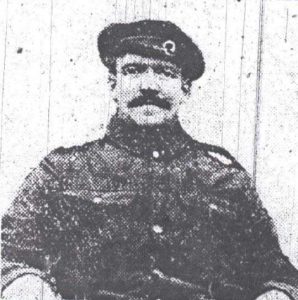
132062, Sapper, William McManus, was born in Batley, Yorkshire on 18 May 1884, but his mother, Mary Townsend, was unmarried and therefore his birth was recorded as William Townsend. However, Mary married Thomas McManus two years later and William thereafter used the McManus surname.

132062, Sapper, William McManus. Picture of William McManus courtesy of the Batley History Group.

In July 1902 he added two years to his age and enlisted into the King’s Royal Rifle Corps, but only served for 179 days before being given a free discharge. Returning to Batley he resumed mining, and in March 1905 William married Maggie Redgwick, a 21 year-old rag sorter – using his proper surname of Townsend on the marriage certificate. Unfortunately, William appears to have spent a short time in Wakefield Prison as a debtor in 1907, and by the 1911 Census he and Maggie were living, childless, at 38 Peel Street, Batley. In July 1911, however, Maggie reverted to her maiden name and left Britain for the USA to live with her aunt. The failure of the marriage may have been the catalyst for William to move to Darfield, near Barnsley, Yorkshire, where he was employed at the Mitchell Main Colliery for more than two years before enlisting into the Royal Engineers as a tunneller’s mate on 22 September 1915, using the McManus surname.

After being equipped and given a minimum of military training at the Royal Engineer’s Depot at Chatham, Kent, he arrived in France on 9 October and joined the 252 Tunnelling Company on the 21st. On 6 November he was remustered to tunneller. On 2 January 1916 he was admitted to hospital for an unspecified illness, and in mid-February he was found guilty of overstaying leave by 24 hours, for which the company commander, Major Trower, sentenced him to 14 day’s Field Punishment No.2 and fined him one day’s pay. His punishment was only completed the day before his death, thanks to 1916 being leap year.

His father, Thomas McManus, had been in receipt of a separation allowance while William was serving, and he was also awarded a five shillings a week pension payable from 3 October 1916, but unfortunately this was short-lived as Thomas died just 25 days later. Although he is generally commemorated under his assumed surname, McManus, he is named as William Townsend on the memorial at St. Mary of the Angels Catholic Church, Batley.

Thanks go to the ‘Past to Present Genealogy’ website and the Batley History Group for information.

Sapper James Bernasconi

132108, Sapper, James Bernasconi. Thanks go to Bernard Bernasconi for information that has helped to build the story of his grandfather.

The third man to die in the 1 March 1916 explosion was 132108, Sapper, James Bernasconi. James was born to James and Martha Bernasconi in 1884 at Leeds, Yorkshire. He married Ethel Haley in December 1910, and a son, Frederick, was born in January 1912. A second son, James, was born in September 1913, but unfortunately he died in July 1915.

James Bernasconi worked as a coal miner and enlisted at Leeds as a tunnellers mate on 23 September 1915 and, after the briefest training, embarked for France on 9 October to join 252 Tunnelling Company. Following his death in the explosion of 1 March 1916, enquiries were made on behalf of his widow regarding his personal effects namely ‘… a watch which she would like for her little boy if it had been found and his Rosary Beads’, however, it appears that these items were not forthcoming. His widow was subsequently awarded a pension of 15 shillings a week.

13 November 2025 Ceremonies

As usual there will be two ceremonies held at Beaumont Hamel on the morning of 13 November, the anniversary of the second mine explosion at the Hawthorn Redoubt and the subsequent capture of the village by the men of the 51st (Highland) Division. The first ceremony, that I organise on behalf of the Scotland (North) Branch of the Western Front Association, will be held at 10:30 a.m. at the 51st (Highland) Division flagstaff in the centre of the village. At its conclusion everyone is invited to walk up to the Hawthorn Crater for the HRCA ceremony, before returning to the village for refreshments.

Derek Bird

Newsletter Editor
derek.bird876@gmail.com

HRCA contact details: –
Website: www.hawthornridgeca.com
Email: enquiries@hawthornridgeca.com
Mobile: 07747 862014
Twitter: @HawthornRidgeCA
Facebook: Hawthorn Ridge Crater Association
The Crater News – Dec ’23

An occasional newsletter from the Hawthorn Ridge Crater Association (HRCA)
No. 3 – December 2023

Introduction

Welcome to the latest edition of ‘The Crater News’ in which I have once again mixed historical information with reports on recent events.  As always, should you have something of interest relating to the Hawthorn Crater or the surrounding area let me know and I might be able to use it in future editions.

13 November 2023

On the 107th anniversary of the firing of the second mine under the Hawthorn Redoubt, two commemorations were held.  The first at the 51st (Highland) Division flagstaff in the centre of Beaumont Hamel commemorates the Highlanders who went forward at 5:45 a.m. and succeeded in capturing the village after a very hard day’s fighting.  This is an event that I have organised on behalf of the Scotland (North) Branch of The Western Front Association since 2006 when we unveiled the new flagstaff and memorial stone.  I am pleased that a good number of villagers and visitors from many countries, including the UK, Canada and the Netherlands, attended this year’s ceremony.

The mayor of Beaumont Hamel and I prepare to lay the first tributes at the Highland Division flagstaff as Yves Holbecq plays ‘The Flowers of the Forest’.
Photo courtesy of Arno Roorda

Once the ceremony at the flagstaff was completed I changed roles and joined everyone behind the piper going up to the Hawthorn Crater, where the HRCA’s ceremony took place.  The weather was at least reasonably kind, even if only compared to the torrential rain in the previous and following days!

Piper Yves Holbecq leads everyone from the flagstaff to the Hawthorn Crater.  Photo courtesy of Dane Wright

After introductions and words of welcome from HRCA Chairman, Terry Berry, and the Mayor of Beaumont Hamel, Agnes Lavaquerie, the Exhortation was read, the Last Post was played and a minute’s silence was observed.  The silence was broken by Yves Holbecq playing a new tune he has specially composed for the occasion, ‘Remembrance at the Hawthorn Crater’, and we thank Yves for this kind gesture.

L to R:  Souvenir Francais standard bearer; French re-enactors; piper Yves Holbecq; Terry Berry; Agnes Lavaquerie and members of the HRCA committee at the Hawthorn Crater.  Photo courtesy of Tanya Ferguson.
After the conclusion of the ceremony at the Hawthorn Crater we returned to the village hall for some excellent refreshments with a suitable Scottish flavour – even the chocolate mousse had  whisky in it!
 
Photo courtesy of Arno Roorda

Tunnelling at Beaumont Hamel – Overview

In this edition I am continuing Colin Lukas-Winn’s overview of tunnelling operations; this time he focuses more on the work carried out in the Beaumont Hamel area:

The first question most people ask when they hear the term ‘underground war’ is why?  There are in fact several reasons for the decision to go underground, but the primary one was to break any stalemate on the surface.  Trench warfare can very easily degenerate into a dull, tedious and predictable pattern of minor actions, trench raids and sniping.  This state of affairs was usually broken by the artillery, long and short range guns making life very arduous in the trenches, and it was for this type of reason that the Germans first brought miners and tunnellers to the conflict in November 1914.  Their remit was not offensive but defensive, they constructed vast subterranean shelters linked by galleries and even, as was the case later on at Beaumont Hamel, extended the medieval sous-terrains dug by the villagers as protection against the feared Spanish troops during the 17th Century Franco-Spanish War.  These shelters, to a certain extent, negated all but the heaviest calibres of artillery.

The next thing to take into account is the topography of the area.  In the case of Hawthorn Ridge being situated in a gentle valley, leading up to the flatter land towards Serre on one flank and Newfoundland Park on the other.  It can be seen that any activity on anywhere but these flatter areas would be very quickly and easily seen and dealt with.  A case in point was the large scale attack the French mounted on 19 November 1914.  This attack was very robustly repulsed with the French taking heavy casualties along the whole Hamel to La Signy Farm front.  As a result the commanders ordered miners of the 6th Engineer Regiment into the area around Cote 143, which we now know as the Redan Ridge, to drive saps and galleries forward towards the German lines.  One gallery had a charge placed at its end to destroy a listening post, in which it was entirely successful but unfortunately it also caused an unknown German charge to detonate resulting in heavy damage to the French front line and some casualties.  Both sides then settled down to a systematic pattern of mining, countermining and listening.  No large (over 2,500 kilos) charges were used during this period and indeed the artillery began to take charge of the field once more.  The most obvious effect of the underground work was the almost lunar, cratered ground around Cote 143, which made any further surface attacks at best difficult and more likely impossible.  Underground works also took place around ‘Raven en Y’ (Y Ravine), the deep, steep features of which made it eminently suitable for huge dugouts, store rooms, aid posts and anything else that could be protected by moving it below ground.

The sector became a ‘quiet area’ but mining continued right through until July 1915 when the British 4th and 48th Divisions arrived to take over the northern sector of the Somme area.  Also, in common with other areas taken over, it was decided the mining activities would continue but in a more focussed and deliberate way.  The French works tended to be too shallow and often poorly constructed, whereas the Royal Engineers had, even at this early stage of mining activity, a much better understanding of geology, strata and the performance of explosives under differing conditions.  Around Beaumont Hamel the responsibility for mining was handed to 252 Tunnelling Company, under the command of Captain Reginald (universally known as Rex) Trower.  He was a real character not averse to propping himself against a trench wall with a rifle and taking pot shots at low flying German aircraft.  In peacetime he was the Paris Representative of the Ingersoll Rand Company and as such was able to acquire powerful compressors to power either drills or forcing jacks to speed up tunnelling operations.  An entry in the 252 Company’s War Diary attests to its achievements: ‘This Company has every record for the Army beaten by the driving in the Hawthorne [sic] Mine.  In this we made 35 feet [11 metres] in 24 hours; 200 feet [61 metres] in one week of seven days; 322 feet [98 metres] in fourteen days and 565 feet [172 metres] in 26 days.  This is one tunnel with one face only and the length to destroy the enemy will be 1055 feet [320 metres]’.  However it was not always plain sailing, as explained: ‘Extraordinary difficulty is being encountered with mine H3.  The length is now 900ft [274 metres] and work is being carried on silently by wetting the face and working the chalk out with bayonets.  This face is now entirely flint and progress is very slow’.  So slow in fact that the decision was taken to divert the tunnel left until the flint was passed, before resuming towards the original target point.  The unfortunate outcome of this was that the tunnel failed to reach its intended target point in the time available and the charge room was positioned 100 feet [30 metres] short.  This resulted in only 20% of the Hawthorn Redoubt being destroyed by the mine, although most of the enemy’s nearby trenches were filled by falling debris.

252 Company had begun work by digging saps and short tunnels for Stokes Mortar positions.  Thirteen would eventually be completed, along a tunnel for access to the Sunken Lane, before they turned their attention to H3, a tunnel running north of Mary Sap, towards the Hawthorn Redoubt some 1050 feet [320 metres] distant.  The tunnel was entered via a standard 4 foot [1.2 metres] square shaft dug from the junction of Pilk Street and Cripps Cut trenches to a depth of 56 feet [17 metres] below the surface.  The tunnel itself was the standard RE size of 4 foot 6 inches [1.37 metres] high by 2 foot 6 inches [0.76 metres] wide, was lit by candles and dug in the normal silent manner for fear of German listening posts detecting the noise of working.  There is, however, no real evidence of counter mining in this area except for a German diary entry stating that listeners were searching for British miners at work; notwithstanding this all the usual protocols still had to be followed to protect the important tunnel.

H3 was one of 19 mines, eight large and eleven smaller charges, planned to be blown on 1 July along the Somme front, mostly placed under redoubts or other strategically important positions and designed to negate these positions from having any influence over the planned advance by British troops.  This particular mine consisted of 40,600 pounds [18.4 tonnes] of Ammonal high explosive (a mix of ammonium nitrate, aluminium powder and charcoal), with a guncotton core and electrically fired detonators.

H3 was timed to be blown at 7:20 a.m. on 1 July, a time chosen by Hunter-Weston (Commander III Corps) despite many protestations and discussions about the choice.  It was even suggested by Brigadier Harvey that Trower had some say in the decision.  Harvey told Edmonds, the official historian, ‘My own impression of Trower is that he probably had something to do with the mine being fired early, and that when the result was a fearful massacre of our own troops, he denied all responsibility for it’.  Trower vehemently denied the accusations, pointing out ‘I remember distinctly VIII Corps HQ wishing to fire the mine the night before and you stopping that.  I also remember the keen disappointment amongst the company when we understood that the mine was not to be the signal for going over.  The VIII Corps were of the opinion that the falling debris would kill a great many of our own men, and not having fired a mine as big, I was not willing to swear that some of our men might not be hit by falling stuff.  That is, I think, the point that made VIII Corps insist on the Zero minus 10 as the hour’.  To this day it is difficult to say with certainty who made the fateful decision, or their reasoning.

The other 18 mines were to be blown at 7:28 a.m. with the attack by the infantry timed for 7:30 a.m., the delay to allow the debris to fall to earth before the advancing troops arrived on the spot.  The Hawthorn Ridge blow was filmed by Geoffrey Malins, the official cinematographer of the British Army and remains the only large scale mine to ever be recorded live on film.

The attack failed due to various factors, but as soon as 4 July plans were being made to repeat the exercise within a few months.  To this end the miners removed the tamping from H3 and dug south east to create a new charge room some 140 feet [43 metres] to the south of the original one.  This time 30,000lb [13.6 tonnes] of Ammonal was used, a smaller amount as the volume of ground to be ‘lifted’ was less due to the existing crater from the previous blow and the lack of resistance within.  Lessons had been learned from July, and this time the mine was blown in near darkness at 5:45 a.m. on 13 November, with the attacking troops advancing at the same moment – it was now known that the debris would fall to ground in seconds not minutes.  Another benefit was that the blast wave washed across and through the first crater, which the Germans had fortified since the July explosion, probably killing instantly most of those manning the posts around the crater lip.

Changes to the Committee

At the AGM held in the Mairie at Beaumont Hamel on 11 November, a change in the composition of the HRCA committee was confirmed.  Rick Smith is moving to a new post covering research and website development, which is a fairly self-explanatory role.  He will therefore now be the first port of call should anyone have any information to pass on regarding the crater, the fighting that took place in vicinity of Beaumont Hamel, or the men who served there.

The post of secretary has been taken on by Tanya Ferguson.  Tanya has been a supporter of the HRCA since its earliest days and is keen to contribute to the cause of caring for the Hawthorn Crater and remembering those who fought and died there.  Her contact details for general matters regarding the HRCA are: –

Email:  tanyamf@hotmail.com

Phone:  0044 (0)7757 124325

Membership Report

Rick Smith is now looking to gather in membership fees for 2024. These are maintained at just £10 per annum.

For information on membership, please contact Rick at rick@hawthornridgeca.com

And Finally

The programme of maintenance at the Hawthorn Crater was completed this year, despite the weather being bad at times.  While working parties from the UK have done their bit, we are indebted to Francis Lavaquerie for his ongoing commitment to look after the site and keep it in good order.  It is a great comfort to the committee to know that we have such a dedicated man on the spot.

There has not been much in the way of repairs needed over the past year, but updated signs at the entrance (in three languages) have now been installed.  There is some damage to the perimeter fence which will be addresses in 2024, and also installation of the new QR code posts will be completed.  When fully established the QR codes will then enable anyone to scan them with their phone and be shown detailed information on the crater as they move around the site.

Rick Smith has also recently overseen the production of the German version of the information leaflet and this is now available at tourist sites on the Somme.  Should you wish to view it (or the English and French versions) they can be seen, downloaded and printed off at the HRCA website at  www.hawthornridgeca.com

Derek Bird

Newsletter Editor
derek.bird876@gmail.com

HRCA contact details: –
Website: www.hawthornridgeca.com
Email: enquiries@hawthornridgeca.com
Mobile: 07747 862014
Twitter: @HawthornRidgeCA
Facebook: Hawthorn Ridge Crater Association
The Crater News – Dec ’22

An occasional newsletter from the Hawthorn Ridge Crater Association (HRCA)
No. 1 – December 2022

Introduction

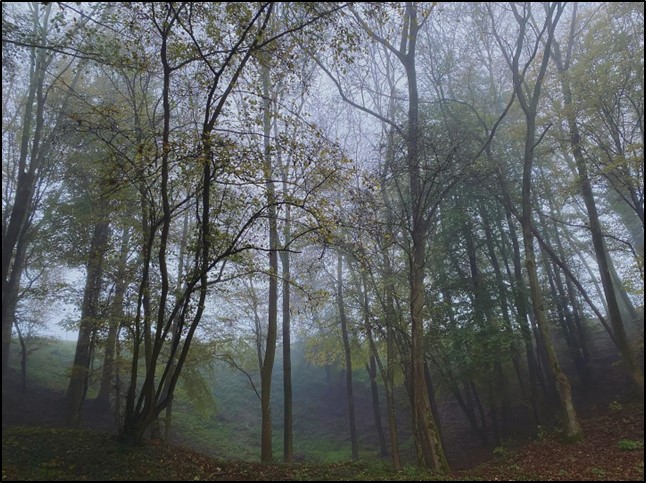
What could be a better start to the newsletter than an evocative picture taken by Dane Wright at the bottom of the Hawthorn Crater on 12 November 2022, when the whole of the Somme was shrouded in thick fog?

As I am sure you are fully aware the HRCA, like so many other organisations, has had to face the many problems posed by the Covid pandemic. However, we now hope that that unfortunate episode is behind us and we can now resume developing the association to ensure that this iconic site is cared for and protected in the future.

As part of that development I have taken on the new role of newsletter editor and hope to send out editions every few months. I will, however, be very much dependent on obtaining information, stories and photographs from many different sources, including of course your good selves. So, just a few lines in, here is my first plea! If you have any information on any aspect of the fighting at the craters or the surrounding area, or on the men who were there, I would very much like to hear from you with a view to spreading the stories to the wider membership.

2022 Annual General Meeting

The AGM of the HRCA was held at the Mairie in Beaumont Hamel on the evening of 11 November 2022, where the past year’s activities were reviewed and plans for 2023 set out. Much effort has been expended in ensuring that the fencing and paths have been maintained, with repairs being carried out where necessary and, while members of the committee have been on site on occasion, the real praise must go to Francis Lavaquerie, our man on the spot. Throughout the existence of the HRCA Francis has worked tirelessly and during the epidemic, when none of us were able to assist, he continued to keep the site in extremely good order. Francis is ably supported by his wife, Marie-Jose, who also acts as the secretary of the French side of the HRCA. This has been an excellent example of how the HRCA, as a Franco-British association, is well placed to overcome difficulties as they arise.

Now that said fences and paths (and two new information boards at the entrance) are in place, 2023 will hopefully only see the need for routine maintenance and minor repairs.

Honorary Life Memberships

At the AGM it was decided to honour Francis and Marie-Jose Lavaquerie with Honorary Life Membership of the HRCA. As previously mentioned, their work to ensure the future of the craters, particularly through the pandemic period, merits the highest praise and this is a fitting recognition of their efforts.

13 November Ceremonies

For the past 16 years I have organised a ceremony at the 51st (Highland) Division flagstaff in the centre of Beaumont Hamel on the anniversary of the capture of the village. The original flagstaff was unveiled in 1924, but over the years was reduced to a four-foot high stump, although it did retain the original bronze plaque. I decided that the flagstaff should be re-instated and raised the funds to buy a replacement, along with a new memorial stone and flags. The new flagstaff was erected in the autumn of 2006 and an unveiling ceremony was held on 13 November 2006, the 90th anniversary of the Highlanders’ capture of the village.

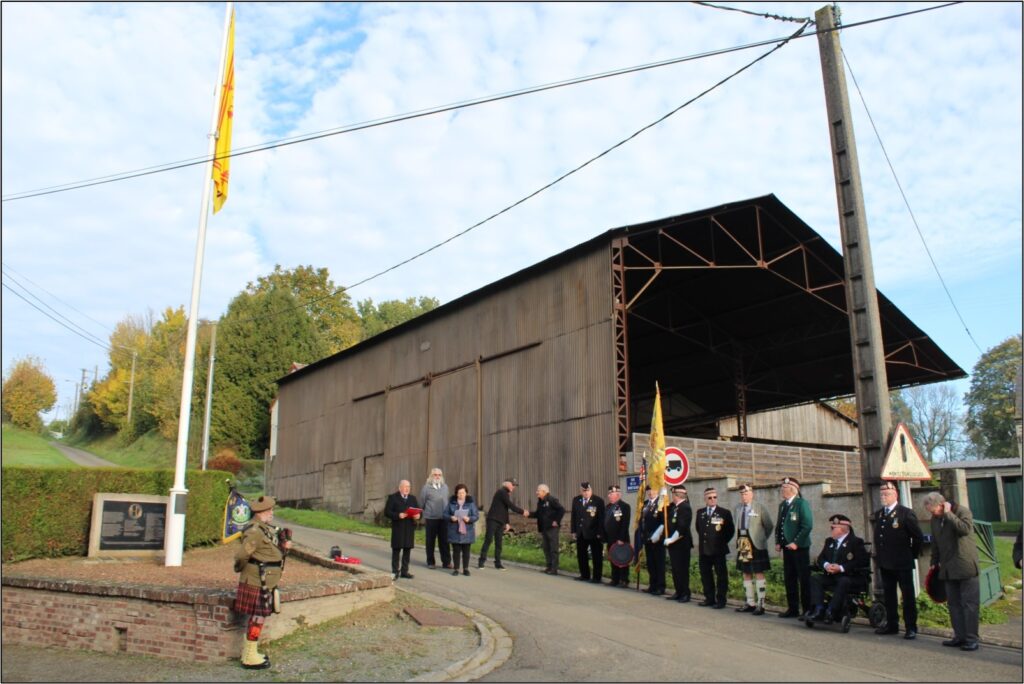
Officials, piper, Argyll and Sutherland Highlanders Association standard bearers, and wreath layers at the 51st (Highland) Division flagstaff on the morning of 13 November 2022.

Since the formation of the HRCA I am delighted that many of the committee have been attending the flagstaff ceremony, and the event has subsequently expanded as most of those present then proceed up to the Hawthorn Crater for another short ceremony, followed by return to the village for a vin d’honneur in the village hall. This seems to be a good format and we would be delighted to see you next year at the flagstaff in the centre of Beaumont Hamel at 10:30 a.m. on 13 November.

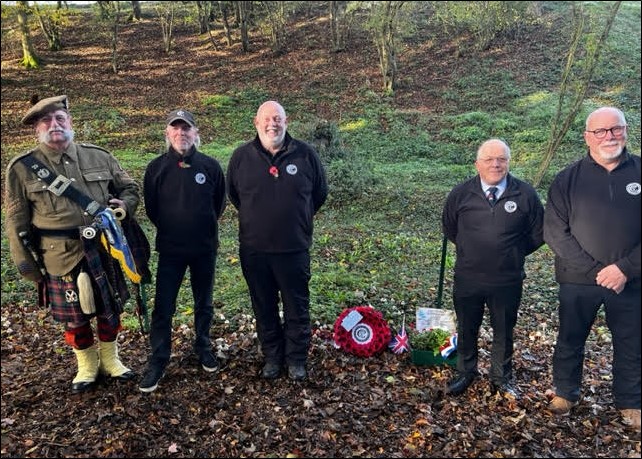
At the Hawthorn Crater after the wreath-laying ceremony on the morning of 13 November 2022. L to R: Yves Holbecq, Rick Smith, Terry Berry, Derek Bird, Colin Lukacs-Winn.

Archaeology Report

Dane Wright, our lead archaeologist, has kindly provided an overview of research at the craters: –

The HRCA’s initial intentions for the site was to bring the craters to the forefront of all battlefield walks and tours, to tell the whole story of the events which took place, not just in the summer of 1916, but also to understand the site’s strategic and tactical importance. The archaeological work which was first carried out in 2018 had a primary aim of non-intrusive works, which includes a photographic archive of the site pre-works, a detailed sketch plan of all visible features and 3D laser scans and multi-spectral drone imagery. This would then form the basis on which specific academic questions would be created.

A walk over survey gave some fantastic early results, including possible defensive works established within the upcast material created by the first ‘overcharged’ mine of 1 July 1916. Unfortunately, these features were also showing signs of severe damage through burrowing animals and large tree roots. It was decided that the next phase of works was to look at the southernmost identified position as this was already exposed to the elements, the base of which also had a vast network of animal burrows. This seemed the best place to gain information without altering the craters, what would be termed rescue archaeology.

Small archaeological excavations were carried out in the summer and winter of 2018, in which the position was properly identified, and found to consist of a small rectangular scoop in slight semi-circle reminiscent of a fire bay in a crenellated trench system. The base of this ‘fire bay’ was heavily damaged by animal burrows, however, there was evidence of a possible shallow trench base. Within the backfill of this were remnants of communication wire, barbed wire and angle iron revetment. A single spent German bullet casing was recovered, which was attributed to the fighting of 1918. The archaeology is very difficult to fully understand in small almost ‘keyhole surgery’ like areas; it is also quite unique excavating such shattered ground.

Further work is needed, unfortunately Covid managed to slow the momentum. Plans are in place to carry out a small excavation within a position identified around the north-western lip of the northern crater in the near future. We have a multi-national team of very experienced archaeologists at the ready, and aim to run an outreach element alongside the excavations as they are being carried out. This will allow visitors to ask the archaeologists questions, and items will be displayed as they are found to give an extra dimension to their visit.

Southern section of fire bay one, showing the chalk upcast created by the detonation of the mine, and the probable German position dug into it.
Possible trench base orientated North-South between fire bays 1 and 2.

252nd Tunnelling Company, Royal Engineers

The earliest entry in the War Diary for the 252nd Tunnelling Company was on 21 October 1915. The company was forming at Rouen and Captain Reginald (Rex) Trower, RE, was the first commanding officer. Over the following days they moved forward and by 1 November had arrived at the sector assigned to them. Their area of responsibility ran from facing Serre in the north to south of Beaumont Hamel, and encompassed both the Redan and Hawthorn Ridges. Initially their effort was focussed on the Redan Ridge, where they dug shafts down as deep at 150 feet (46 Metres), along with multiple galleries for the systems known as RI, RII, RIII and RIV.

The first mention of mining on Hawthorn Ridge does not come until 15 March 1916, when worked was started on HI and HII. H3, which was the tunnel to eventually reach the Hawthorn Redoubt, was first mentioned on 11 April with the comment ‘H3 face was driven 35 feet [11 Metres] through solid chalk’, indicating that work must have already been progressing for some time.

I hope that in later editions I can explore some of 252 Company’s remarkable mining exploits, their battles against enemy counter-mining, and of course the stories of the men who were there. If you have information on any aspect of the tunnelling or the tunnellers, or indeed any aspect of the fighting around Beaumont Hamel, please contact me.

Membership Report

While the pandemic was preventing visitors from the UK travelling to France, the decision was taken to not press for any membership fees over that period, however, with the lifting of travel restrictions and full resumption of HRCA activities, Rick Smith is now looking to gather in membership fees for 2023. These are maintained at just £10 per annum.

For information on membership, please contact Rick at rick@hawthornridgeca.com

New Information Leaflets

Rick Smith has produced some excellent new leaflets that help to explain the site to visitors. There are currently English and French versions, and work is underway to get a German version as well. Copies have been distributed to suitable locations on the Somme and they will hopefully help to draw in more visitors. They will also be added to the website at the next update.

And Finally

I hope that now all travel restrictions have been lifted you will (if you haven’t done so already) visit the Hawthorn Crater to see what has been achieved in recent times. I hope that you will be impressed and will report back to me your thoughts, and possibly send me a photograph or two of your visit.

Derek Bird

Newsletter Editor
derek.bird876@gmail.com

HRCA contact details: –
Website: www.hawthornridgeca.com
Email: enquiries@hawthornridgeca.com
Mobile: 07747 862014
Twitter: @HawthornRidgeCA